

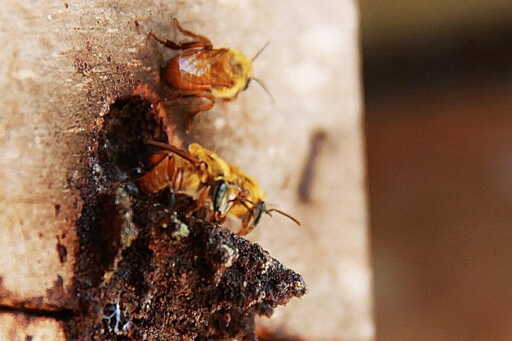
Açaí’s deep purple pulp is widely considered a “superfood” for its antioxidants, vitamins and minerals. The berry grows naturally in the Amazon and has become a star for the rainforest’s bioeconomy, reaping more than $1 billion worldwide. Now, a growing body of research is showing that its antioxidant properties are not exclusive to the berry and are also present in its neighbors. A study by scientists from Brazil’s agricultural research company, Embrapa, in partnership with the Federal University of Pará (UFPA), has shed light on the pharmaceutical potential of a cream formulated with propolis produced by native Amazonian stingless honeybees, known as meliponines. The experts identified healing and anti-inflammatory properties of substances sourced from the propolis (a resinous substance collected by honeybees from tree buds, used by them to fill crevices and to seal and varnish honeycombs) of the species Scaptotrigona aff. postica, popularly known in the northern Brazilian region and nearby areas as abelha-canudo. According to the findings, dermatological tests showed results comparable to those of healing ointments available in average cosmetic markets, giving positive perspectives for the creation of by-products. “The propolis-based cream directly influenced the lesion maturation process and exhibited a milder inflammatory response,” according to the study, published in October 2024, while describing that “biopharmaceuticals such as propolis-based creams offer advantages such as minimal side effects, low chemical residues, and negligible preservatives.” Despite being far less numerous and well-known than their more famous stinging “cousins” — particularly for not producing honey in the same quantity and…This article was originally published on Mongabay
From Conservation news via this RSS feed
You must log in or # to comment.