

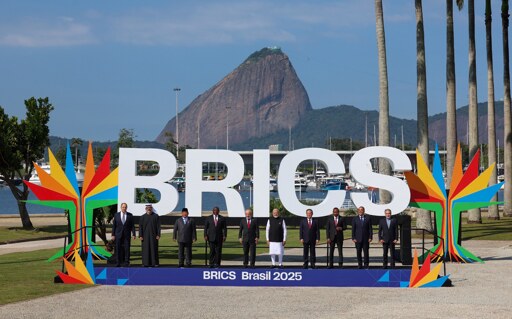
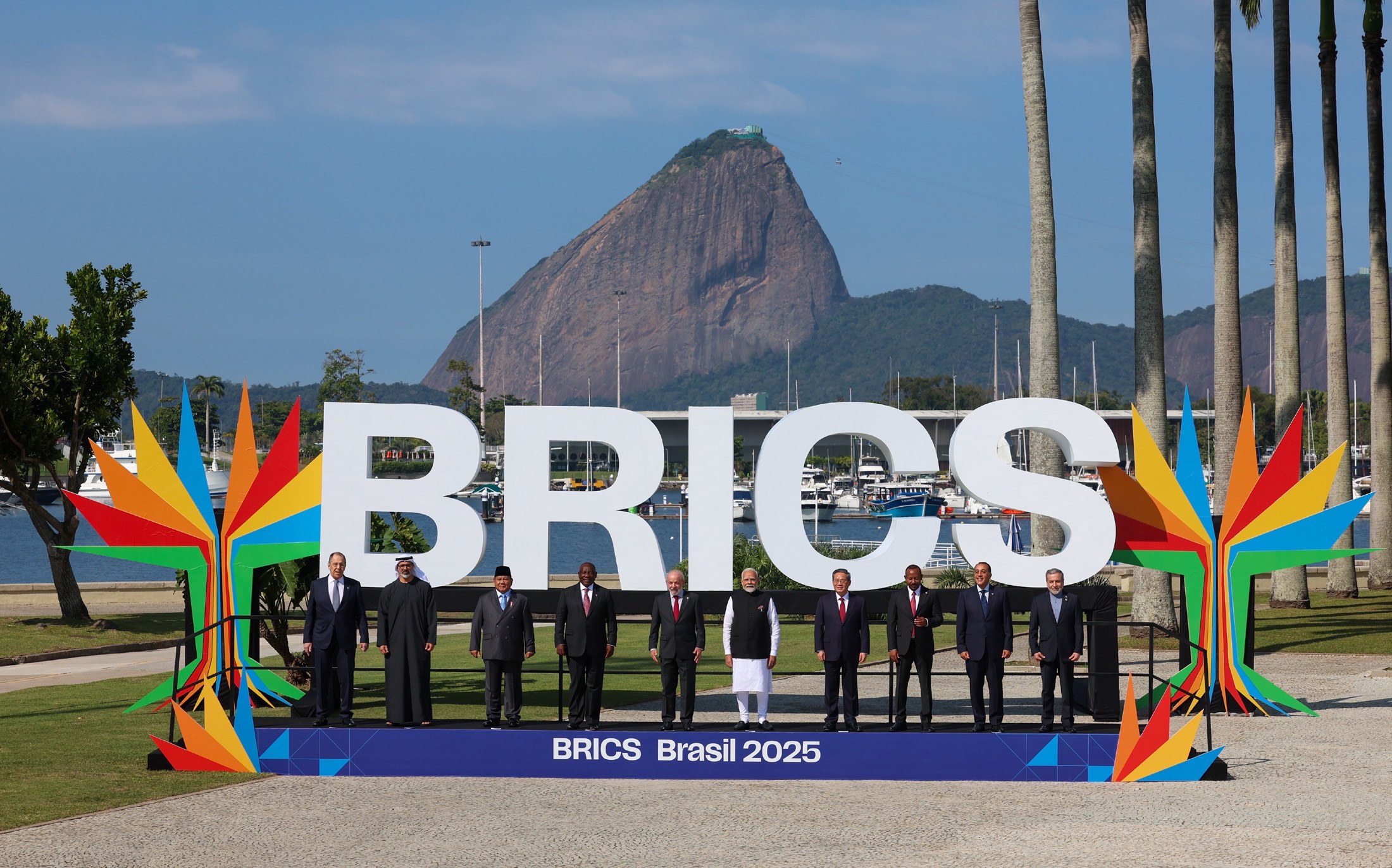
Photograph Source: Prime Minister’s Office (GODL-India)
The U.S. now assumes leadership of the G20 until the Miami summit ends on December 15, 2026 – but not without having lost some crucial soft power. In the wake of Donald Trump’s farcical attacks on the host of last week’s G20 summit in Johannesburg, might the Brazil-Russia-India-China-South Africa (plus Egypt-Ethiopia-Indonesia-Iran-United Arab Emirates) BRICS bloc – maybe alongside some annoyed Europeans – finally stand up straight, and boycott the Florida meeting?
After all, a process of shifting power relations – symbolic and real – is supposedly underway. At the University of South Africa in Pretoria on November 20, two days before G20 leaders met, Columbia University economist Jeffrey Sachs gave a viral speech in which he castigated Trump – as the equivalent of a four-year old throwing tantrums – and proclaimed that U.S. power
is fading. It’s fading in part because of the BRICS. Because the BRICS are saying we don’t need to be under the thumb of a US empire. That’s what President Lula said when he was hosting the BRICS this summer. And Trump put on a tariff on Brazil because he didn’t like a court proceeding against the preceding president who had tried to make a coup. And so he put on a penalty tariff and President Lula said, ‘We don’t need an emperor, and we’re not going to succumb to this kind of pressure.’ So the BRICS, of which you are an esteemed member … have 46% of the world population. Thank you. And 41% of the world GDP. And they can look at the G7 and say, ‘Who are you?’ And that’s what they’re doing. So this is the new phase of geopolitics.
Sachs’ rhetoric is certainly pleasing, but in a manner reminiscent of a too-brief sugar high. Looking more closely over the past six months, the (aspiring) multi-polar world has provided many examples of the opposite process, suggesting the BRICS’ threat to U.S. imperialism is in fact, fading. Read on if you are worried that Sachs vastly hypes the BRICS, by not digging deeply enough, dialectically, into the devils in the details. Read on if you are worried that the BRICS’ ruling elites can and do behave in neoliberal subimperialist – not anti-imperialist – ways.
“We collapsed the ambitious agenda we had about revitalizing the Global South”
In the most obvious two examples of Trump appeasement syndrome evident in late November, first, there was no punishment whatsoever – e.g. climate taxes (such as a ‘carbon border adjustment mechanism’ on U.S. exports) – announced against his withdrawal from United Nations climate talks, which were hosted from November 10-22 by Brazilian President Lula da Silva in Belém.
The idea of smart sanctions against the U.S. for climate crimes was first mooted by Nobel Prize-winning economist Joe Stiglitz two decades ago. In 2016-17, campaigning by (now-jailed conservative) former French President Nicolas Sarkozy – defending his own capitalists – and by leading climate justice movement strategist Naomi Klein promoted a carbon tax against the U.S… In contrast, technocrats overpopulating the Brazilian COP30 climate summit could muster no such gumption.
Second, regular U.S. temper tantrums were appeased by South Africa during this year’s G20 chairing process, rather than decrying and punishing Trump’s wanton-destructive approach to climate, public health, humanitarian aid, international rule-of-law, long-accepted rules-of-military-engagement, and trade multilateralism. Indeed no one in power – aside from the Yemenese Houthis controlling Red Sea access – has stood up against Trump, his ‘Department of War’ and paramilitary immigration agents as they facilitate ongoing genocide in Gaza; attack speedboats offshore Venezuela (killing scores); recklessly bomb Iranian nuclear facilities; nonchalantly threaten to invade Nigeria, Greenland and Panama; and brutalize immigrants including desperate refugees.
To illustrate, the G20 hosts behaved in an obsequious manner in relation to Trump starting a year ago when after his first outburst threatening the BRICS with tariffs if de-dollarization was pursued, South African President Cyril Ramaphosa begged Trump for a state visit and game of golf. This was openly explained by Pretoria’s former U.S. Ambassador, Ebrahim Rasool, on November 28, in an interview worth citing at length:
We’ve tried the appeasement. Our president went to the White House [on May 22] with two white Afrikaner golfers and a white Afrikaner billionaire, Johan Rupert: ‘please tell him we’re not that bad.’ We tried the appeasement route. It didn’t work… Before I left [on March 14], Trump punished us and I explained that after I left, he doubled down on the tariffs even though we went with an appeasement agenda to the White House, as our president did, and I as I explained. So, we’ve tried the appeasement route. It’s not done anything. We’ve even, as we led the discussions to the G20, we kind of collapsed the ambitious agenda we had about revitalizing the Global South in this G20, completing four years of Global South leadership of the G20, starting with India, Indonesia, Brazil and now South Africa. We’ve built up to this crescendo. And then South Africa had to say, ‘listen we’re not going to achieve this, what we want to achieve on climate – go to COP 30 – what we want to achieve on other things. Let’s work with the UN agencies, let’s stick to the financial economic agenda for this G20.’ So we gave into Trump’s idea that we’ve widened the G20 too much. He then said that his vice president will come. We said, ‘no that’s great, let’s go, let’s find a declaration that is comfortable for them as well.’ They’ve now said they’re not even going to entertain a declaration or a communique: ‘If President Ramaphosa wants to end the G20, he should simply he should simply have a chairperson statement.’ So every attempt at appeasing has not worked. And I can say in the seven months since my departure, and this weekend when our minister [Ronald Lamola] said what I said, if I can put it like that, that this is supremacy. I think that they have certainly tried the appeasement route and now we are saying, ‘okay there’s nothing we can do about this man. He’s in fact repeating the idea of a white genocide etc etc.’ So there is just malafides. There’s just bad faith that is involved here.
It didn’t have to be like this, of course. Across the world, there have been upsurges of dissent – e.g. ‘No Kings!’ protests gathering many millions in the U.S. in June and October – and international boycotts both against Trump’s economy and against Washington’s main personification of uncaring death and destruction, Elon Musk. Following a rebuff to Trump’s attempt to incorporate Canada as a ‘51st state,’ a first set of tariffs were imposed by Washington. This generated a bottom-up sanctions process against U.S. goods, by ordinary Canadians, in early February, followed by a BDS-USA process in many European societies.
And the world boycott against Trump-sidekick Musk’s firms (Tesla and X.com) during the first half of 2025 also proved that surgical strikes can be formidable, crashing a quarter of his net worth (more than $100 billion), and soon forcing him out of the White House, back to repairing his broken corporate empire.
In that spirit, nearly all leaders who attended the November 22-23 G20 summit in Johannesburg could well have tabled not just a toothless, mild-mannered declaration devoid of ambition (as Rasool confessed). Instead, they could have voted Trump off the G20 island and shifted the 2026 G20 out of the U.S., expelling Washington from the body while he remains in office, just the way that – at the behest of Barack Obama – the G8 expelled Russia right after Vladimir Putin’s 2014 Crimea invasion.
This was not such a fantasy, because in September, there were indications that even G7-member Europeans would support a ‘G19’ without Trump. According to Institute for Global Dialogue Research Director Mikatekiso Kubayi, “Some embassies have already indicated, as such, that ‘look, we were even prepared to go G19 if need be.’ I don’t know if that would ever have been possible. But at least there’s some sort of sentiment towards moving along, even under the challenging circumstances.”
On November 23, Ramaphosa had mildly rebuked and refused Trump’s efforts to ‘hand over’ the G20 gavel to the 2026 host via a deputy U.S. ambassador to Pretoria, for it was an insult to the South African leader’s conservative sense of protocol and hence dignity. As a result, Trump announced on November 26 that he would expel South Africa from the 2026 G20 summit in Miami. To justify this, Trump again made false charges of ‘horrific human rights abuses’ and ‘genocide’ against Afrikaner farmers. (The main problem of survival that the latter faced, was Trump’s own mid-2025 30% tariffs imposed on U.S. imports of South African citrus products, nuts, grapes and wine – largely supplied by those same farmers.)
Trump’s November 26 Truth Social post:
The United States did not attend the G20 in South Africa, because the South African Government refuses to acknowledge or address the horrific Human Right Abuses endured by Afrikaners, and other descendants of Dutch, French, and German settlers. To put it more bluntly, they are killing white people, and randomly allowing their farms to be taken from them. Perhaps, worst of all, the soon to be out of business New York Times and the Fake News Media won’t issue a word against this genocide. That’s why all the Liars and Pretenders of the Radical Left Media are going out of business! At the conclusion of the G20, South Africa refused to hand off the G20 Presidency to a Senior Representative from our U.S. Embassy, who attended the Closing Ceremony. Therefore, at my direction, South Africa will NOT be receiving an invitation to the 2026 G20, which will be hosted in the Great City of Miami, Florida next year. South Africa has demonstrated to the World they are not a country worthy of Membership anywhere, and we are going to stop all payments and subsidies to them, effective immediately. Thank you for your attention to this matter!
Trump’s nonsense deserves no wasted time on rebuttal; but tellingly, even his own U.S. State Department Human Rights Report (issued three months earlier) had failed to identify any ‘genocide’ or similar crimes. At worst, Rubio’s department accused South Africa of having recently passed legislation (entirely consistent with its liberal constitution, grounded in property rights) that “could enable the government to seize ethnic minority Afrikaners’ agricultural property without compensation” – without mentioning expropriation law applies to anyone else’s property, for that matter (far more common would be, for example, a low-income black woman’s peri-urban shack in the way of a new sewage line).
In the wake of Washington’s ban on Pretoria’s participation, on November 29, Ramaphosa’s spokesperson offered this militant – albeit still entirely procedural – reaction from the South African president:
The world cannot allow this brazen disdain for rules and established norms of diplomatic engagements. The general disregard for rules is even being challenged in the US. Now, it’s being brought to global multilateral platforms. It can’t go unchallenged in global fora. And you can’t allow a precedent where this becomes acceptable regardless of where it emanates from.
Matters may change, but Trump appears intent on denying Ramaphosa access to Miami next year. On November 19, his State Department had also revoked the travel visa of former South African foreign minister Naledi Pandor, because, as Pakistani scholar-activist Junaid Ahmed recounts:
Pandor remains one of the clearest moral compasses in global politics. Second, her analysis of oppression – whether in Gaza, the Congo, or Islamabad – remains indispensable. Third, her visa revocation is not a reflection of her weakness, but of empire’s fear. The real question now is not who fears Dr. Pandor. We know that answer. The real question – the one that determines the future of solidarity – is: Who among us is prepared to stop fearing the empire that fears her?
There is still plenty of time to mobilize an alternative. As Ronald Reagan found in 1988 to his dismay – after refusing Yasser Arafat entry to the UN General Assembly – one logical reaction to U.S. abuse of its multilateral-institution hosting power, is to hold the meeting somewhere else (in that case Geneva): this time as a G20 with South Africa but not the U.S.
Another option is a straight boycott, such as the 2022 Summit of the Americas witnessed from several Latin American leaders, due to Joe Biden’s refusal to invite Cuba, Venezuela, and Nicaragua. Even a mainstream commentator from South Africa’s Newzroom Afrika tv news*,* Simon Marks, suggested that, “maybe the other 19 members of the G20 decide to express solidarity with South Africa by saying, ‘Forget it. We’ll not go to Miami, but we’d like to do this G20 summit this year somewhere else.’ … all of this raises huge questions about whether that summit next year is actually going to take place.”
At minimum, South African international relations commentator Oscar van Heerdon proposed on November 28, “I do think that if Trump doubles down on this issue, BRICS nations are going to boycott the next G20. I think Brazil, Russia, India and China are going to say if South Africa is not allowed to come, then we will also not come.”
BRICS as faders, not fighters
But the BRICS bloc contains loyal allies of the U.S. If we include Saudi Arabia – as did 2025 BRICS host Lula in his presidency (notwithstanding Russia having given up by late 2024) – then out of 11 BRICS, three are Washington’s solid subimperial partners, adding Egypt and the United Arab Emirates. And Ethiopia and especially the 2026 BRICS host India are generally also pro-Western and pro-Israel.
BRICS internal divisions extend to trade, which is why since February, Trump has found it fairly easy to divide-and-conquer the bloc. Resistance has come only from China’s threat to withhold rare earth minerals and magnets from U.S. suppliers, and Vladimir Putin’s refusal to make a Ukraine peace deal on the (very generous) terms Trump – anxious to have U.S. oil companies return to Russian fields – had suggested during their August meeting in Alaska.
The BRICS’ failure to work coherently against Trump tariffs was witnessed again on September 8 when Lula’s hosting of a virtual conference resulted in no concrete measures. Indeed on October 27, Lula told a news conference that his meeting with Trump at the ASEAN summit the day before in Malaysia left him “very happy… optimistic… I respect Trump, he respects me. The destiny was sealed. Soon there will be no problem between the US and Brazil.” As Livemint’s Akriti Anand reported, the Brazilian leader was willing to discuss with Trump “opportunities to boost the development of the key minerals used in electric vehicles, advanced weapons systems and medical devices,” which Washington rewarded by retracting the 50% tariffs he had put on Brazil’s coffee producers, in solidarity with Jair Bolsonaro.
Contrast that deal-making desire with the more militant approach of Colombian president Gustavo Petro, who on October 1 pulled his country out of NATO: “If a North Atlantic government decides to ally itself with crimes against humanity, what should we do there? These are drastic measures, but I think they must be taken now.” (Petro added, “I’m not going to be in the BRICS either, because the BRICS are oil-related.”)
These divisions have sobered Brazilian journalist Pepe Escobar, who on November 6 admitted that there was “not an overall BRICS strategy to counteract the empire. And this is this something that should they have they should have started this thing yesterday. It is taking too long. And sooner or later we could have a BRICS member falling or a BRICS partner falling or a direct destabilization of the empire of a BRICS member or a BRICS partner. This is extremely dangerous. Extremely dangerous but there’s still no political will”.
The day before, Escobar had also regretted how he had become “extremely euphoric after the BRICS summit in Kazan” (in October 2024). Since then Escobar had a reality check: “Internal frictions in BRICS are still very very serious. And BRICS is not united, not at all. And there are some very very dodgy players inside BRICS. I’ll give you just one, United Arab Emirates. We could go on about this forever, you know… I heard some frightening very serious inside information about the BRICS bank which I cannot make public.”
BRICS as a structurally-dependent subimperial bloc
The BRICS New Development Bank has been frightening enough already, especially in a South Africa where its loans directly mimic Western multilateral financial destruction and corruption. New York-based radical economist Michael Hudson observed on August 6 the lack of BRICS financiers’ will to overcome their neoliberal mentality:
At the last BRICS meeting you have the same request that they’ve been making for a couple of years now: ‘We want Global South countries to have more representation in the IMF and the World Bank and the Security Council.’ I think that’s a terrible terrible idea. The problem isn’t to get more representation in an IMF whose guiding philosophy is to impose class war in the form of economic austerity to lower wages to make labor unions illegal, so that you can keep the cost of labor low, in the pretense that this makes countries more competitive and solvent.” According to Hudson, “What is lacking in the BRICS so far is a distinct economic philosophy. What they’ve talked about is how can we improve our position within the existing neoliberal economic philosophy, and even within the IMF and the World Bank. So the IMF has been very clever. It’s found the most reactionary Global South representatives to join the board of directors… There’s an illusion that if you appoint a right-wing neoliberal pro-rentier pro-creditor appointee, that somehow that’s going to represent the country.
Similar complaints were expressed on August 26 by the best-known political economist from (new BRICS partner) Malaysia, Jomo Kwame Sundaram: “BRICS has no record of strong and consistent advocacy of the interests of smaller developing economies. Most financially weak small nations doubt that BRICS+ will serve them well.”
To understand why, BRICS New Development Bank vice president Paulo Nogueira Batista explained on May 30 that in Brasilia’s key economic ministries, “what we have there is a collection of neoliberals, all aligned with the Western agenda.” As a result, he continued,
the Brazilian government is not politically strong. Among other reasons, because it is infested with officials who have little or no identification with the BRICS and maintain priority links with the U.S. and Europe (the famous fifth column). The Foreign Ministry, for example, with a few exceptions, has been dominated by bureaucracy and careerism. The Treasury is silent, with Minister Haddad frequently absent from the debate. The Central Bank has always been an obstacle to the BRICS.
The problem extends far beyond financial bureaucrats. Perhaps the most cutting statement in recent months was from Argentine Marxist Claudio Katz, just before the July Rio de Janeiro leaders’ summit:
One need only compare the composition of the current BRICS leadership with the leadership that headed Bandung to confirm the monumental distance that separates the two organizations. Putin, Lula, and Ramaphosa have no kinship with Nehru, Nasser, and Zhou EnLai; and Modi and Bolsonaro were opposed to those figures. The fact that far-right presidents are able to keep their countries within the BRICS during their terms in office illustrates the impressive political plasticity of that bloc. The direct complicity with Israel of new members – such as Saudi Arabia, the United Arab Emirates, and Egypt – is also indicative of the organization’s profile. None of this collusion with imperialism had any place in Bandung.
In all these ways, with all of these voices – many who were once as vociferously pro-BRICS as Jeffrey Sachs remains – we should be able to set aside any further illusions in what currently postures as multi-polar politics. The BRICS’ 2026 hosting by its most consistently rightwing leader, Narendra Modi, is obviously the nail in the coffin for claims it will have any liberatory intent, much less impact.
The great dependency theorist Ruy Mauro Marini would recognize this situation, and would perhaps extend his famous 70-year old thesis about Brazil’s position in the world economy, to describe the BRICS as the logical economic-bloc formation which dependent capitalism assumes, upon reaching the stage of subimperialism: servile even to Donald Trump’s depravities, notwithstanding, that as Ambassador Rasool confirmed, “every attempt at appeasing has not worked.”
The post Like South Africa, the BRICS Suffer From Trump Appeasement Syndrome appeared first on CounterPunch.org.
From CounterPunch.org via this RSS feed
You must log in or # to comment.