

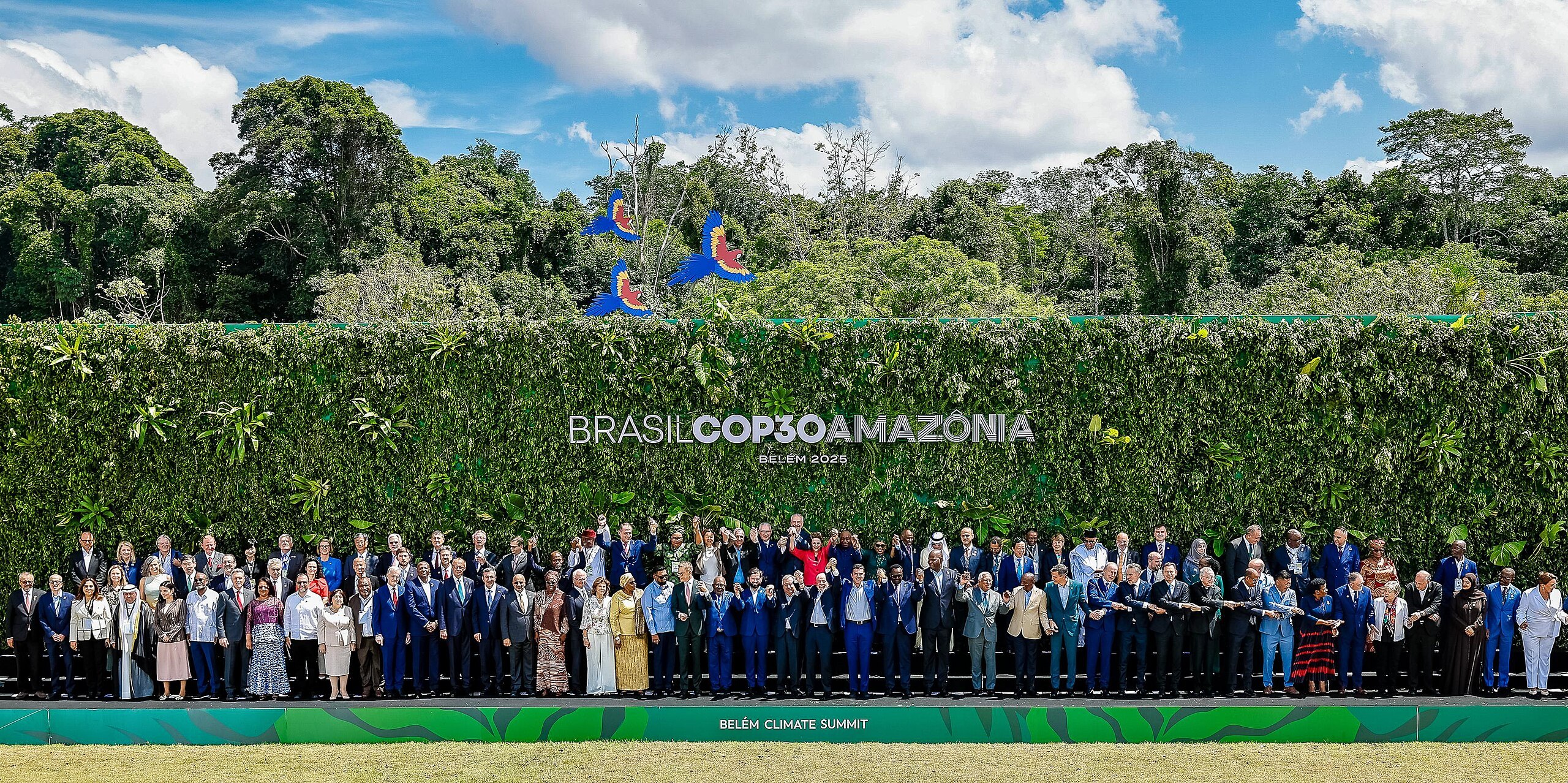
Photograph Source: Lula Oficial – CC BY-SA 4.0
For regular viewers of Amy Goodman’s Democracy Now! Program, she and her team recently reported from the COP30 conference in Belém, Brazil. This COPS spotlighted Indigenous people, and the program had numerous interviews with not only representatives of different Indigenous groups but also environmental activists challenging fossil-fuel hegemony.
The Money
Sadly, none of the well-meaning people interviewed mentioned that the global oil-and-gas cartel garnered $5.9 trillion in revenues for 2024. And the U.S. coal industry accounts for an additional $16.4 billion.
Most disturbing is Wikipedia revealing breakdown of the oil & gas revenues for individual companies by country for 2022. Its comprehensive list is drawn from data for S&P Global Commodity Insights Top 250 Global Energy Company Rankings, along with Statista and Sovereign Wealth Fund Institute.
The Wikipedia list reminds readers that Brazil’s oil-and-gas companies are relatively small companies compared to, say, those in the U.S. or Saudi Arabia. It identifies the following with 2023 revenues:
• Brazil’s three companies as YPFB ($8.1/b), Petrobras ($124.4/b) and Ultrapar ($27.8/b).
• In the U.S., it identifies 31 companies, including Chevron Corp. ($246.2), ExxonMobil ($413.6), Marathon ($179.9), Philips 66 ($175.7/b) and Valero Energy ($176.3/b).
• Saudi Arabia there are Bahri ($2.2/b) and Saudi Aramco ($604.3/b) – the world’s largest oil and gas company.
Most troubling, the Council on Foreign Relations reports, “The United States is the world’s top producer of oil and natural gas.” It adds, “The country’s economy runs on these fossil fuels, but producing and burning them releases greenhouse gas emissions that cause climate change.” And the American Petroleum Institute (API) claims it represents 600 members who produce, process and distribute its products. It adds, “America’s oil and natural gas industry supports 10.3 million jobs in the United States and nearly 8 percent of our nation’s Gross Domestic Product.”
According to Resources for the Future (RFF), a Washington-based nonprofit group, “Compared with 10 years ago, US oil and gas employment has fallen by about 40 percent while production has increased by about 60 percent for oil and almost 50 percent for natural gas.”
Going further, the FRR warns “the economic outlook for US oil and gas-producing regions is highly variable.” Among the “uncertain factors will shape those regions’ economic futures” are (i) fast-growing and emerging technologies (e.g., solar, batteries, enhanced geothermal, advanced nuclear); (ii) the potential for climate and environmental policies, both at home and abroad, to reduce demand for hydrocarbons; and (iii) the potential for low-cost producers in the Middle East to respond to expected demand declines by “opening the taps” to capture market share.
Trump and the Saudis
More troubling, money buys power and power secures influence. This was no clearer exhibited than in the recent get-together between Donald Trump and Saudi Crown Prince Mohammed bin Salman [MBS]. Not only did Trump host a lavish, black-tie dinner for the prince, but in a poorly orchestrated news conference he insisted that the prince “knew nothing” about the 2018 assassination – and dismemberment — of Jamal Khashoggi, a Washington Post columnist and Saudi dissident.
At the time, the Post reported: “A team of 15 Saudi agents flew to Istanbul on government aircraft in October and killed Khashoggi inside the Saudi Consulate, where he had gone to pick up documents that he needed for his planned marriage to a Turkish woman.”
Trump is America’s foremost let’s-make-money transactional president and, as part of MBS’s visit, the White House announced, “that Saudi Arabia will be increasing their investment commitments in the United States to almost $1 trillion ….” The original deal was for $600 million but at the press announcement, T$ Trump pushed the total to $1 trillion. For this, the Saudis will get F-35 fighter jets, tanks and other military equipment.
For Trump, his family and organization, relations with the MBS and other Saudis are all about the money. White House spokeswoman Karoline Leavitt said, “Neither the President nor his family has ever engaged, or will ever engage, in conflicts of interest.” Sure.
The New York Times recently reported on “at least four Trump-branded developments in Saudi Arabia.” These deals include:
• Diriyah: this is a $63 billion project in which “a Trump-branded property” would be part of what the Times calls “one of Saudi Arabia’s largest government-owned real estate developments.”
• Trump-branded projects: including a $1 billion Trump tower planned for Jeddah and two projects for Riyadh, the Saudi capital.
• Golf: the Saudi-backed SLIV Golf will host tournaments at the Trump National Doral Golf Club near Miami.
And there is Trump’s son-in-law, Jared Kushner, who’s become a virtual cash register for Saudi money. The Times notes, its “sovereign wealth fund has contributed $2 billion to an investment fund run by Jared Kushner … who cultivated close ties to Prince Mohammed during the president’s first term.” Together, the Saudis and Kushner’s firm took over the video game publisher Electronic Arts private around $55 billion.
At his January 2025 inauguration address, Trump came to power recalling former Maryland Lt Gov Michael Steele slogan ranted at the 2008 Republican convention, “drill, baby, drill!” Shortly after taking office, he declared in an Executive Order (14153), “Unleashing American Energy,” that it “is thus in the national interest to unleash America’s affordable and reliable energy and natural resources. This will restore American prosperity —- including for those men and women who have been forgotten by our economy in recent years.” It added, “It will also rebuild our Nation’s economic and military security, which will deliver peace through strength.”
To fulfill this goal, Trrunp has pushed for increased oil and gas lease sales. The Bureau of Land Management raised over $38 million in oil and gas lease sales for 23 parcels in Montana and North Dakota. It did this by, as one source reports, “significantly improved well economics through three-mile lateral drilling technology in the Bakken and Three Forks formations of eastern Montana.”
Most recently, Trump mandated at least 36 oil and gas lease sales for federal waters, including 30 in the Gulf and six in Cook Inlet, Alaska. A U.S. Congressional report notes, Revenues from oil and natural gas leases on onshore federal lands totaled $8.497 billion in FY2023 ….” Another source notes, “Robust offshore oil and natural gas development could generate over $8 billion in additional government revenue by 2040.”
So, when thinking about the ongoing environmental battle, don’t forget in addition to saving the planet and life on this planet, it’s also all about the money.
The post Environmental Crisis: It’s All About the Money appeared first on CounterPunch.org.
From CounterPunch.org via this RSS feed
You must log in or # to comment.