

Drop Site is a reader-funded, independent news outlet. Without your support, we can’t operate. Please consider making a 501©(3) tax-deductible donation today.
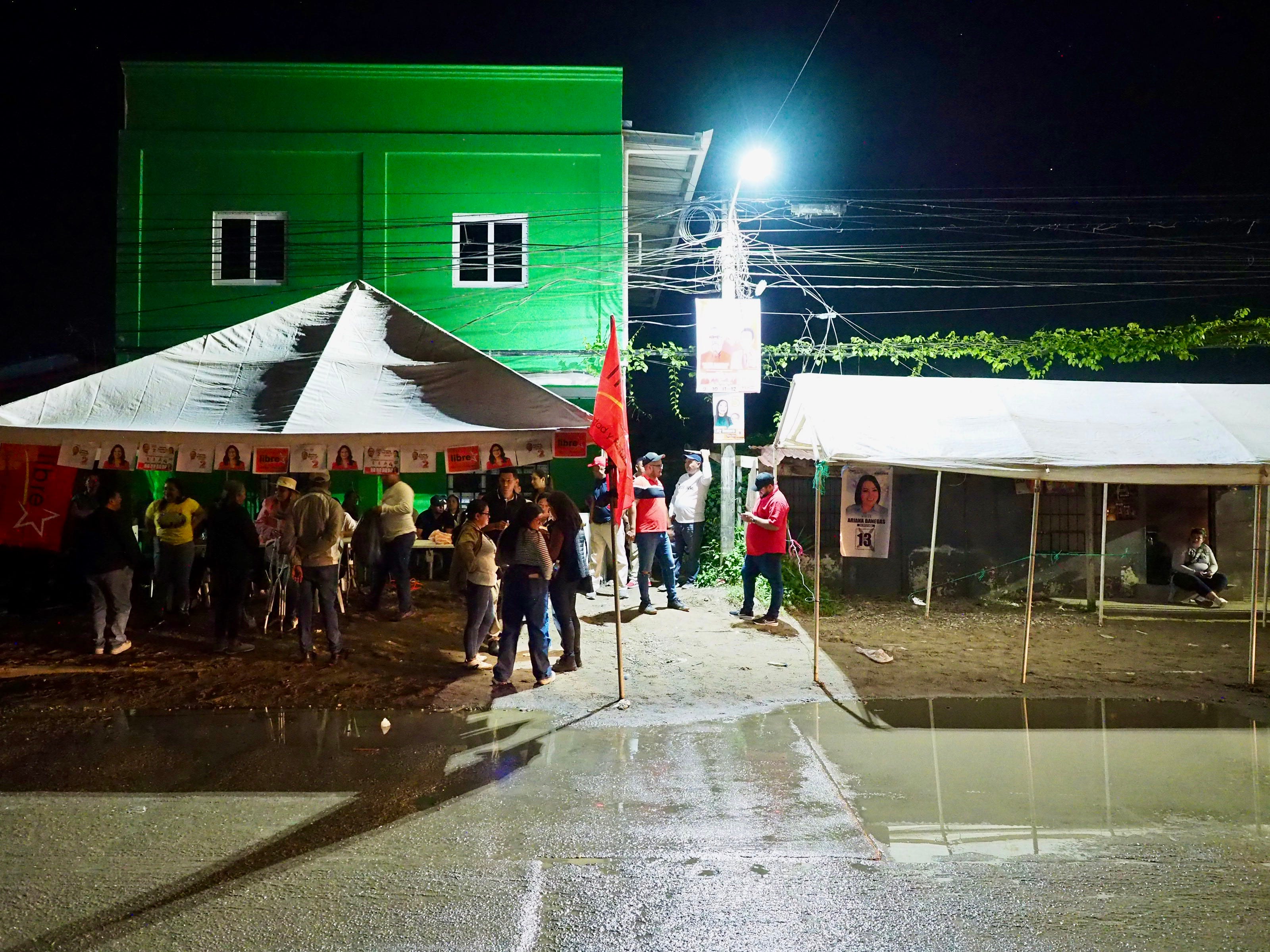
Libre Party supporters gather outside at 5 AM last Sunday on election day at the Froylan Turcios Institute, a voting location in the northern city of Tocoa, in the Colón Department of Honduras (Photo provided by author).
TOCOA, Honduras—Hondurans delivered a shock result in elections Sunday, rejecting the ruling Libre party and opting to return to the traditional parties that historically dominated the country’s politics.
Early results indicate that Nasry Asfura of the right-wing National Party will be elected president, with Salvador Nasralla of the Liberal Party coming in a close second, relegating Rixi Moncada’s Libre Party to third place.
Asfura appeared to benefit from late endorsements from regional right-wing actors, such as Argentina’s Javier Milei, and U.S. President Donald Trump’s unprecedented intervention into Honduras politics after he explicitly called for the population to vote for the conservative former mayor of the capital Tegucigalpa.
The result stunned the Libre Party, whose polls and internal figures had indicated it would perform much better.
Libre had shaken up Honduran politics after a landslide victory in 2021 that was widely viewed as a referendum on former President Juan Orlanado Hernández (JOH) and his right-wing authoritarian rule. Hérnandez is currently serving a 45-year sentence in the United States after being convicted of drug trafficking. President Trump pledged to pardon Hernández, alleging he had been mistreated by Biden-era prosecutors and was not actually guilty. Sunday’s results open the door to the possibility of the return of the former president to Honduras should Trump follow through on his promise to pardon him.
Libre’s eruption in 2021 appeared to smash the bipartisan system that had long dominated. The Libre government led by Xiomara Castro—wife of former President Manuel Zelaya, who had been ousted in a U.S.-backed coup in 2009—made significant advancements in combating rampant poverty, but her administration appeared to fall short of expectations after having promised a transformational government.
Hondurans, particularly those from the country’s social movements, expressed a prevailing sense of disappointment in Libre.
“We found that, in the short time they had, they generated a lot of frustration among the population because there was no clear government plan—no clear roadmap for where they were going to lead us—especially in seeking structural solutions to the major conflicts affecting the population,” Juana Esquivel, a member of the coordinating committee of the Tocoa Municipal Committee, which has been heavily involved in campesino land struggles in the department of Colón, told Drop Site News.
Rita Romero, a supporter of the committee and a human rights advocate, said that there was an evident contradiction between Libre’s discourse on the promotion of human rights and its record in practice as a government.
The clearest example was the political assassination of grassroots activist Juan López on September 14, 2024. In addition to his human rights advocacy, López himself was a member and supporter of Libre, and those demanding justice for him allege that he was killed by his political rivals from within Libre, who held office in the municipality of Tocoa.
“As a political actor, he understood very clearly the internal corruption within the party he loved so much, and he was not willing to let that corruption destroy his party,” Romero told Drop Site. “So what happened? The party, instead of channeling the energy of its members fighting for a renewed party and a new option, preferred to hold on to the acts of corruption that Juan López had been denouncing for years, up until hours before he was killed.”
Others in the country expressed frustration with the economic management of the country under President Castro, and felt a sense of nostalgia for conditions under former President Hernández, despite his sordid history.
“If we’re being honest, when the National Party under Juan Orlando was in power, things were comfortable: prices, the economy—they weren’t exactly good, but we were comfortable; and once Xiomara came in, everything went up dramatically. In the towns or more remote areas, prices shot up—fuel, food, everything,” José Alberto Echeverría, resident of Tocoa, told Drop Site News.
After Trump’s endorsement of the National Party candidate and pledge to pardon Hernández, there was speculation by Libre supporters that it could paradoxically boost their chances. The return of JOH, as the former president is commonly known in Honduras, as an issue at the ballot box ultimately did not have that effect.
Echeverría said he was willing to look past the National Party’s ties to organized crime over his economic concerns and his disappointment with Castro.
“She didn’t do anything in four years and with Juan Orlando, I assure you, even though people said he was a drug trafficker and all that, at least we had something guaranteed with him,” he said.
Like in Argentina, where the Trump administration dangled a massive bailout over voters’ heads before the vote, his bribe may have ultimately worked, especially given Honduras’s longstanding ties to the US. The country is home to one of the few U.S. military bases in the region, and a significant number of Hondurans have migrated north since the 1980s, with remittances playing an important role in the national economy.
Ariana Melissa Banegas Cárcamo, a lawmaker for the National Party seeking reelection in the department of Colón, said she had no issue with Trump’s direct intervention in the election, framing the United States’s role as “guarantors of democracy.”
“It is completely normal. Countries always have strategic allies in matters of investment, and in electoral matters as well–why not? There are always friendly nations that support democracy—that support respecting the will of the people,” Banegas told Drop Site News.
For their part, both Romero and Esquivel expressed outrage over Trump’s interference in the country’s democracy.
“We’ve had U.S. interventionism as part of our history, but at least it was disguised. We had never seen such a transparent, public discourse from a U.S. government telling a Honduran citizen how to vote,” said Romero, who warned it could be a sign of things to come for the whole world.
Esquivel likewise maintains that Trump’s brazen intervention is a reflection of the advance and confidence of the right in the region.
“It puts us—as a social movement, as citizens—on alert: how far are we willing to let the right advance in our countries?”
Given the setback suffered by the parliamentary left in Honduras, many today are asking this very question. Esquivel places her faith in the country’s social movements and the opportunity this moment presents for internal bolstering.
“If there is a lesson learned from these four years of the Libre government, it is that the answer in the territories does not lie in the party; it lies in the social movement,” concluded Romero.
With Asfura having won by the slimmest of margins—and thanks to the last-minute boost by Trump—Nasralla is expected to contest the results, setting the stage for instability in Honduras.
From Drop Site News via this RSS feed