

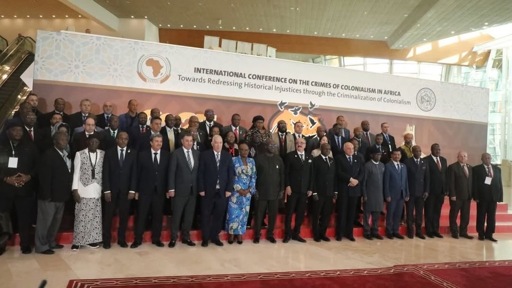
On December 1, 2025, African leaders, diplomats, and scholars gathered in Algiers, Algeria for a conference on the crimes of colonialism in Africa. Dubbed, The International Conference on Colonial Crimes in Africa: Towards Correcting Historical Injustices by Criminalizing Colonialism, the event occurred under the leadership of President Abdelmadjid Tebboune, and culminated in the drafting and adoption of the Algiers Declaration. The statement consolidates decades of reparations and anti-colonial advocacy into a coherent continental position.
The conference takes place on the heels of African Union (AU) resolutions earlier in 2025, which recognized slavery and colonialism as genocides and crimes against humanity.
The Algiers Declaration
The declaration is vast in scope, it situates reparations within a broader struggle for sovereignty, legality, ecological justice, and economic change. It begins by positioning memory as a terrain of political contestation, arguing that colonialism was not only a system of exploitation but also an assault on African histories, identities, and cosmologies. Reclaiming memory, therefore, becomes foundational to reclaiming sovereignty. In this vision, the establishment of a Pan-African digital archive, the revision of educational curricula to center African historical experiences, the creation of memorials and museums, and the restitution of stolen artifacts and human remains are not acts of nostalgia; they are exercises in narrative power, the right of African peoples to define their own past and, therefore, their political future.
Codifying colonial crimes
Building upon this epistemic reclamation, the declaration advances a bold legal agenda; the codification of colonialism as a crime in international law. By mobilizing domestic courts, the African Court on Human and Peoples’ Rights, the UN General Assembly, the International Court of Justice, and even the International Criminal Court, the AU seeks to convert historical injustices into actionable legal claims.
Environmental reparations
The declaration also widened the reparations discourse by foregrounding the environmental violence of colonialism. Extractivism, forced agricultural schemes, and nuclear testing left deep ecological scars across the continent, from the Congo Basin to the Sahara. To address these, the document calls for a continental environmental damage assessment, the formation of an African Platform for Environmental Justice, and demands for rehabilitation, compensation, and technological support. In doing so, the AU links the ecological destruction of the colonial era to contemporary climate vulnerability, reframing reparations as essential to Africa’s environmental survival.
Socio-economic reparations
Finally, the declaration confronts the socio-economic legacies of colonial exploitation. It proposes a continent-wide audit of economic plunder, demands for compensation, debt cancellation, and reforms of global financial governance. The AU’s analysis recognizes that colonialism persists structurally through unequal trade regimes, debt dependency, the lingering effects of structural adjustment, predatory corporate contracts, and Africa’s limited control over global markets and technologies. This is a major geopolitical shift; Africa is attempting to globalize the reparations question.
What are the contradictions
Despite its historic ambition, Pan African organizers also raise probing questions about whether the AU’s approach can genuinely challenge the structures of domination that shape the continent today.
In conversation with People Dispatch, Blaise Tulo, of the Social Movement of Ghana (SMG), articulates a central contradiction at the heart of Africa’s reparations debate: “Reparations bring colonial crimes to the agenda which is very important and should be supported, but the neocolonial governments in Africa are looking at the monetary gain.” His critique looks at a structural dilemma: many African states remain entangled in systems of dependency shaped by Western financial institutions, multinational corporations, and unequal geopolitical partnerships. As a result, their interest in reparations often appears less about justice and historical accountability and more about securing new avenues for negotiation within the existing global order. This raises the question: can governments complicit in neo-colonial arrangements genuinely lead a transformative anti-colonial reparations agenda?
Tulo presses this further; “If they pay, does it mean the neocolonial order has ended? Because the structure has only transformed and evolved.” He points out the reality that Africa continues to operate within extractive financial and economic systems, debt regimes, privatization mandates, and austerity programs that reproduce colonial logics of accumulation by dispossession. Seen this way, the reparations debate cannot be disconnected from the broader struggle against neoliberalism. Any settlement that ignores the material foundations of exploitation risks becoming symbolic rather than the transformative change required.
The danger, Tulo says, lies in allowing reparations to become a political diversion. “We cannot let the demand for reparations be a distraction. It cannot be a substitute for class struggle.” It demands a materialist understanding of African liberation; reparations must be inherently political, not just legal or monetary. Without addressing class relations, labor exploitation, land dispossession, and the capitalist structures inherited and adapted from colonial rule, any compensation, if it arrives, risks being captured by the same elite class who have long benefited from neo-colonial arrangements. In this sense, the reparations struggle is inseparable from the fight to dismantle the socio-economic architecture that continues to sustain inequality across the continent.
The strength of the Algiers Declaration lies in its multi-dimensional framework spanning memory, legal codification, ecological justice, and socio-economic redress. But this expansion must not be overly invested in legal technicalities, symbolic acts of restitution, and diplomatic proclamations, while sidestepping the deeper contradictions within African political economies. The declaration’s ambition must recognize the entrenched interests of the neocolonial state, persistent internal plunder, the rise of militarized governance and political repression, and the continent’s ongoing subordination to global capitalism.
Read More: Five reasons why the UAE is fixated on Sudan
The future of African sovereignty
The Algiers Declaration is monumental. Africa must defend its sovereignty over its historical narrative, its capacity to define legal norms, its insistence that colonialism was a crime rather than a civilizing project, and its right to economic redress, cultural restitution, and global restructuring.
Read More: Burkina Faso begins producing solar-powered electric cars with help from China
Nevertheless, Africa’s challenge is not only to seek justice for the past but to restructure the conditions of the present in ways that make true sovereignty possible.
The post Algeria hosts conference on the crimes of colonialism in Africa appeared first on Peoples Dispatch.
From Peoples Dispatch via this RSS feed
You must log in or # to comment.