

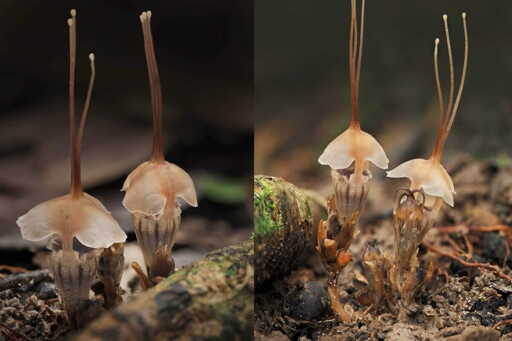
In November 2023, naturalist Gim Siew Tan chanced upon an unusual plant with whitish-peach flowers growing near the buttress of a tree at a popular picnic site in Hulu Langat Forest Reserve in Selangor, Malaysia. Researchers subsequently collected and analyzed specimens of the plant and found that it was a new-to-science species of “fairy lantern” — a group of plants that lack chlorophyll and spend most of their lives underground, hidden from view. The research team, including Tan, have formally described the species in a recent study, naming it Thismia selangorensis. Its species name refers to Selangor, the state where it was found. “This discovery shows that significant scientific finds are not limited to remote jungles; they can also be made in ordinary environments where constant human activity leaves little room for expectation,” Siti-Munirah Mat Yunoh, study lead author from the Forest Research Institute Malaysia, said in a statement. The newly described Thismia selangorensis. Image courtesy of Gim Siew Tan. Fairy lanterns in the genus Thismia live a cryptic life: They’re mostly found underground in leaf-litter-rich forest soils, emerging above ground only to briefly flower. Their lack of chlorophyll means that Thismia plants can’t make their own food; instead, they’re mycoheterotrophic, that is, they parasitize fungi for their nutrient supply. The newly described Thismia selangorensis only blooms between October and February, the researchers note. “Its flowers are often small, inconspicuous, and hidden beneath leaf litter or root buttresses,” they add. T. selangorensis appears to be rare. Since it was first spotted…This article was originally published on Mongabay
From Conservation news via this RSS feed
You must log in or # to comment.