

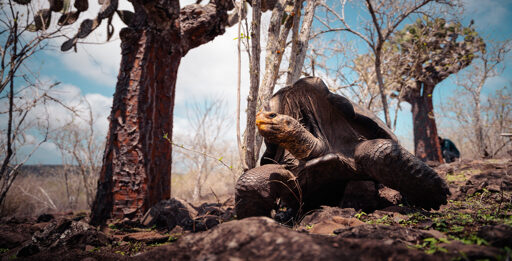
For the first time in nearly two centuries, giant tortoises are once again roaming Floreana Island in the Galápagos, a conservation milestone more than a decade in the making. Early settlers on Floreana Island altered the landscape and hunted the Floreana giant tortoise (Chelonoidis niger niger) into extinction about 180 years ago. But while working on Wolf Volcano, roughly 180 kilometers (112 miles) away on Isabela Island, researchers with the Galápagos Conservancy noticed something unexpected. “The tortoises seemed different,” Penny Becker, CEO of Island Conservation told Mongabay in a video call. “They looked different and they were behaving differently.” So, the researchers took DNA samples from those tortoises and compared them with DNA from tortoise bones found in caves on Floreana. “Indeed, there were some pretty strong genetics left in the Wolf [Volcano] population from tortoises that were here on Floreana,” Becker said. How the heavy terrestrial reptiles got to Wolf Volcano remains uncertain. They could have floated on ocean currents or been transported by whaling ships that kept tortoises for food. In any case, scientists launched a breeding program using the Wolf Volcano tortoises to establish a new hybrid population for reintroduction to Floreana. On Feb. 20, with support from local residents and a consortium of partners, 156 endangered tortoises were released. Each of them is between 10 and 13 years old. They will reach sexual maturity at roughly 25 years old, so building a self-sustaining population will take time. Becker is confident in the project’s long-term success. The tortoises’…This article was originally published on Mongabay
From Conservation news via this RSS feed