

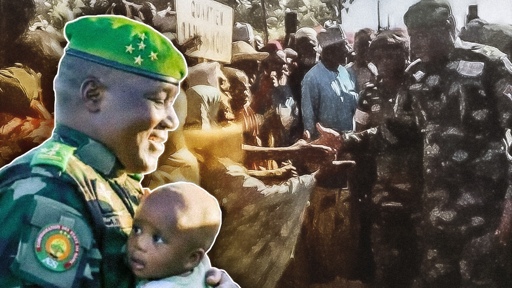
Hundreds of thousands of people took to the streets across Niger between November 8 and 20 to greet their president, General Abdourahamane Tchiani, who was on an unprecedented trip to all seven regions by road in a 12-day-long journey.
“The last time a president travelled to all seven regions by road was in the 80s”, when Col. Seyni Kountché used to pay annual visits after harvest in this time of the year, said Abdullahi Salifou, deputy secretary of the Convergence for the National Sovereignty of the Sahel (COSNAS).
Since then, presidents have only travelled by air to the capitals of different regions for campaigning ahead of elections, he added, explaining the jubilation of the crowds on “seeing the president come to visit them via road for the first time in almost forty years.”
Even forty years ago, Seyni did not travel to all regions on a single journey, but on several trips from Niamey and back, which makes Tchiani’s cross-country road trip “unprecedented in the history of independent Niger,” said Aboubakar Alassane of the West Africa Peoples Organization (WAPO).
“Stopping at every village on route,” he met the traditional chiefs, women’s organizations, farmers, and civil society groups like COSNAS and M62 that had led the demonstrations demanding withdrawal of French troops, said Salifou.
“Entire towns and villages were out to greet him. Crowds were even larger than the mass mobilizations celebrating his coup,” ousting the France-backed regime in June 2023 amid the mass protests calling for the expulsion of French troops.
The popular trust in his military government, already consolidated by successfully expelling the French troops despite threats of war, has reached its highest after Tchiani made this journey, he insisted.
Land caravan organized amid a neo-colonial proxy war waged through terror groups
Tchiani’s journey came amid a proxy war allegedly waged by France using terror groups to destabilize the country after its troops were expelled. Niger’s partners in the Alliance of Sahel States (AES) – namely its neighbors Mali and Burkina Faso, which had also expelled French troops after popular coups amid mass protests – have also accused France of fielding terror groups to destabilize former colonies, asserting sovereignty.
Read: France is a state sponsor of terror, AES countries declare
Inflating the strength of these groups, Western media reports systematically omit mention of the gains made by the AES states in reasserting control over territories lost by the state to terror groups. Instead, they are portrayed as besieged military junta’s and struggling to survive after expelling the French troops, out of an excess of anti-colonial exuberance.
“Media reports and interviews with diplomats indicate that Tchiani is paranoid, often irrational, and rarely leaves his barricaded presidential palace,” according to a “policy brief” published by the European Council on Foreign Relations last October.
Just over a year later, Tchiani went on his journey across Niger, starting from Tillaberi, after spending a few days in this western-most region, beset by terror attacks.
The Islamic State in the Sahel Province (IS Sahel) had killed at least 127 villagers in five attacks across the region this March. Also active here is the Al-Qaeda affiliated JNIM, whose recent attacks on fuel tankers in Mali were exaggerated by the Western media and travel advisories as a siege on the capital.
Read: Mali defends sovereignty against a Western-backed “proxy war” by terror groups
Tchiani set out on his journey in this region on November 8 after a public meeting in the city of Téra. “In Téra! On the border with Mali and Burkina Faso!” Alassane exclaimed. The infamous tri-border had long been a lawless zone where the various terror groups, spawned across Sahel by NATO’s destruction of Libya in 2011, vied for territorial control.
“The president was there, several ministers were there. The people had gathered in large numbers. If these terrorists had any territorial control, they would have attacked. But they couldn’t because the state has regained control,” Alassane emphasized.
That is not to say, however, that the terror groups ravaging this region have been eliminated. On October 19, when Tchiani had travelled on to the eastern edge of the country, terrorists killed 17 soldiers in an attack on a gendarmerie post in the Tillaberi region’s Garbougna village on the Téra–Niamey road.
Some reports ascribe it to Islamic State in the Greater Sahara (ISGS), others to the JNIM, but Alassane insists these are only different names for the French proxy forces.
Although attacks by these groups persist, Alassane argues that their loss of territorial control and reassertion of state power in the region is a critical advance, demonstrated by Tchiani’s public meeting in Téra.
From Téra, he journeyed eastward to the neighboring region of Dosso, where he held another public meeting in Gaya, near the tense border with Benin, across which secret French bases are alleged to be training terror groups.
Read: The people of Benin intensify anti-French protests in the wake of a terror attack
Then, covering the Tahoua region further east, Tchiani detoured north to Agadez, Niger’s largest region. From its capital by the same name, he went up the Sahara desert, all the way to Assamaka, a town in the far north near the Algerian border, “which no president had ever visited,” recalled Alassane.
Tchiani shatters stereotypes
Tchiani, he added, often left the road and ventured off onto the sands to greet the nomads passing by on camels to inquire “about their animals, their problems, and reassure them” of state support. “His security personnel were nervous and confused” by this mold-breaking gesture of shaking hands with camel-back nomads because they are commonly feared and suspected to be terrorists in this region of Africa, which has a centuries-old uneasy history with this community known as the Tuaregs.
It was the camel-back riders who raided the villages to abduct people and sell them as slaves in the markets of Saudi Arabia, he explained. When the Europeans arrived, the nomads collaborated with them in the transatlantic slave trade. Armed and licensed to kill by European colonizers who had hired them for policing, they were feared even after the end of slavery.
When terror groups and separatist insurgencies spread across the Sahel over the last decade in the aftermath of Libya’s destruction, they recruited camel-back nomads in large numbers. “Even today, fighters and weapons are transported across borders by terror groups mainly on camels”, which has given rise to stereotyping the Tuareg community as terrorists.
When people working in the fields encounter the nomads passing by on camels, “they run and hide in the bushes. But Tchiani has broken this stereotype by meeting and greeting them. He has given a political message to the country that there is no need to fear them – that they are not a danger anymore.”
Niger’s leader is not removed, but among the masses
On returning to Agadez city, Tchiani then traveled across the southern regions of Zinder and Maradi, before concluding the journey in the eastern region of Diffa, which borders Chad to the east and Nigeria to the south. Tens of thousands swarmed the National Route No. 1 to welcome Tchiani as he entered Diffa city.
“There was never such a large gathering in Diffa before. People feared attending even a small meeting because Boko Haram would attack. But Tchiani’s presence gave them confidence,” said Alassane, emphatic that he was not sealed off from the crowd in a security cordon.
“People came through to greet him. He instructed the security to allow them. He went through crowds of people. Anyone with a gun could have killed him.”
Thanking the region’s people for their warm welcome, Tchiani, in his address, spoke about the ills of drug use and unemployment among youth. He reassured them of jobs created by the government’s construction of roads and water towers, the oil exploration work that commenced last year, and the Large Irrigation Program being piloted in Diffa.
A struggle for survival between Imperialism and Sovereignty
Reassuring that the armed forces will protect the people, he went on to add that “the insecurity currently facing the Diffa region is totally different from” what is being portrayed in the media. It “has no connection with Islam. On the contrary,” he added, “it is a situation born from the desire of neo-colonial powers to continue their domination over our people.”
He reiterated this in a speech to the troops at the Diffa Defense Zone No. 5 that the problem of terrorism the region has been suffering for over a decade originates solely from the desire of certain neo-colonial powers to preserve their prosperity, wealth, and domination over our states.”
The unfolding conflict, he argued, is a “struggle for survival… on both sides”: the “greed” of the “imperialist powers” on the one end, and the people’s “dignity and sovereignty” on the other.
Having asserted its “dignity and sovereignty” by ousting France’s puppet regime, expelling its troops, and nationalizing resources like Uranium to wrest back control from French corporations, Niger has laid claim to “dignity and sovereignty”.
Read: Niger to nationalize uranium to wrest control over its resource from France
But “the fight ahead will be harder and longer”, he admitted, claiming no false victories in haste. Nevertheless, confident in the final victory because the imperialists are “living in the wrong era,” he declared: “What happened 130 years ago [colonization] will not happen again.”
A hero’s welcome
Thus concluding his road trip, Tchiani took a flight back to Niamey, geographically located in the Tillaberi region from where he started, but administered separately as the national capital. Salifou, along with tens of thousands of other people, had already lined up on either side of the road from Niamey airport to the Presidential Palace by that evening to give Tchiani a hero’s welcome.
“It was around 9 pm when he passed by us. As and when he passed, the people assembled along the road followed him” all the way to the Presidential Palace, Salifou recalled. “He marched with the people on foot for 12 kilometers from the airport to the Presidential Palace,” added Alassane.
“Entering the Palace carried by this human tide, General Tchiani demonstrated that his true legitimacy comes from the people”, said Abdourahamane Oumarou, president of Urgences Panafricanistes (Pan-Africanist Emergencies) in Niger.
“It reveals a Chief in symbiosis with his people, protected not by armored vehicles but by the energy of thousands of citizens.”
Arguing that “if the regime were not solid, no President would ever expose himself” as Tchiani did on this journey, Oumarou declared: “This Thursday evening, fear changed sides!”
Read: Niger hosts historic conference on the fight against neocolonialism in the Sahel
The post On the road: an unprecedented cross-country journey by Niger’s president amid a neo-colonial proxy war appeared first on Peoples Dispatch.
From Peoples Dispatch via this RSS feed