

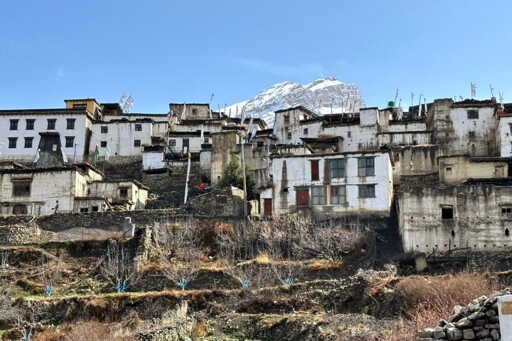
MUSTANG, Nepal — Sudip Thakali now plans to change the roof of his family house from mud to blended cement concrete (BCC) to avoid water leakage during the rains. This is not the first time the 37-year-old is trying to make his ancestral home in the Trans-Himalayan village of Thini in Mustang district livable while preserving the traditional essence of the house. Three years ago, he plastered the outer layer of the walls up to 1.2 meters (4 feet) from the ground with thin layers of cement concrete to prevent rainwater from seeping into the mud-gravel mixed walls. Rooftop view of Thini village in Mustang, Nepal. Almost all houses have mud roofs and mud-stone walls. Image by tanka dhakal. “The wall seems to be doing fine because of the cemented outer layer, but water leakage from the roof is becoming a headache now,” Sudip said. “It rained for more than 48 hours [in the last week of October] and the roof was leaking. I am thinking about replacing it with a very thin BCC ceiling.” In Nepal’s Trans-Himalayan region, houses have traditionally been built using locally available materials such as clay, mud, sand, gravel, stone and wood. These houses are renowned for their natural insulation properties. However, changing weather patterns and intense rainfall, whether over short periods or continuously for days as happened in late October, have created new problems, including water seepage through roofs and the weakening of mud-stone walls, forcing local communities to consider alternatives to their traditional…This article was originally published on Mongabay
From Conservation news via this RSS feed
You must log in or # to comment.