

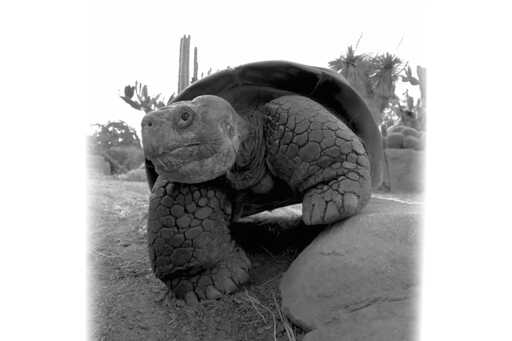
Founder’s Briefs: An occasional series where Mongabay founder Rhett Ayers Butler shares analysis, perspectives and story summaries. She moved slowly, as if time were something best savored. Visitors leaned over railings or knelt at the edge of her enclosure as she stretched her neck toward a leaf of romaine. Children noted she was older than their grandparents. Their parents did the math and realized she was older than the zoo itself. Few paused to consider that she once walked on a very different kind of ground. Gramma, the Galápagos tortoise who died recently in San Diego at an estimated 141 years of age, carried with her a past that was not merely long but instructive. When she hatched on one of the islands that gave Darwin his insight into evolution, giant tortoises were still common. Tens of thousands roamed the lava plains. But she was born into a landscape already thinned by more than a century of human appetite. To sailors in earlier centuries, a tortoise was a barrel of fresh meat that moved itself. Crews dragged them across jagged rock and stacked them in ship holds, alive for months without food or water. Oil rendered from their fat lit lamps. Their abundance made caution seem unnecessary. Her own journey north was a quieter chapter of that same story. Taken from the Galápagos, she passed through The Bronx Zoo before arriving in California around 1930. The San Diego Zoo became her home: concrete underfoot, predictable meals, and the curiosity of…This article was originally published on Mongabay
From Conservation news via this RSS feed