



Tricontinental: Institute for Social Research in collaboration with the UL (Uralungal Labour Contract Cooperative Society) Research Centre
The artwork in this study was produced by members of Young Socialist Artists (YSA). Since 2020, this group has brought together artists and cultural workers from across India who are embedded in social and political movements in their regions. Most of the YSA members who created the illustrations for this study are from and based in Kerala, where these cooperatives are part of the fabric of everyday life. The illustrations are based on photographs taken by the researchers who produced this text during their field visits.
Ashique Ali Thuppilikkat is the co-founder and director of the SAFAR Foundation, an action research centre based in West Bengal, India. He was active with the student movement at Delhi University and Jawaharlal Nehru University, where he researched cooperatives during his MPhil in political science. He is currently a PhD student at the University of Toronto, Canada, and a researcher at STREET Lab. His research focuses on socio-technical designs for resistance, exploring the intersection of technology and labour/social movement organising.
Aswathi Rebecca Asok is a development economist and law graduate with expertise in interdisciplinary, evidence-based, and policy-oriented research. Over the past nine years, Aswathi has conducted extensive research on Kerala’s development trajectory and explored a wide range of topics such as financial inclusion, poverty, gender, migration, labour, and decentralisation. She was a student activist at multiple universities and campuses in India.
Najeeb VR is a social scientist and research coordinator at the UL Research Centre in Kozhikode, Kerala, where he integrates transdisciplinary approaches to cooperative development, social transformation, and knowledge systems. He is also a member of the expert committee for the 14th Five-Year Plan Subgroup of the Kerala State Planning Board and actively contributes to academic outreach, curriculum development, and public scholarship. He holds a PhD in sociology from Jawaharlal Nehru University and is a recipient of the Revise PhD Fellowship of the Kerala Council for Historical Research.
Vijoo Krishnan is the general secretary of the All India Kisan Sabha (AIKS) and a polit bureau member of the Communist Party of India (Marxist). As a leader of the AIKS, he played a crucial role in the historic farmers’ agitation in Delhi in 2021–2022. Before becoming a full-time political activist, he was the head of the Department of Political Science at St. Joseph’s College, Bangalore. In 1998–1999, he was the president of the Jawaharlal Nehru University Students’ Union. Vijoo is also a photographer who captures the everyday life of the working class.
Nidheesh J Villatt is a member of the All India Kisan Sabha’s Central Kisan Committee as well as the research coordinator of the P Sundarayya Memorial Trust, a research institute that focuses on agrarian issues and movements. Nidheesh is dedicated to studying and building the worker-peasant alliance, with a focus on its political economy and philosophy. He has written about agrarian and industrial class struggles, ‘competition’ under capitalism, political ecology, and Hindutva.
Nitheesh Narayanan is a movement researcher and writer who works at Tricontinental: Institute for Social Research. He studies the history of working-class movements, including cooperatives, and was previously the vice president of the Students’ Federation of India and editor of its journal, Student Struggle. He has a PhD from Jawaharlal Nehru University. He is the author of a number of books in English and Malayalam, including The 1921 Rebellion in Malabar: A Collection of Communist Writings, edited with Vijay Prashad, and If Humanity Is A Country: Cuban Days.
Sarga TK is an assistant professor at Azim Premji University, Bhopal. Her research engages with themes of urban mobility, labour migration, and construction cooperatives, exploring how work and movement shape the urban landscape. She previously taught at Kannur University in Kerala.
Subin Dennis is an economist and a researcher at Tricontinental Institute for Social Research. He worked with the online news portal NewsClick as a correspondent before joining Tricontinental. He was active with the student movement and served as the Delhi state vice-president of the Students’ Federation of India. Subin’s writings in English and Malayalam on issues related to the economy and politics appear in various periodicals and websites. He is currently based in Kerala.
Vijay Prashad is the director of Tricontinental: Institute for Social Research. He is the author of forty books, including The Darker Nations: A People’s History of the Third World, The Poorer Nations: A Possible History of Global South, and (with Grieve Chelwa) How the International Monetary Fund Suffocates Africa. Vijay is an editor at LeftWord Books (New Delhi), Inkani Books (Johannesburg), and La Trocha (Santiago).
Introduction: Possible Communism
But there was in store a still greater victory of the political economy of labour over the political economy of property. We speak of the cooperative movement, especially of the cooperative factories raised by the unassisted efforts of a few bold ‘hands’. The value of these great social experiments cannot be overrated. By deed, instead of by argument, they have shown that production on a large scale, and in accord with the behest of modern science, may be carried on without the existence of a class of masters employing a class of hands; that to bear fruit, the means of labour need not be monopolised as a means of dominion over, and of extortion against, the labouring man himself; and that, like slave labour, like serf labour, hired labour is but a transitory and inferior form, destined to disappear before associated labour plying its toil with a willing hand, a ready mind, and a joyous heart.1
– Karl Marx, Inaugural Address of the International Working Men’s Association, 1864.
Misery greets the planet. Poverty persists for billions of the world’s people. Climate change – the product of capitalist expansionism – threatens the survival of life on Earth. Wars of grotesque proportions creep across the globe in myriad forms, including Israel’s genocide against Palestinians in Gaza, as famines driven by human behaviour plague swathes of the population. It is as if the five horsemen of the apocalypse are no longer sufficient – instead, untold horsemen ride around the planet suffocating the possibilities of human life.
All of this contributes to the sense that nothing other than this nightmare is possible, that alternatives cannot be imagined. When resilient people dare to think of a better future, as they inevitably do, those in power meet them with mockery and strive to snuff them out. It is better for the powerful and the propertied to see to it that no alternative is allowed to flourish. The survival of even one kernel of hope would call into question the claim that History has ended.
One of these kernels is the Indian state of Kerala (population of 35 million), which has a rich history of socialist construction. Ten years after India won its independence in 1947, the Communist Party of India won state elections in Kerala. Right from the start, the left government in Kerala adopted an agenda to smash ancient social hierarchies and customs, provide social goods to the public that were not readily available in the rest of India (including quality public education, health care, and transportation), and construct the basis of working-class and peasant power by defending workers’ rights to organise in unions and build cooperatives. Though the national government in Delhi unconstitutionally removed the communist state government in Kerala in 1959, the agenda set by the left remained largely in place. The left has returned to power periodically (1967–1969, 1980–1981, 1987–1991, 1996–2001, 2006–2011, and 2016–present), each time expanding the agenda of decentralisation, encouraging public action, and building the basis for social democratic state institutions.2 Even when the right came to power in the intervening years, it was not able to undermine the dynamic that had been set in motion by the left governments. It was in this context that the cooperative movement developed in Kerala.
People who are critical of the capitalist system are often as critical of the alternatives being built within the parameters of this system because they argue that such institutions are captive to capitalism’s logic. But this is a flawed assessment of cooperatives, which are – in fact – incubators of different logics of life and work that serve as beacons of inspiration and hope, offering a window into what humanity is capable of once the fetters of capitalism are transcended. Cooperatives provide schools for the working class and peasantry to learn how to build social relations based on a different economic foundation. In his third volume of Capital, Marx wrote:
The cooperative factories of the labourers themselves represent within the old form the first sprouts of the new, although they naturally reproduce, and must reproduce, everywhere in their actual organisation all the shortcomings of the prevailing system. But the antithesis between capital and labour is overcome within them, if at first only by way of making the associated labourers into their own capitalist, i.e. by enabling them to use the means of production for the employment of their own labour. They show how a new mode of production naturally grows out of an old one, when the development of the material forces of production and of the corresponding forms of social production have reached a particular stage.3
Marx’s insight here is crucial. Cooperatives are neither inherently mired in the capitalist law of value, nor are they easily able to transcend it. They are ‘sprouts’, he writes, of an alternative through which the working class can experiment with the annulment of capitalist management. Marx looked with great pride at the workers’ utopia being built in the Paris Commune of 1871, where he saw how the communards developed workers’ cooperatives and other means of building a new society amidst the jubilation of toppling the Second Empire of Louis Napoleon III (1852–1870).4 In The Civil War in France, Marx wrote that during the two months of the commune’s existence, from March to May 1871, the commune was the ‘form at last discovered’ for the future workers’ state. It was in this text that Marx wrote of the insights of cooperatives:
If cooperative production is not to remain a sham and a snare; if it is to supersede the capitalist system; if the united cooperative societies are to regulate national production upon a common plan, thus taking it under their control and putting an end to the constant anarchy and periodical convulsions which are the fatality of capitalist production – what else, gentlemen, would it be but communism, ‘possible’ communism.5
This text, The Cooperative Movement in Kerala, India, is part of a series from Tricontinental: Institute for Social Research called Studies on Socialist Construction. It is about possible communism, the possibilities in our time of a future society. An honest appraisal of a heroic venture, this study shows us that Kerala’s cooperatives have been able not only to survive in a small niche, but also to grow into substantial institutions that have become an integral part of the region’s social life. There are 16,429 registered cooperative societies in Kerala today (12,278 of which are active, 3,354 of which are dormant, and 797 of which are under liquidation).6 Cooperatives operate in a wide range of sectors, from the production and distribution of goods and services to hospitals and restaurants to agricultural production and housing construction. The largest cooperative (although not strictly registered as a cooperative), Kudumbashree, has 4.8 million members, all of whom are women. One in four women in Kerala is a member of this cooperative. There are also many cooperative-like organisations that are registered as charitable societies and trusts, such as the Brahmagiri Development Society, which focuses on agrarian development, and the Janatha Charitable Society, a major milk producer. Most of the active cooperative societies have branches in different parts of the state.
There are, of course, challenges and contradictions, and these are discussed with clarity: there is no sense in exaggerating the possibilities presented by cooperatives that must struggle to survive in a world where the capitalist law of value is the law of the land. Nor is there sense in minimising these cooperatives’ important contributions to the people who live in Kerala – both in material and spiritual terms. These cooperatives are not merely a source of inspiration: they provide a blueprint for cooperatives around the world as seeds of a just future that exist within the confines of capitalism today.
Kerala’s Cooperatives
In 1943, at the 7th Session of the All India Kisan Sabha (AIKS, the country’s largest farmers’ union) in Bhakna Kalan, Punjab, the delegates discussed a range of issues, including the building of cooperatives. In one of their resolutions, the AIKS argued that cooperatives could help the farmers fight the ‘distress and humiliation’ of capitalist and colonial agriculture and enable them to achieve ‘economic, social, and national freedom’. During the deliberations, communist leader EMS Namboodiripad (1909–1998), or EMS as he was called, wrote a note entitled ‘Organisation – Not a Machine’. In the note, EMS pointed out that the resolutions would mean nothing without militant organisation that goes beyond ‘abstract politics’. Cooperatives would need to be built by the peasantry and agricultural workers to expand the democratic revolution and build the confidence of rural workers.7
In October 1956, the Communist Party of India held a meeting in Thrissur, Kerala, that focused on cooperatives. The meeting was chaired by Professor Joseph Mundassery, who would become the first minister of education and cooperation during EMS’s tenure as the chief minister of Kerala (1957–1959), and resolved that rather than allow the cooperatives to become a ‘pocket borough’ of the feudal classes, working people themselves would build them and there would be political education about the role these cooperatives played in building democracy and socialism. The party leadership also emphasised the need for successful rural credit societies and cooperative banks controlled by communists and workers as a way of eliminating the stranglehold of the moneylenders, nourishing agricultural production, and improving the living conditions of peasants and agricultural workers. It is out of this ideological clarity that Kerala’s cooperatives emerged to become a beacon for democratic worker-led cooperatives around the world.
Brief portraits of some of Kerala’s cooperatives make up the rest of this study. These portraits are written by scholars and political leaders who have worked closely with the cooperatives to learn about them and assess them. The data in the essays has been largely accumulated from the cooperatives and from government documents. We are grateful to the UL Research Centre for assisting us with this work.
These essays reveal some important facts:
The cooperative sector in Kerala would not have flourished without a long history of social reform that created the social basis for cooperation. When news about the Soviet Union trickled into Kerala, people involved in the social reform and anti-caste movements expressed their curiosity about its attempts to reconstruct social and economic relations. This curiosity led to studies about the cooperative movement in the Soviet Union, which were then presented in social reform and anti-caste movements’ public meetings.The cooperative sector developed due to the vitality of the class struggle in Kerala, where organised peasants and workers pushed the social reform movement to combine the struggles against caste, landlordism, and colonialism. It was in these struggles that the peasant movement – mainly in northern Kerala – took the initiative to start peasant cooperatives to help the most impoverished amongst them. The emergence of these cooperatives weakened the grip of landlords, who could no longer lend money at usurious rates to the indebted peasantry or continue to be their main provider of consumer goods. Instead, they watched as the peasant cooperatives lifted the confidence of the masses. The success of cooperatives led to their duplication in other parts of the region, building on the organisational habits of mass movements.The first communist ministry that came to power in Kerala (1957–1959) received mass support from the mass social reform movement and was bolstered both by the class struggle of previous decades and by the success of the cooperative movement. In turn, the communist government used a part of Kerala’s social wealth to finance the growth of more cooperatives across the state. The government set up coir (coconut fibre), handloom, and toddy (fermented coconut sap that is an alcoholic drink) cooperatives to enhance these sectors of the economy and improve the working conditions and wages of the workers.The emphasis on building cooperatives to ensure mass employment and higher wages as well as to improve the efficiency and productivity of different enterprises meant that cooperatives could compete against the private sector.The leadership of oppressed castes was drawn to the cooperative system and saw in them an opportunity to realise their independence and emancipation. At the December 1929 Cheramar Samajam Conference, for instance, the organisation’s president, Chaajan, told the two thousand members of the Pulaya community present there that these cooperative societies, along with education programmes and an anti-alcohol campaign, would be crucial for their struggles.8The role of political education within cooperatives enabled their members to understand what they were building (socialism) and how what they were building was different – and better – than what the private sector had built (capitalism).Without an extensive network of financial cooperatives, the entire sector would have been starved of funds. This system has also depended on the left’s periodic entry into government, which has prevented the large-scale privatisation of Kerala’s credit markets.The cooperatives’ democratic structure, alongside the innovation of their members, allows them to diversify their work and adapt to the changing times. When tobacco consumption habits changed, for instance, the Dinesh Beedi9 Workers’ Central Cooperative Society shifted to food production.A key element in Kerala’s cooperative movement is its commitment to social change, with an emphasis on using cooperative organisation to transcend patriarchy (through women’s cooperatives), caste hierarchies (through oppressed caste cooperatives), discrimination against tribal or Adivasi communities (through Scheduled Tribe10cooperatives), and discrimination against transgender communities (through transgender cooperatives) as well as to promote equality for people with disabilities.
This study shows how effective these cooperatives have been in promoting a social form of economic activity that offers a counter to the pressures of capitalism. In that regressive form of economic competition, workers’ livelihoods are the first to be dismissed, while profit is enshrined as a god. Kerala’s cooperatives invert this value system, putting the needs – and dignity – of the working class at their heart.

Vanshika Babbar (Young Socialist Artists), Uralungal Cooperative Workers, 2025.
Sahya Tea Cooperative
Nidheesh J Villatt and Vijoo Krishnan
At the 35th conference of the All India Kisan Sabha (AIKS) in December 2022, every delegate received a pack of Sahya tea along with Kerala’s famous spices and other condiments. It was not until months later, during a visit to Assam to report on the decisions made at the conference, that one of the delegates took note of the brand of tea. Local delegates inquired about it, claiming that it was better than their world-renowned Assam tea. Their query led us on a quest to find out more about the brand and the collective effort that went into its emergence.
In a letter to Wilhelm Bracke on 5 May 1875, Karl Marx wrote, ‘every step of real movement is more important than a dozen programmes’.11 The story of the Sahya Tea Cooperative Factory, located in the remote area of Thankamany in the hilly district of Idukki, Kerala, shows the significance of the ‘real movement’ of socialism. Launched in 2017, the factory was established by the Thankamany Service Cooperative Bank, Ltd (founded in 1966). The Cooperative Bank has 15,000 members, most of them small peasants and workers, and operates in the Kamakshy village panchayat,12 which is mainly inhabited by small tea growers. The Thankamany Cooperative Tea Factory mostly manufactures black, green, and a variety of blended teas.
The cooperative bank and tea factory must be understood within the broader trajectory of Kerala’s communist-led cooperative movement.13 Russia’s 1917 October Revolution had a tremendous impact on Kerala’s progressive movements and helped reshape their orientation within the national movement. In 1934, the strongest sections of these movements formed the All India Congress Socialist Party. Five years later, the party’s Kerala unit went on to transform itself into the Kerala unit of the Communist Party of India, which eventually built the AIKS and a number of trade unions in the region. It was in this period and in this context that the AIKS and other progressive forces began to intervene in the cooperative movement and confront the British strategy of keeping cooperatives insulated from the intensified class struggle that was erupting in the 1930s and 1940s. For instance, as EMS documented, during the People’s War (1941–1945)14 communists pressured the imperialist British government to procure grain from landlords and distribute it through ration shops, which were subsequently converted into producer and consumer cooperative societies.15 Communists in Kerala identified building cooperatives as part of the expanding class struggle, distinct from the benevolent colonial idea of cooperatives derived from the Rochdale Principles, which have served as the primary guidelines for cooperatives since 1844.16
The dialectical relationship between building a strong working-class organisation that opposes imperialism and building cooperatives had already been established in the AIKS’s 1943 resolution on cooperatives, passed at its 7th Session. This resolution called on AIKS cadres to initiate cooperatives as a strategy to combat the economic and social subjugation of the peasantry. The insights from this resolution, particularly EMS’s note ‘Organisation – Not a Machine’, emphasised the necessity of militant class organisation to prevent cooperatives from devolving into ‘abstract politics’ and provided a crucial framework for later discussions on building cooperatives.
By the time communists and cooperative movement leaders convened in Thrissur in October 1956, the focus had shifted from the theoretical foundation laid in 1943 to the practical challenges of implementing this foundation in Kerala.17 During the meeting, participants took stock of the cooperatives’ activities in Kerala and criticised the delusions of Prime Minister Jawaharlal Nehru’s bourgeois landlord regime, which suggested that the creation of cooperatives by itself would lead to socialism. The participants made the point that communists had to be consciously involved in the organisation of cooperatives and enrol large numbers of working people into these and other mass organisations in order to ensure their political education in the process. Reference was made to the successful cooperative rural credit societies and banks, which had eliminated the stranglehold of moneylenders and nourished agricultural production, thereby increasing the income of the peasantry and agricultural workers. What distinguished these cooperatives from unsuccessful ones was the role of communists in ensuring that the cooperative form was not coopted by reactionaries who tried to maintain old forms of rural power.
The Emergence of Small Tea Growers
In the late 1990s, the tea industry underwent a sweeping restructuring driven by the profit fetish of monopoly capital, marked by mergers, acquisitions, and an aggressive focus on brand building. Vertically integrated monopolies such as Unilever and Tata – known as Big Tea – abandoned direct ties to agricultural production and divested from tea estate ownership and management. For instance, in March 2000 Tata acquired Tetley Group, the world’s second-largest tea manufacturer and distributor, for £271 million.18 Both Tata and Unilever, the world’s largest tea company, shifted to creating and marketing new branded teas – including crush, tear, and curl (CTC) as well as blended tea products – aimed at a variety of tastes and price ranges.
This transformation coincided with a financial crisis in tea estates, which grow and process tea and are largely managed by non-monopoly capital. While most estates were sold to smaller firms, the monopoly companies secured their supply through contractual clauses that guaranteed access to sufficient unprocessed tea. As Professor Natalie Langford observes, the industry shifted from ‘vertical integration’ to value chains in which ‘firms have sought to advance their competitive position through the outsourcing of lower value-adding activities’.19 In practice, Big Tea considered agricultural production and estate management the most troublesome links in the chain, as they were heavily regulated by labour and environmental law, and sought to distance themselves from these sectors to avoid class struggle. Instead, they consolidated control over higher value-added activities such as blending, packing, branding, distribution, and sales. Meanwhile, small tea growers rose as the main producers of tea leaves: their share increased from 7% in 1991 to 52% in 2022 and is projected to reach 70% by 2030.
Before the formation of the Sahya Tea Cooperative Factory, the roughly 3,500 small tea growers in the Idukki area operated under the stranglehold of a system run by monopoly firms such as Tata and AVT Beverages (a leading player in southern India). These large companies bought green leaves (freshly plucked, unprocessed tea leaves) from both the farmers and ‘agents’ (intermediaries who often act as buyers on behalf of factories, typically charging a commission on the green leaf collected from small farmers) at ‘an arbitrary rate and [under] humiliating terms and conditions’, a group of farmers told us. Many of the farmers shared stories with us about how companies turned away their green leaves when they tried to bargain for a fair price, inventing superficial excuses which forced the farmers – who had carried the leaves from far away – to dispose of them or use them as manure. Scenes of dispirited farmers returning home on their tractors with their rejected crops were commonplace. These methodically planned rejections were designed to create a docile peasantry that would be inured to selling their crops to the companies at low prices. The entire system was highly favourable to the large companies.
In the absence of successful cooperative action, trading agents generally charge small growers across India a commission of 15%–20% per kg of green leaves. A large chunk of this is sold to bought leaf tea factories, which process tea from purchased leaves rather than growing their own. Another chunk is sometimes sold to tea estate factories owned by big plantations. Trading agents evaluate the quality and price of the leaves based on their ‘fine leaf count’ (the proportion of young, tender leaves and buds, which determine the tea’s overall quality) in a very subjective way, compromising the interests of small farmers.20
Bought leaf tea factories usually sell their processed tea at auctions. Since the process is controlled by Big Tea companies (the primary buyers), the tea is sold at distorted prices.21 The entire auction mechanism in India is designed in such a way that the basic postulate of neoclassical economics – that the interaction between supply and demand determines prices – appears as a farce. On the other hand, estate factories typically sell only half of their processed tea at auctions, as mandated by the regulations outlined in the 1983 Tea Marketing Control Order (itself under the 1953 Tea Act), and sell the other half through more profitable private channels.
Auction participants consist of major tea packing companies, trading agents, and other leading packet tea brands. Since these companies then undertake value-added processes such as blending, sorting, grading, and packaging the tea before distributing it to consumers, small tea growers, who are on the lower end of the value chain, receive a disproportionately lower share of consumer spending on tea – around 15%. Tea packing companies, on the other hand, which are mostly big monopoly companies, receive 50% of consumer spending on tea. That is why it is imperative for small tea growers to climb the value chain and gain direct access to markets in order to secure better prices.22 This is exactly what the Sahya Tea Cooperative is setting out to accomplish with its brave move to enter the terrain of Big Tea.
Cooperative Tea
It was the difficult circumstances facing farmers that drove AIKS members to form the Sahya Tea Cooperative in 2017. Designed to process 15,000 kg of green leaves per day, the Sahya Tea Cooperative generates employment for more than 150 workers, most of them recruited from the agricultural working class and peasantry, while also protecting the interests of the peasants amongst the small tea growers. When we visited the cooperative factory and catchment area in September 2023, what caught our attention was the visible confidence among the small tea growers.
The first three years of the cooperative, from 2017 to 2020, were challenging: not only did it have to begin to pay back the large loan it had taken at 12% interest, but it was besieged by a number of shocks, such as the 2018 Kerala flood and the COVID-19 pandemic (2020–2023). Yet, despite the financial challenges the cooperative faced, it was able to procure green leaves and pay farmers INR 12 per kg (far higher than the corporate rate of INR 7 per kg). The cooperative’s steady prices in turn forced the corporate tea suppliers to increase the rates they pay to small tea growers.
The cooperative’s leadership convened peasants and workers to brainstorm how to improve their financial situation. Since Big Tea companies dominated the market with their packaged tea products, they decided to improve their marketing strategy and launch an effort to make inroads into the market. KS Chithra, a popular singer known as the ‘Nightingale of Kerala’, became the Sahya Tea Cooperative’s brand ambassador and helped popularise its brand, refusing to take any payment for her work. To strengthen its market presence, the cooperative also made use of Kerala’s Public Distribution System, such as Supplyco (Kerala State Civil Supplies Corporation) and Consumerfed (Kerala State Cooperative Consumers’ Federation), as well as the system that provides goods to police canteens.
The cooperative also received other forms of support from the state, such as in 2020–2021 when Kerala’s state government bought Sahya tea for the food kits distributed during the pandemic. As a result of these creative marketing mechanisms and state assistance, the cooperative turned a profit in its fourth year (2020–2021) and began to pay INR 18 per kg for green leaves and distribute the profits as incentives to the farmers who supplied the leaves. This set a historic precedent: for the first time, farmers were remunerated fairly for their contributions.
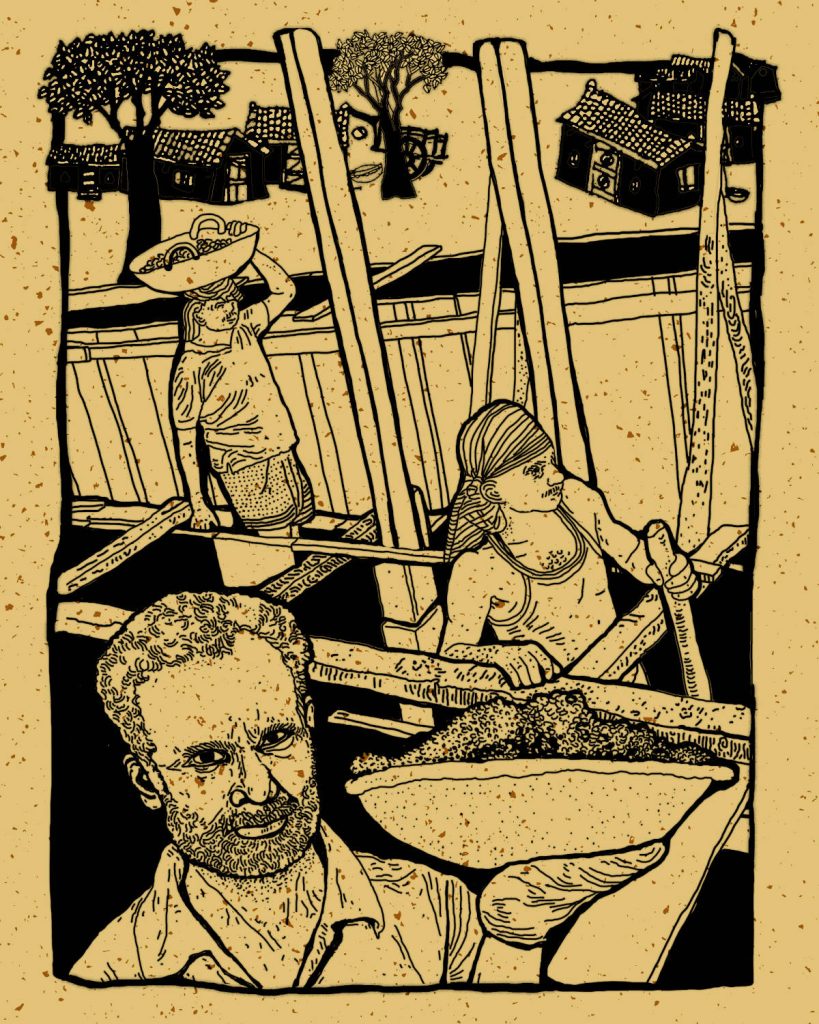
Vanshika Babbar (Young Socialist Artists), Udayapuram Cooperative Workers, 2025.
The Uralungal Labour Contract Cooperative Society
Najeeb VR
In 1925, before the communist movement was established in southwestern India, the followers of the social reformer Vayaleri Kunhikannan Gurukkal, also known as Sri Vagbhatananda Guru, (1885–1939) founded the Uralungal Labour Contract Cooperative Society (ULCCS) to provide construction workers with social protection. Today, the ULCCS is Asia’s largest workers’ cooperative, and it was ranked second in the 2021 World Cooperative Monitor list of industry and utilities cooperatives. United Nations Development Programme Resident Coordinator in India Lise Grande calls it a model cooperative whose success provides ‘great lessons for the rest of the world’.23 From its origins amongst a group of labourers, ULCCS, located in a rural part of Malabar in northern Kerala, now constructs roads and bridges, buildings, and software systems. The cooperative’s commitment to social harmony and inclusion as well as worker cooperation has allowed it to succeed in areas of social production that are often challenging for cooperatives.
The ULCCS was formed at a time when work was difficult to come by and when forms of caste and class discrimination were even more severe than they are today. In 1917, Sri Vagbhatananda Guru’s followers started the Atma Vidya Sangham school, whose members formed the United Credit Cooperative in 1922 to help each other if any of them faced financial problems due to discrimination in the credit market, which was controlled by the dominant castes. They also founded a school for their children, who had been denied education by the dominant castes in the region. Taking the advice of Vagbhatananda, they decided to form the Mutual Aid Society of Daily Wage Labourers in 1924 to circumvent the labour ban that the elite had imposed on them in an effort to curtail their struggle against caste discrimination. Then, on 13 February 1925, the workers created the Uralungal Kooli Velakkaarude Paraspara Sahaaya Sahakarana Sangham (Uralungal Labourers’ Mutual Aid and Cooperative Society, now ULCCS). Slowly, more and more workers joined the ULCCS, which now has a presence across Kerala.
During its initial years, the ULCCS was seldom able to obtain contracts, and when it did, the tender (or contract) amounts were set at a very low level. In order to compete, the ULCCS underbid private contractors, offering 27.5% less than the private bids. Though this enabled them to get some contracts, the profit margins were negligible. Inexperience with road work and other forms of large-scale construction led to problems for the ULCCS. The cooperative sustained itself by obtaining minor contracts from local governments and by receiving short-term loans from the better-off members of the cooperative. The ULCCS also received funds from microfinance systems such as payattu (money-gathering games) and kurikkalyaanam (marriage announcements)24 and used its growing prestige to provide assistance for its members’ basic needs by collecting donations from local merchants.
As time went by, ULCCS workers improved their skills and became more adept at basic business practices. The increased efficiency and quality of their work in turn attracted more lucrative contracts, and their work ethic introduced a new culture of excellence in Kerala’s construction industry. By the 1940s, they began to receive funding from the Malabar Cooperative Central Bank as well as fixed deposits by the public in ULCCS schemes.
Over the past century, the ULCCS has grown from a collective with an initial capital of INR 0.37 (USD 0.13 in 1925 dollars) to an annual revenue of INR 25 billion (USD 300 million) in 2023. It is comprised of 18,000 workers, including more than 1,000 engineers and 1,200 technicians. The cooperative not only advances the well-being of its workers and the surrounding community, fulfilling thirteen out of the seventeen United Nations Sustainable Development Goals, but also ensures that the quality of the work (including its timely completion) is balanced by reasonable costs. These factors, alongside the ULCCS’s modern construction techniques, allow it to compete against private corporations and win major contracts, such as those from the National Highway Authority of India, the Union Ministry of Road Transport and Highways, and the Government of Kerala. The ULCCS has completed over 7,500 major projects and is currently working on 500 projects worth INR 6.5 billion. Since it operates as a cooperative, the ULCCS has been able to provide better pay for its workers than they would earn in the private or even government sectors.
As part of its effort to keep pace with workers’ aspirations, the ULCCS has entered various sectors of the knowledge economy such as software development, diversifying from its initial form as a construction workers’ cooperative to take on the challenges facing cities and work in our times. These initiatives include:
UL CyberPark in Kozhikode, the first cyberpark in India’s cooperative sector and part of one of the central government’s Coastal Economic Zones.UL Technology Solutions, a next-generation digital solutions firm located in the UL CyberPark.The arts and craft villages Sargaalaya (in Iringal) and the Kerala Arts & Crafts Village (in Kovalam), which the ULCSS manages on behalf of the Government of Kerala. These villages help artisans produce handicrafts for the domestic and international markets.UL Housing, which uses the cooperative’s construction skills to build apartment projects under the brand name UL SpaceUs. The first such building, called One Anthem, is in the UL CyberPark.The high-tech Matter Material Testing and Research Laboratory, or MatterLab, an outgrowth of the ULCCS’s construction work created in 2021 to develop and test new sustainable construction materials.The Indian Institute of Infrastructure and Construction, which ULCCS manages on behalf of the Government of Kerala in collaboration with national and international educational institutions.UL Education, which develops students’ skills through a range of institutions and projects, such as: The Madappally Academic Project for Learning and EmpowermentThe Vagbhatananda Edu ProjectThe Scholastic Excellence Programme for StudentsThe UL Space Club (for young aspiring astronauts).The ULCCS Centenary LP School, an aided lower primary school in Muttungal managed by the ULCCS which offers classes from kindergarten to the 4th standard.ULCCS Charitable and Welfare Foundation, the cooperative’s social responsibility wing, which runs three key projects under the name UL Care: The Prasanthi School for Children with Special NeedsThe Nayanar Sadanam Institute of Vocational Training and Placement for Adults with Intellectual ChallengesThe Madithattu Geriatric CentreUL Insight, a management consultancy firm jointly managed with Insight Advisory and Consulting India
As a workers’ cooperative, the ULCCS does not allow non-workers to become members. Its board – which is elected by and represents the workers – has thirteen directors, each of whom has between thirty and thirty-five years of experience in various sectors of the construction industry. Each worksite, including the project’s management, is overseen by a board member who evaluates the work at the end of each day.

Navin S. (Young Socialist Artists), Tailors of Dinesh Apparels, 2025.
Credit Cooperatives in Kerala
Aswathi Rebecca Asok
Credit cooperatives – member-owned financial institutions that provide affordable credit and financial services to rural and marginalised populations – were formed in Kerala even before the state was established in 1956. They largely service small-scale farmers and workers, often where private commercial banks are absent or insufficient. In Kerala, they have historically played a vital role in supporting land reform beneficiaries and preventing the re-concentration of land ownership. For instance, the Trivandrum Central Cooperative Bank was set up in 1915 to provide finance to the emerging cooperative sector in the area. Later, similar credit cooperatives were established across the northern Malabar region and in Cochin. In 1956, the Trivandrum Central Cooperative Bank became the Kerala State Cooperative Bank, anchoring the credit cooperatives of the new state. Today, there are 4,146 credit cooperatives in Kerala, accounting for over one-third of the total lending institutions in the state.25 These credit cooperatives have played a vital role in economically uplifting the people, particularly in rural Kerala. For example, when the communist ministry initiated land reforms in 1957, small-scale farmers who received land needed finance to begin cultivation, but this credit was not available from the private sector in sufficient volumes. It was the credit cooperatives that stepped in, providing the necessary capital and sparing farmers from having to borrow from moneylenders and the feudal class. Without the presence of credit cooperatives, a substantial portion of the distributed land in Kerala would have returned to the feudal class and moneylenders in the form of mortgages.
Though private commercial banking has emerged in rural Kerala, credit cooperatives continue to provide a vital function. Kerala is the fifth-best connected state in India in terms of coverage by commercial bank branches, yet there is a wide rural-urban gap in the distribution of these branches. Reserve Bank of India data from 2024 shows that only 5.3% of these branches are located in rural areas, while 22.5% are in urban areas and 72.2% are in semi-urban areas.26 However, if cooperative credit institutions are added into these figures, 25% of the bank branches in the state are located in rural areas.
The Structure of Credit Cooperatives in Kerala
Kerala’s credit cooperative sector is structured into two parallel systems: short-term cooperatives, which provide seasonal working capital loans for agriculture, and long-term cooperatives, which offer investment credit for rural infrastructure and agricultural development. Each system has its own institutional structure, including banks operating at village, district, and state levels.
Short-term cooperatives have historically operated through a three-tier structure consisting of Primary Agricultural Credit Societies (PACSs) at the village level, district cooperative banks at the district level, and the Kerala State Cooperative Bank at the state level. In 2019, this structure was simplified to two tiers by merging the district- and state-level banks into a single entity now known as Kerala Bank. This simplified structure has strengthened the integration and efficiency of the short-term cooperative network. Broadly speaking, this structure can be visualised as a pyramid: PACSs form the base, and Kerala Bank serves as the apex. Long-term cooperatives form a separate structure anchored by the Kerala State Cooperative Agricultural and Rural Development Bank at the state level and supported by primary cooperative agriculture and rural development banks at the district and block levels.
[Content truncated due to length…]
From | Tricontinental: Institute for Social Research via this RSS feed
You must log in or # to comment.