


Photo: Courtesy of a former CDC employee
It was February when measles killed 6-year-old Kayley Fehr and it was April when measles killed 8-year old Daisy Hildebrand and it was May when measles brought the man from the Agency to the health-food store in Seminole, Texas.
The man was a 53-year-old highly credentialed, chatty bald former Brooklynite physician given to posting photos of his bare abs; he had once appeared on the cover of a magazine in a pin-striped suit and a shirt unbuttoned to reveal a leather harness over his chest. The cover line read THE GOOD DOCTOR. He did not spend much time in Texas, but he did have a tattoo of Jesus on his stomach, and he did find many of the people he met in Texas awesome. He was one of a handful of directors at the Agency who reported directly to the chief medical officer; specifically, he was, as he called it, the vaccine guy. As Vaccine Guy, he had rented a white Jeep and driven an hour past prairie dogs and tumbleweeds so he could better understand the drive a worried parent might take with a stricken child from here in Seminole to the nearest hospital in Lubbock. At the health-food store he paid $10 for a pack of fake M&M’s. They were gray, and they were gray because they were free of artificial dyes, this being a priority of the kind of people who did not vaccinate their children in West Texas.
Vaccine Guy and his staff had tried to get through to the local Mennonites in the usual way, through trusted messengers in the community, but their usual methods failed to work. The trusted messengers were nervous. A midwife worried she might be ostracized if she expressed anything other than total certainty that the vaccines cause autism. The anti-vaxx people had gotten there first. They were there right now, in the form of Children’s Health Defense, the most powerful anti-vaccine lobby in the country. There were, in fact, Children’s Health Defense employees staying in the same Best Western Plus as some Agency employees. They passed one another in the halls.
At the health-food store, Vaccine Guy walked by shelves and shelves of supplements. The kind of people who did not vaccinate their children in West Texas had turned to two doctors, MAHA wellness people, who were administering treatments such as vitamin A, the steroid budesonide, and cod-liver oil on the questionable theory that this would help. Healers, one of Vaccine Guy’s colleagues called them. In March, one of those doctors appeared in a video for his measles clinic in Seminole, around parents and kids, with a rash on his face. “Do you have measles?” asked someone with a microphone. “Yes,” he said.
There was space on the shelves for vitamin A, but it was all gone. Later that week, Vaccine Guy got on a plane and returned to Atlanta to resume his usual responsibilities as a key subordinate to Robert F. Kennedy Jr., the man who had founded Children’s Health Defense, elevated both of the healers, and promised to send more vitamin A to Texas.
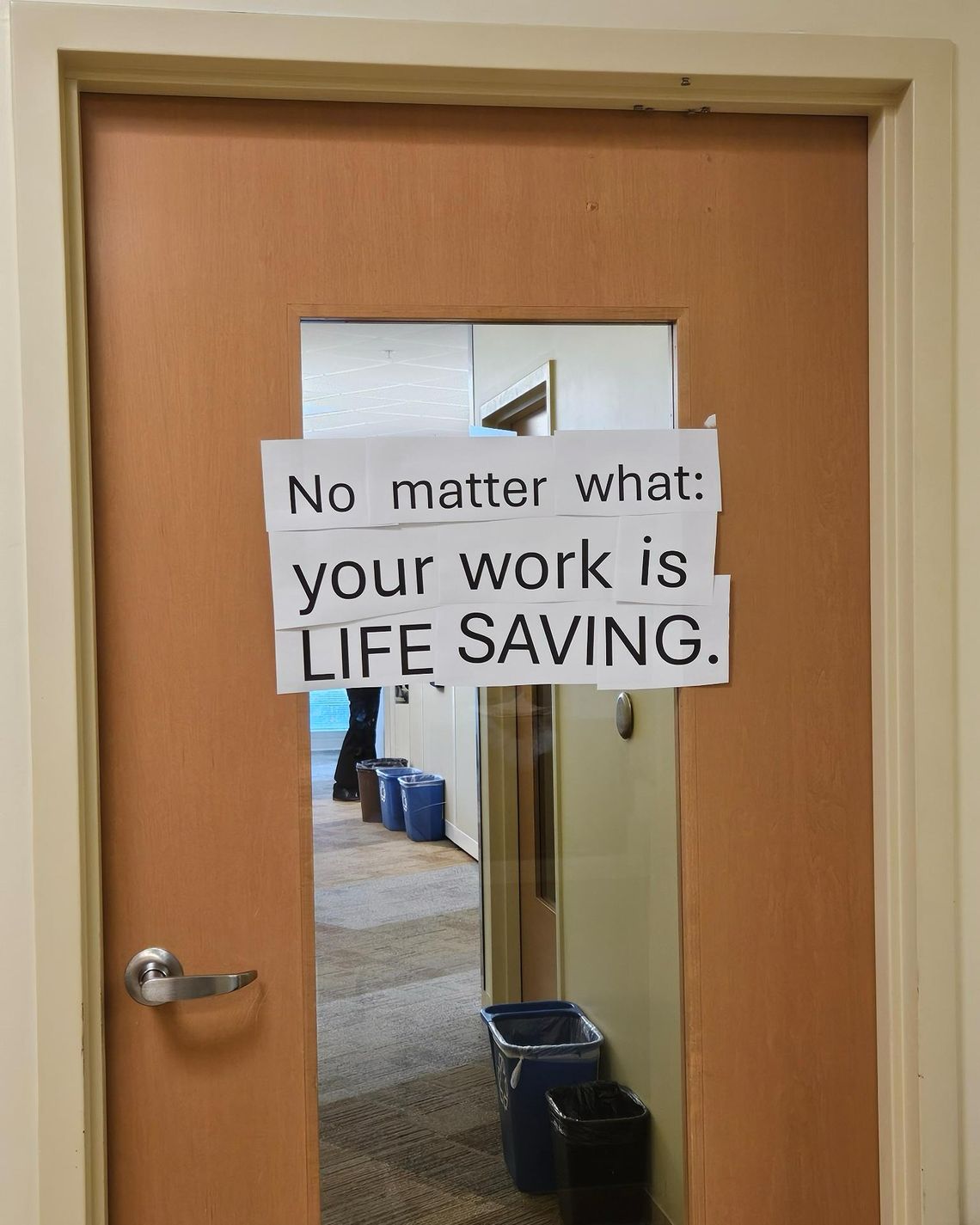
Photo: Courtesy of a former CDC employee
It was still possible in January to believe things would carry on as they had before. Many, if not most, Agency staff had already worked for a Trump administration. There was always a little friction at the beginning of a transition. Surely, thought an Infectious-Disease Specialist, reason would prevail. There will still be checks and balances. Maybe you’d have to be more careful with the vocabulary around contraception, but disagreement would remain constrained to different interpretations of the same sets of data. Perhaps Kennedy, a man who had called the Agency a cesspool of corruption and compared its vaccine work to child rape in the Catholic Church, would not be confirmed. “I don’t believe I ever compared the CDC to Nazi death camps,” he said during his Senate hearings. (This story was compiled from in-depth conversations with 16 current and former staffers. All are anonymized.)
The Agency lives in a sterile pocket of a verdant city, a series of gently curved, shimmering structures enclosing green space that was, in January, brown. Late that month, a rare Atlanta snowstorm blanketed the campus in white. The next day, the administration issued a communications freeze prohibiting almost all contact with the outside world unless specifically approved by a political appointee. This was a disruptive order for an agency of 15,000 people mostly charged with disbursing money and sharing expertise with outsiders. Full calendars were suddenly empty. A Maternal-HIV Specialist accustomed to receiving a hundred emails a day reported receiving like four.
The Maternal-HIV Specialist was short and athletic and wore her dark hair invariably back, tied up with a black elastic. She was supposed to be participating in a meeting with 20 people from around the world. Of course she would not be able to go to the meeting, but would she be allowed to tell the hosts that she could not participate? How do you communicate that you cannot communicate? She had heard that if you emailed WHO or UNICEF in particular, that could be used against you. A COVID Specialist had a presentation in which WHO guidance was mentioned. Was that allowed? Did that slide need to be deleted? Yes, some people said. No, said others. For the first time in more than 60 years, the Morbidity and Mortality Weekly Report did not go out.
The Infectious-Disease Specialist was a Japanese American woman with a warm smile and ready laugh, always in a dress. When the order came to bring everyone back to work, she thought, At least I can wear all my dresses again. She was in charge of the testing required for all incoming immigrants. She could not respond to emails from doctors across the world asking for clarity about medical tests required of those immigrants. The answers kept changing. Could they give a training to help foreign doctors administer the relevant tests? Yes, you can. No, you can’t. Yes, you can.
The Maternal-HIV Specialist had lived all over the world, many places in Africa. On the Doctors Without Borders application, there had been a question: “How would you feel if you woke up in a totally different place than you had gone to sleep?” She thought she would be pretty much fine with this. She would think, Huh. What happened. Sometimes she thought she should try to worry more about her safety as a woman. She thought people were basically good.
It was during the communications freeze that the staff learned about an executive order: “DEFENDING WOMEN FROM GENDER IDEOLOGY EXTREMISM AND RESTORING BIOLOGICAL TRUTH TO THE FEDERAL GOVERNMENT.” Once, as a doctor in South Sudan, the Maternal-HIV Specialist had siphoned diesel from a drum into a generator by sucking on a small tube. At the Agency, she spent hour after hour, day after day, pressing CONTROL-F through documents, replacing gender with sex. She CONTROLLED-F as she ate oatmeal at her desk, and she CONTROLLED-F as she waited for water to boil. Studies, information pages, FAQs. There were people on her team who did this with her; there were others, it was understood, who would not be able to handle it. What, she wondered, was her team supposed to do about the term gender-based violence? The word transgender would seem to be forbidden; what was to be done with HIV data explicitly collected on trans populations? Data on nonbinary and trans people was simply stripped out, as if it had never been collected.
Supervisors were told that everyone would have to go through their performance plans and delete words such as diversity. The Maternal-HIV Specialist told her team of 20 people to do this. Is this legal? they asked. Should we be doing this? Shouldn’t we refuse? The Maternal-HIV Specialist didn’t know what to say. Should they be doing this? Was it now her job to defend it? I’ll continue to share your concerns with our division, she told her team.
There were forms that gave options such as MALE, FEMALE, PREFER NOT TO ANSWER. Was that allowed? an Epidemiologist asked her supervisor, who had to ask someone else. Rarely were there answers, but there were this time: That was not allowed. What about data in which the gender had not been noted, data that read unknown? This was not allowed either. The Epidemiologist went home to her blonde shepherd mix who was there waiting for her every evening by the door. Her dog, and dogs in general, would become very important to her in this period of her life.
The communications freeze technically ended, but the ambiguity did not. Could they travel? Could they present at conferences for which they had been preparing for months? Public-health officials from Texas were beginning to ask questions about a measles outbreak. Measles persists in the air for two hours after an infected person walks away, but if clinics were unable to wait two hours between patients, was there some way to decontaminate? They were having no luck getting through. Millions of dollars that might otherwise have gone to Texas were tied up. The Agency, said the head of a local nonprofit, had gone dark.
While the word gender was clearly prohibited, the teams, thousands of people, were mostly left to themselves to decide which terms were prohibited by the executive order DEFENDING WOMEN FROM GENDER IDEOLOGY EXTREMISM. The Maternal-HIV Specialist kept a list on her desk in red pen: pregnant people, DEI, equity, diversity. She wrote inclusion, but then she crossed it out. It was important, she thought, not to overcomply. What about documents saved on their computers? Did those also have to be changed? Many, many, many meetings were held on the subject of vocabulary acceptable to the administration. Questions were sent up the chain to the Chief Medical Officer.
The Chief Medical Officer is a 53-year-old, five-foot-one physician who gives, in an endearing way, the impression that she is just barely tolerating you. I am who I am, she says. I’m not a yes-person. Her hair is bristle-straight, black shot through with white, cut clean at the shoulders. Building 21, where she worked, was 12 stories of blast-resistant glass, and her office was located on the top floor, where she was the only nonadministrative staffer not appointed by the administration, a lone scientist surrounded by politicals.
It wasn’t clear to her whom she should even ask the questions coming from her staff. Policy? Comms? Chief of staff? She sent three pages of questions to Washington several times. Mostly, there was no response.
Once, the Maternal-HIV Specialist had been on a work retreat with others from the Agency. They’d taken a personality test. Many of the people around her were told they had cool-blue energy. People with cool-blue energy are detail focused, precise, cautious. Cool-Blue Types may struggle with ambiguity. Cool-Blue Types may struggle with fast-paced change.
In those early months, people brought treats to the office: doughnuts, muffins, cookies. We’ll get through this. Let’s take a walk. It was in late January that everyone on staff received an email with the subject heading “A Fork in the Road.” Employees who wished to resign, the email said, should type “Resign” in the body of a reply email. Also they should “hit send.” A Substance-Abuse-Prevention Specialist recalled the many, many digital-hygiene trainings she had been required to take. She looked at the email address: unfamiliar. She hit SPAM. The widespread assumption that the deferred-resignation program was actually a phishing scam was presumably why, two days later, the administration sent them an email stating that the program was “valid” and “lawful.”
The day after Valentine’s Day, the Substance-Abuse-Prevention Specialist received, along with around 1,300 of her colleagues, 10 percent of the workforce, an email. “You are not fit for continued employment,” the email said, and “your performance has not been adequate” to justify continuing at the Agency. The Substance-Abuse-Prevention Specialist sent, in response, her performance review from the previous year, which had been so glowing she received a cash award.
Senior staffers were asked to rank their probationary employees from most to least necessary. A data person known in the office as the Spreadsheet Queen was not in charge of anyone, but she felt that those who were should not do this. It was true that they might lose their jobs if they refused, but what would happen if they complied with every demand? The Spreadsheet Queen was a slim mom in her early 40s, often in a thrifted tee and jeans, and she was not as surprised as many of her colleagues at what was happening because she had noted some warning signs. She had read Project 2025, which called the Agency “perhaps the most incompetent and arrogant agency in the federal government,” accused it of wanting “to force on children” the “experimental COVID mRNA vaccine,” and suggested it be put to better use as a kind of surveillance machine monitoring “abortion tourism” across states. At a 40th-birthday party for a friend, everyone was asked to give a short presentation about something they were passionate about. Someone talked about the dozens of romance novels she had read that year. Another spoke on her favorite podcasts. The Spreadsheet Queen presented on “fighting fascism.” The senior officials went ahead and ranked their employees.
By February, norms had changed. Amid widespread fear of putting anything in writing, official communication was kept to a minimum. Any email, it turned out, could be a meeting. A thousand Signal chats bloomed. Six-year-old Kayley Fehr contracted a rash, as did all four of her siblings, though her siblings got better as her fever rose. Her mouth filled with sores so tender she could not eat. She was struggling to breathe. She stopped talking. She died sedated at the hospital in Lubbock, and her parents said they’d made the right choice not to vaccinate against measles.
The enduring mystery of what the Agency actually did only deepened when one consulted Agency staffers, who would tell you that the Agency saves lives and protects the public health, answers so vague as to be at best meaningless and at worst generative of skepticism. The Agency, they would say, just issues recommendations, the implication being that it was a benign, powerless adviser, but quack capture of the Agency was disastrous because the Agency did, indirectly, end up determining which vaccines are covered by insurance, a role of great consequence and authority. The Agency was a messy, slow, siloed bureaucracy. It was also the primary source of American knowledge about its constituent bodies. When Kennedy monologued unsteadily about the rise of chronic disease, it was the Agency’s data to which he referred. It was a vast locus of knowledge, centuries of expertise, carefully cultured connective tissue between hyperlocal officials dealing with emergencies and scientists with data on how to best respond. It was the agency to which providers turned when their knowledge hit a limit: What is the appropriate post-exposure prophylaxis for someone whose relative has been diagnosed with hepatitis A? It was where the expert on Candida auris, a drug-resistant fungus, waited to be called upon for questions about C. auris. It was the agency tasked with analyzing E. coli in walnuts, listeria in Camembert, and salmonella in pistachio cream.
Kennedy’s confirmation was made difficult by the resistance of a gastroenterologist Republican senator from Louisiana inconveniently familiar with the benefits of vaccination. Kennedy assured the senator he would not change the Advisory Committee on Immunization Practices, which issues recommendations on the vaccine schedule, and the senator chose to believe him. The nation’s most prominent anti-vaccine activist was confirmed to the position of secretary of Health and Human Services on February 13. “I’m going to keep asking questions but hold my preconceived answers lightly. I’m willing to be wrong,” he said in an address to the Agency. Many people chose to believe him. If you don’t believe him, thought Vaccine Guy, you can’t do your job.
It wasn’t until Vaccine Guy saw Kennedy talking about bird flu on cable news that he understood where things were headed. Kennedy advocated “letting it run through the flock” so we can “preserve the birds that are immune to it.” This prescription, which almost no veterinarians or epidemiologists agree with and at least one called a “huge biosecurity risk,” amounted, in Vaccine Guy’s mind, to this: Cull the weak.
The Infectious-Disease Specialist noticed that her job was changing. Once, she had fielded questions from all over the world about testing requirements for refugees and other immigrants. But now the refugee-testing questions were all from one place, regarding one type of person: white South Africans. She cried in front of her team, at meetings, thinking of the refugees who would not be admitted. She lay awake at night, unable to sleep.
The Maternal-HIV Specialist began reading a book called On Tyranny. “Do not obey in advance,” the book said. “Defend institutions.” A team leader on her way back from a meeting found two men leaving her office. Both were wearing Tesla T-shirts. “We came to update your computer,” one said. Every week now, employees were supposed to send DOGE a list of five things they’d accomplished. “Complied fully and faithfully with my oath of office,” wrote the Spreadsheet Queen. She began checking her office for bugs: above the light fixtures, underneath her desk. Was DOGE in the office right now? People were afraid to leave before five; what if DOGE had agents here, watching? In a women’s bathroom, people began posting sticky notes: IT’S OKAY TO NOT BE OKAY FOR A WHILE! And: JUST BREATHE! And: TAKE CARE OF YOU!
In March, geese returned to the pond in the middle of campus, 50 of them, grown birds and later their goslings, splashing in the water and poking through gardens beginning to bud. The Canadian Invasion, staffers called it. They ate lunch on blankets outside and took walks on the manicured paths in the shadows of the large buildings.
People who worked on vaccines were surprised to still have their jobs. Are they just keeping us around to fully control us? thought the COVID Specialist. One branch of the vaccine-related departments had been cut, but everyone knew why that was: The branch title had the word equity in it.
The Chief Medical Officer was not a yes-person, but she was an ER doctor. She knew how to handle stress, triage, come back fresh in the morning. People in the office sometimes wondered if she were human; how could she simply soldier on amid all of it, very often the only scientist in the room? One way she dealt with it was by planning for the end. She cleared out her drawers but kept her pictures on the wall. She kept two canvas bags in her office for the day she would walk out.
The Maternal-HIV Specialist worked on mother-to-child transmission, the kind of PEPFAR-aligned mission that Republicans traditionally cared about, and therefore did not expect to be fired. At 5:30 a.m. on April 1, after she got her bike helmet out and her bag ready to cycle to work, she got a text from a colleague. They’d all been terminated. “Stop working immediately,” the email said. She was allowed to come to the office and retrieve her Diet Coke and oatmeal and workout clothes.
An additional 20 percent of the Agency was gone, but for a while, no one knew which parts. No announcements were made. No supervisors were informed. Finally someone rolled giant dry-erase boards into the library on the first floor of the building. *PLEASE DO NOT ERASE* someone scrawled up top, and then, as staffers came to know who had been cut through informal channels, they kept notes.
Division of Viral Hepatitis
Division of STD Prevention
Scientific Integrity Branch
Freedom of Information Act Office
And on and on. On the 12th floor of Building 21, the Chief Medical Officer, in full ER-doctor mode, held a meeting with 30 people around a horseshoe table to decide how they would adjust to the cuts. The number of people laid off remains unclear even today, but some of them were directors who reported directly to her. She appointed acting directors. She determined who would deal with the labs that would have to be shut down, who would handle the samples, the animals. We lost our reproductive-health experts in dengue response, she told the group. Who will step up? For two hours, she went over every center and office in the department. She thanked everyone for their time and then the Chief Medical Officer was surprised to find herself crying, there before 30 people. I’m sorry this is happening to our agency, she said through tears. I don’t know why I’m still here.
People who had been separated, as it was called, had questions: How long will my insurance last? Where are my retirement benefits? Where do I turn in my computer? But half of the human-resources staff had been placed on administrative leave. They’re destroying the infrastructure of the Agency, thought someone who had been there 25 years but, as of April 1, would be there no more. In order to get cancer treatment for her husband, a recently separated staffer needed a piece of paper stating that she had temporary continuing insurance coverage from the Agency. She could get no one to answer her emails about this.
The hospital in Lubbock was now treating children with both measles and toxicity from excessive amounts of vitamin A. Daisy Hildebrand had been a healthy blonde round-faced 8-year-old girl in red eyeglasses. The world found out about her death on April 5. Local authorities had intended to wait until the following week before telling the public, in deference to the family, so her funeral could be held in peace. But news of the death was leaked. Specifically the news was leaked on X by a white-bearded biochemist the New York Times has called a “COVID misinformation star.” The biochemist linked to his Substack essay arguing that Daisy Hildebrand had not died of measles but of something else entirely.
In March, the president nominated a middle-aged microbiologist to lead the Agency, a woman who lacked, unlike nearly every director who had preceded her since the founding of the Agency in 1946, a medical degree. The Political Appointee was a slight, white-haired woman given to platitudes. She liked to call everyone “dedicated” and declare things “critically important.” Many Democrats were opposed to her confirmation, which would take place months later; they assumed she would be a yes-person. Not opposed was the Chief Medical Officer, who would in theory work directly under her. At least she’s a scientist, she thought. It could be worse.
The COVID Specialist was a perfectionist, but she was working on it. She had had a very hard time when it was her turn to delete pregnant person from everything under her jurisdiction. She had needed a friend on the phone to talk her through it. She’d grown up all over the world, was instinctively upset by extreme inequality, and had chosen this work with the idea that it was her best way to fix something. Both she and Vaccine Guy had been involved in the slow, careful process of generating COVID guidance and studying the safety of the COVID vaccine in pregnancy. This was a multiyear, ongoing effort. Different sets of data, published and unpublished, were amassed and evaluated: Here’s good data, here’s less good data, there’s a potential for bias. Staffers generated a 50-page document explaining the recommendations for various groups and the rationalization for those recommendations.
In a meeting he was running on the 12th floor of Building 21, Vaccine Guy’s phone started vibrating so much he checked it while someone else was talking. “I didn’t know you guys were changing the children’s schedule,” read one text. Vaccine Guy didn’t know what that meant: The vaccine schedule had not changed. He gathered there was some video on X he needed to watch immediately; he excused himself from the meeting to watch the video in the hall. “I couldn’t be more pleased,” said Kennedy in his trembling voice, as if through an oscillating fan, “to announce that the COVID vaccine for healthy children and healthy pregnant women has been removed from the immunization schedule.” Vaccine Guy was astonished. Was this real? It was inconceivable that the schedule would change without anyone even consulting his staff.
After a pause, Vaccine Guy thought, Okay: He’s the secretary. He can make a directive even though it’s crazy. He began asking questions. Could he see the data on which the change was based? No, he could not. Could he have a directive in writing? No, the video was the directive. Generally speaking, he thought, we don’t update the national recommendations based on an unhinged video with poor grammar. He pushed. He needed something in writing. Finally, someone very young told him that there was a memo with recommendations and pages and pages of data.
We’ll take it, said Vaccine Guy.
When the email came, it was a two-page memo with no data. The memo, Vaccine Guy realized, did not match the video. The video said “healthy pregnant women.” The memo said “all pregnant women.”
Kennedy, it was clear, did not have cool-blue energy. He was unbothered by ambiguity, unworried about details, comfortable with fast change. The distinction between pregnant women and healthy pregnant women might have felt small to him but was extraordinarily meaningful to people who spent all day with COVID-related data.
The accumulation of evidence on the vaccine was among the COVID Specialist’s proudest and most important contributions to science. It was her opinion that this change would kill people. Babies under 6 months could be protected by the vaccine only in pregnancy. At home, she lost it. She was on the wooden floor of her living room crying. Her husband picked her up off the floor and held her.

Photo: Alyssa Pointer/Reuters
The infectious-disease Specialist noticed that her hair was falling out. She had lost weight. I don’t think I’ve formed a memory all year, a colleague told her. A researcher was told his work had “no chance” of ever making it out of the building. He had several papers about the social determinants of public health, which is to say, how physical location affects health outcomes. Your Zip Code is more important than your genetic code, people in his field liked to say. The papers were already written. He had spent years on them. It would be as if they had never existed.
In June, trees on campus were heavy with leaves and the heat hung thick in the air, the kind of mosquito-forward weather that illuminated the Agency’s origins in Atlanta as a response to the parasitic ravages of malaria. Staffers walked into the lobby and felt the cold blast of air-conditioning. Four months into his tenure, Kennedy had yet to visit the Agency he ran, but in June he fired every member of the Advisory Committee on Immunization Practices, the committee he had assured the senators at his confirmation hearing he would not touch, and replaced them with, among others, a nurse who said her son had contracted autism from a vaccine, a biostatistician dismissed by Harvard for refusing to be vaccinated against COVID, and the COVID-misinformation superstar who had doxed Daisy Hildebrand after she died of measles, which he said was not measles at all.
One day, the Chief Medical Officer pulled Vaccine Guy into her office. Let’s talk about what lines we won’t cross, she said. She had a draft resignation letter that she updated every two weeks. She believed it would help her to leave on her own terms. It would help her to be brave. She didn’t want to be in a situation, looking back, where she hadn’t said what needed to be said. You’re not going to make it to the end, she said. I’m not going to make it to the end. After Kennedy fired all of the vaccine experts, the Chief Medical Officer called the Political Appointee, who still was not confirmed. I don’t think I’m going to last until you are here, she said.
Please wait, said the Political Appointee. When I come, I will make changes. The Chief Medical Officer decided to believe her; she would wait.
The Agency had once been a fun place to work. People would pop into one another’s offices with questions. It was different now. There was a lot of crying. Like a dark cloak had fallen over us, the Infectious-Disease Specialist thought. People had stopped bringing doughnuts. So many offices were empty, colleagues terminated and resigned. Staffers stopped expecting their emails to be answered; you could not assume that the department you were emailing still existed.
Democrats grilled the Political Appointeeduring her confirmation hearing; she was evasive. Many things were “critically important.” Kennedy, she said, “laid out a very clear vision for making America healthier again,” and she could not think of a single reason to criticize him. She had, according to Kennedy, “unimpeachable scientific credentials.” He had “full confidence in her.” Every single Democrat voted “no.” She started in her role July 31.
A week later, the Epidemiologist who loved dogs heard a dull, repetitive, echoing sound. It’s construction, said someone who saw her staring out the floor-to-ceiling windows in the hall. They were high up in the building, with a broad view of the street below. There was a day care at street level where staffers sent their kids, and the Epidemiologist was accustomed to hearing the sounds of kids playing during the day. On a Friday afternoon? asked the Epidemiologist. Her face was right next to the glass. They heard it again: Bang. Bang. Bang. When she looked back down toward the street, she saw someone with a toddler under each arm running into the day care. She heard glass breaking.
She ran to the other side of the building. There were about 20 people on her floor at the time, and they dispersed into different offices. She and three staffers ran into one office and barricaded the door with a bookcase. They kept the lights off. Someone could be roaming the stairwell with a gun. The only window was a transom above the door; a rectangle of light fell on the wall.
The shooter was not roaming the halls with a gun, though he had apparently tried to walk into the Agency two days before. He was shooting from the second floor of a CVS across the street, a 30-year-old man in a surgical mask carrying two handguns, a rifle, and a shotgun, all liberated from his father’s gun safe. He believed intensely that he had been rendered mentally unwell by a COVID-19 vaccination and that the Agency was covering up evidence of the vaccine’s danger.
The Epidemiologist knew two of the people with whom she was barricaded; one person she had never met before. They whispered and stared at the light of their phones. It wasn’t that the Epidemiologist had thought this could never happen. She had definitely considered the possibility of a shooting at the Agency, because the Agency had been a workplace for hundreds of recently fired, disgruntled employees. Perhaps it was one of them.
“I love you guys,” the Epidemiologist texted her mom and husband. The person she didn’t know had a teenage daughter at home alone and wondered aloud what to tell her daughter without worrying her.
From the second floor of the CVS, the man who believed he had been injured by a vaccine fired round after round over the day care, through the glass of the Agency buildings. A 33-year-old police officer pulled up; the shooter killed him, tried to exit the CVS, found he was locked inside, and shot himself.
It was still light outside an hour after the Epidemiologist had locked herself in the office. She decided it was safe to open the door and walk back over to the window in the hallway, the one she’d been right up against. There were three round holes in the glass, from which small cracks spread outward all the way to the edge of the window. On the carpet she stepped over a piece of gnarled metal; a bullet fragment.
The shooting occurred on August 8. On August 9 at 10:30 a.m. Kennedy posted on X. “Fishing the Kenae,” he wrote, referring to the Kenai River in Alaska. Among the pictures he posted was one of himself holding three giant shimmering fish, their mouths agape, Kennedy’s legs calf-deep in the river.
The following Monday, the Chief Medical Officer met her boss for the first time. She would remember this meeting chiefly as short. Secretary Kennedy looked at some shattered glass, thanked some police officers, and left. The Spreadsheet Queen saw him arrive at campus, and she saw him leave the campus less than two hours later. There was a makeshift memorial for the police officer piled high with flowers, and she watched him be driven past it. This moment, watching Kennedy slide right past the memorial without stopping, would stay with the Spreadsheet Queen. She still had the capacity, it turned out, to be shocked. No one is coming to help us, she thought. The Infectious-Disease Specialist resigned, afraid for her life and that of her child. When Vaccine Guy returned to work his office was covered in fine glass dust, like glitter. There was a bullet hole high in the window.

Photo: Courtesy of a former CDC employee
What, after all, are two dead kids? In 2023 in the U.S., some 2,500 children died from guns, 700 from drowning, 1,000 from cars. To the anti-vaxxer, the focus on Kayley and Daisy was hysterical overreaction, but the difference was this: No one had died of measles in this country since 2015. We had not solved guns or drowning or cars; we had solved measles.
According to the Political Appointee, Kennedy told her that the Agency was filled with horrible people who were killing children. He told her to fire staffers until she achieved total compliance with his demands and to preapprove whatever recommendations his unconventional ACIP picks came up with. The Political Appointee forwarded the Chief Medical Officer an email showing a new procedure wherein the Appointee needed approval to make any policy or staffing change.
Well, that’s not gonna fucking work, the Chief Medical Officer told her over the phone. You’ve been cut out.
According to the Political Appointee, Kennedy told her to accede to his demands or resign. She would not do either. The White House fired her on August 27. Kennedy no longer believed she was supremely qualified; in fact, she was untrustworthy. Democrats apologized to her; she had not, in fact, been a yes-person.
The Chief Medical Officer had waited for change, and it had not come. She pulled up the resignation letter she had written. Vaccine Guy pulled up the resignation letter she had advised him to have ready. They got on the phone and took a vote: Was it time? Vaccine Guy would be able, thanks to the Chief Medical Officer, to say precisely what he wanted at the moment he felt it necessary. He was resigning, he wrote, because he believed the changes at the Agency would lead to suffering and death.
“The recent shooting … is not,” his letter read, “why I am resigning. My grandfather, who I am named after, stood up to fascist forces in Greece and lost his life doing so. I am resigning to make him and his legacy proud. I am resigning because of the cowardice of a leader that cannot admit that HIS and his minions’ words over decades created an environment where violence like this can occur. I reject his and his colleagues’ thoughts and prayers, and advise they direct those to people that they have not actively harmed.” Packing up his office, he brushed broken glass off some trophies. His index finger bloomed red with blood.
The Spreadsheet Queen read about the resignations on a Signal chat. She read, too, that there would be a rally for Vaccine Guy and the Chief Medical Officer as they walked out of the building. She told others about it; Come to the rally. When she got there, it was the largest rally she had ever seen at the Agency, hundreds of her colleagues lining the streets, holding signs: SCIENCE NOT CONSPIRACIES and YOU ARE HEROES. The Chief Medical Officer and Vaccine Guy held bouquets of flowers, hugged colleagues, and gave speeches later played on the news. This was it: the kind of thing that mattered, that drew attention, that was the opposite of ranking your employees for the benefit of someone who wanted to fire them.
Vaccine Guy advised Americans not to trust the Agency. Trying to Humpty Dumpty it is not going to be the way, he said. It has been infiltrated. The whole thing is falling down. We have to let them throw the grenade in and start from the ground up.
When the Epidemiologist went to work in September, she walked by windows covered in brown paper to mask bullet holes. To use the bathroom she walked by an X scrawled in red marker on the white wall; that was how the cops had let one another know they’d cleared the room. The Epidemiologist had meetings on her calendar that wouldn’t happen because the people they were with had been fired, but she could not remove the meetings from the calendar because the person who had put them there was no longer employed. She was volunteering at a dog shelter to deal with anxiety from the shooting.
In September, there were reports of C. auris in Kansas, but the Agency’s contract with the C. auris expert had expired. There was an outbreak of botulism in infant formula, and in another era the Agency’s scientists would have been on television issuing warnings, but they were not allowed to interact directly with the media. There was an HIV outbreak in Maine, and the state asked for a team, but no team was sent. Staff were ordered to change all references of mpox to monkeypox, and no one could come up with any real justification for this beyond forcing them to do something they considered racist.
“We want the bureaucrats to be traumatically affected,” a top administration official said in a speech a few years ago. “When they wake up in the morning, we want them to not want to go to work because they are increasingly viewed as the villains.”
In October, some 1,300 more people were terminated, but then around 700 were told their termination had been a coding error and invited back to work. It’s like being in an emotionally abusive relationship, the Spreadsheet Queen told her friends. First they tell you you’re worthless. And then they start harassing you about little things, like with the five bullet points. And now you can’t communicate out. And you can’t work. And then you’re shot at, which seems like the height of it, but it’s not. And then he breaks up with you but realizes actually he wants you back.
Measles flourished in Utah and New Mexico, and scientists continued to gain new knowledge about a disease with us since at least the 12th century. Among the most recent discoveries is this: The measles virus, alone among known pathogens, results in “immunologic amnesia,” wiping away as with a memory the host’s hard-won ability to fight other diseases — flu, COVID, strep, anything. Measles dismantles in a few weeks what has been built over a lifetime of vaccination and exposure. What has been learned in the past will not carry forward into the future. When the old threats reassert themselves, the ailing body will have to start from scratch.
From Intelligencer - Daily News, Politics, Business, and Tech via this RSS feed
You must log in or # to comment.