

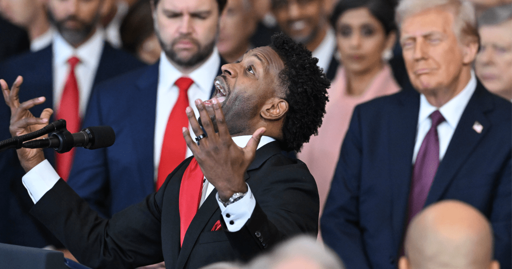
Detroit pastor Lorenzo Sewell is one of the most prominent Black conservatives in President Donald Trump’s orbit. It all started last summer when the president visited Sewell’s 180 Church while campaigning in Detroit. A month later, Sewell spoke at the Republican National Convention. And in January, he prayed for the new president during his inauguration inside the US Capitol. As Sewell’s voice echoed around the domed rotunda, the prayer sounded familiar to many. That’s because Sewell adapted Martin Luther King Jr.’s famous “I Have a Dream” speech.
As Trump dismantles DEI policies around the country and pushes efforts to erase Black history from schools and museums, Sewell remains one of the president’s most prominent Black defenders and argues that the Trump presidency is actually improving Black Americans’ lives.
&Subscribe to Mother Jones podcasts on Apple Podcasts or your favorite podcast app.
“I believe that racism is when you close the door of opportunity to people because of their skin color, intentionally or unintentionally,” Sewell says. “And I believe President Trump is a anti-racist because he opened the door of opportunity to somebody like me, in a context where nobody would vote for him.”
On this week’s More To The Story, Sewell sits down with host Al Letson to talk about his upbringing as a drug dealer in Detroit, his conversion to Christianity, and his inauguration prayer. Letson challenges Sewell’s ideas about racism, his support of Charlie Kirk, and his defense of the Trump administration’s rollback of DEI policies.
This following interview was edited for length and clarity. More To The Story transcripts are produced by a third-party transcription service and may contain errors.
Al Letson: Pastor Sewell, how are you doing today?
Pastor Lorenzo Sewell: Man, I’m so Holy Ghost happy to be with you, my brother. I’m excited to be with your audience, believing that we’re going to have a great time today.
So you were born and raised in Detroit. What was it like, growing up in the city?
I was born and raised on the east side of Detroit. My dad told me that he murdered a man at 11 years old. I was on the corner of Kilbourne and Queen. I was in my first drive-by. I was raised in an era where the Best Friends gang, of Maserati Rick and White Boy Rick, and he had this gang that the FBI said was one of the murderous gangs in the history of America.
I remember when, the first time I got into a fight, and my friends wanted me to go and get a gun to shoot somebody. I remember those days. I remember when my uncle got addicted to crack. I remember when the house across the street from me was burnt up in a gang rival. I remember looting stores as a kid. I remember walking down to go to middle school, and as soon as you crossed Six Mile, you got into a fight with the Six Mile Boys, right?
So I remember seeing friends get a nice pair of shoes, and then people pull up in cars, and take their shoes and their coats from them. And I grew up in that. I grew up seeing dogs fight, right? I mean, I grew up seeing pit bulls fight for money.
And in the midst of that context and culture, my mother moved us out of Detroit. And I was a part of what we call the second Great Migration, of black people moving away from each other. And I tell you, man, I’m here now on the west side, this is where my church is. Detroit, man, has been, and it is, right now, a very complex place.
We are a culture of crime, because we are entrenched in poverty. And I tell you, man, it’s tough, because if you travel just, I mean, 20 minutes away from here, you are in one of the most affluent areas in our country.
You start talking about Bloomfield and Birmingham, and you literally see the stark contrast. And even if you go from the east side, where I grew up, and you go right next door to Grosse Pointe, you see some of the greatest wealth in our country right there in Henry Ford’s, right? See the Ford family. So that’s what it’s like growing up in Detroit, man.
It’s really, really, it’s tough, man, because as I sit here today, man, if you go outside of my church and walk down the street, you don’t know, man. You might get robbed, just because people are dealing with mental illness, and that’s what we’re dealing with.
Talk me through the moment when, because I’ve saw some interviews with you, and as you’ve put it before, in your youth, you were a street pharmacist.
Yes, sir.
And so, what was your … Because I’m always interested in this moment, where someone has that road to Damascus moment, when everything changes, like your eyes kind of open up, and it begins, whether it is a quick change, or it’s the straw that broke the back of whatever lifestyle you were in, and you begin to shift. Tell me about that moment.
Yeah, I was in a situation where my older sister, she was actually in a domestic violence relationship, and I was a street pharmacist, I was a drug guy. One of the reasons why I sold drugs, it wasn’t necessarily because I needed money, because my mother worked hard.
I sold drugs because I was looking for a surrogate father. I was looking for a male figure in my life to affirm me, to tell me, “Good job,” even if I was doing bad things. And that was my supplier.
And I did it well. And I made a lot of money. And I was in Daytona Beach, man. I’ll never forget this day. I was in Daytona Beach. I was cutting myself, because I was on acid and ‘shrooms, and I was high, drunk, and a security guard came over to me, and he said, “Can I pray for you?
And I remember in that moment feeling like, number one, I was offended. Number two, “Who do you think you are?” Number three, “Don’t you see what I have?” Right? “I have this party, I have this resort, I got the females here, who do you think you are to say pray for me?”
And he was like, “No, I’m not trying to offend you, man. Can I pray for you?” And I remember in that moment, when he prayed for me, I remember in that moment I experienced then, what I know now, is the conviction. I was convicted that stealing drugs was wrong. I went back to the only church I knew of.
It was my grandmother’s church. Actually, it’s right down the street from where my church is right now. I’m in my church right at my church office, right down the street. So I went there, and I’ll never forget this. It was April 18, 1999. I’ll never forget this moment.
I’m trying to reconcile. Is Jesus really who he says he is? Is Jesus really God? Is God real? I can’t say that I was an anti-Christ person. I would just say that I had not known the God of the Bible. I mean, the only thing I knew about Bible paper is, I smoked weed out of it when I didn’t have any blunts left over. That’s the only thing I knew about the Bible. You see what I’m saying? That’s it.
Yeah. Yeah, yeah, yeah.
So Bishop Merritt says, “Does anybody want to give their heart to the Lord?” And man, I walked down that aisle. And when I walked down that aisle, I was crying, and Bishop gave me the microphone. I mean, there’s thousands of people, man. I mean, the place is packed. And he says, “Why are you crying?” I said, “I love Jesus.”
I got baptized that same day. I went to the only guy that I thought could take my life. I thought he could kill me. I thought he had the ability to literally destroy me, the guy who I sold drugs for. And I gave him all the money, I gave him all the drugs, and I said, “I’m done.”
And he’s like, “What do you mean? Are the cops on to you? Are you sick?” I said, “No, I gave my life to Jesus.” And in that moment, I stood up, I went to walk out of the apartment, and he said, “Zo.”
And I turned around, and he said, “I respect you. ” And it was at that moment that I knew that God of the Bible was real. I went to school the next day, people thought I took a bad hit of acid.
I mean, my homeboys were coming up to me like, “Come on, man. You going to come down, man. Go drink some water,” type of thing. I mean, literally. They were like, “Man, you need to drink some water. You’ll be fine.” So I just started preaching, man.
I started getting into the Bible, I started preaching, and I preached my first sermon a year later, when I was 19. I pastored my first church when I was 21, and became the pastor of an all white, multi-site, multimillion dollar church. I became the first Black campus pastor, someone would say like a franchise pastor type of thing, where we had a main church, and we had other churches around, and I was the first Black pastor there.
And it was funny, because God set me up, man, because my mother never told me I was Black. I never grew up in a context where people were like, “Oh, you’re Black, so you’re this. Oh, you’re black, so you’re that.” I never grew up in that context.
All my friends were white, my girlfriends were white, and my mother never sat down with me, and had the talk, right? My mother was never like, “You’re Black. “I mean, I didn’t know I was Black, until I was 17 years old, when my best friend-
Hold on, hold on, hold on, hold on. We got to unpack that. We got to unpack that.
Yes, sir.
Because you are a Black man, living in Detroit …
Yes, sir.
Which is one of the blackest cities that I’ve ever been to. And you’re saying, you did not reflect on the fact that you were Black in that city, until you were 17?
It wasn’t until I was 17 that my best friend came out of the house and said, “We can’t be friends anymore,” with tears in his eyes, man, crying. I mean, we were tough guys, drug dealers, tough guys. No, we worked out all the time.
I mean, he’s like, “Look, man, we can’t be friends anymore, because my grandmother said, because you’re Black.” And that was the moment that I understood why all my girlfriends would say,” We can be boyfriend and girlfriend in school, but you can never come to my house.”
I understood that when we played basketball, my friends, I can never go into their homes. So until President Trump came to my church, which, I didn’t invite him to come. I voted Republican my whole life. I never looked at it as a Black thing or as a white thing.
Some of my best friends are … Well, every city I’ve ever served in has been all Democrat, and it is what it is, but I’ve always been conservative, always vote Republican. I never looked at it as a Black white thing.
And one of my best friends who actually was involved in politics, I asked him one time, I just asked him out of curiosity.
I thought maybe he could enlighten me, I thought maybe he could teach me, in terms of politics. I said, “Why are you a Democrat? “And he said, “Because I’m Black.” And I thought to myself, I did not understand that.
So when President Trump came, I did not understand how many people expected a Black man to be Democrat. I had no idea until he came because my church was threatened to be blown up.
People called me, said, “They’re going to kill my wife, kill my children.” One member of my church told me that his family was going to blow his house up. And it was all because there were Black radio personalities. I didn’t know who Joy Reed was. I had no idea who Roland Martin was.
If Roland Martin would have came up to me, and gave me a high five, I would’ve not known who he was. But as soon as he spoke against me, that’s when I started getting these threats. I started getting these phone calls. “You’re supposed to be a Black man, you’re supposed to be a Black man.” And I was like, “It’s a President.”
Two things. One is, that that behavior of, not the behavior of Joy Reed and Roland Martin, I didn’t see the clips, I can’t speak to that.
I’m talking about the behavior of you being specifically targeted, and all the vitriol. That is horrendous, and should not be … It’s not acceptable in any way, shape, form or fashion. I will say that it also happens from the right, as well.
Sure.
So it’s like, we are living in these times, where people are unhinged, people both left, right, or whatever.
Sure.
And there are people who like to start fires, because they just want to watch the world burn, right?
Sure.
That’s from Batman, I got to be honest, so …
[inaudible 00:13:18].
But yeah, there are people who start fires, because they just want to watch the world burn, and that’s what it is. So then, it becomes this thing, and that’s the political mess we’re in right now.
And this is the part that, just from a pure logical perspective, if you and I disagree with something, my job is to listen, listen to your perspective. Hopefully, if I’m a good debater, I can articulate your perspective better than you could, and then, let me give you my perspective.
So, from the political perspective, it has become so foreign to me, that you and I could have different points of view politically, but that means you want to fight me, like we going to fight because of that?
Yeah.
That’s crazy. That, to me, is unbelievable, that we live in a context, and I’m going to bring up Charlie Kirk. I have intimate knowledge of Charlie, because he had me on the show, he had me speak at a lot of his events. And do I believe that Charlie Kirk was a racist? No. And let me tell you why.
Because racism means closing the door of opportunities to people because of their skin color. I see Charlie Kirk opening up opportunities to people like me, giving me platforms. If he was-
Hold on, hold on. Let me respond to that.
Yeah? Yup.
Let me respond to that.
Yup.
Respectfully, respectfully, I think that Charlie Kirk saw you as useful.
Help me.
I think that when Charlie Kirk saw Black people that he did not think were useful, he spoke about them in racist manners. And so, just because a racist is nice to a single Black person, or a few Black people, because he’s nice to you, because he’s nice to Candace Owens, does not absolve him of his racist ideology. It just means that he understands that you and him think somewhat alike, and so therefore, he’s going to give you a platform because you are reinforcing him.
And if you are on that platform, then he can say, “Look, I’m not racist. I had Reverend Sewell on. “
Sure.
But when it’s a Black person that disagrees with him, then suddenly, they’re not qualified. The Bible says, “What you do to the least of my people is what you’re doing to me.” So if he is dogging people that are Black, specifically, and calling it out, because they are Black, that’s racist behavior. And we cannot whitewash that.
Sure. So let me say this, and this is what I do my best to try to articulate, and I do my best to try to live out. I don’t care if people don’t like Black people. I don’t care if anybody doesn’t like me because I’m Black. Let me tell you why.
We have the power. Black people, we cannot put a President in an office. We cannot put a gubernatorial candidate in our office. There’s just not enough of us. But guess what we can do? Unlike anybody else in this country, we can propel people.
Here’s the thing about what you’re saying is, I hear you. I would say that it does matter, in the sense of, that those individuals who may not like you because you’re Black are a part of systems, and they can direct systems. And systems constantly, constantly are the way that … That’s the textbook definition of racism, is that the system is stopping you from doing things.
Donald Trump is in charge of a system. And while Charlie Kirk was not in charge of a system, he put a lot of influence on the system. So his influence on the system, if he has a racist point of view, that affects the system. For example, like Charlie Kirk was one of the people who was speaking a lot against DEI. DEI had nothing to do with people who were unqualified getting jobs. DEI was simply about opening up the field, and letting people who were qualified to get the jobs.
I grew up in a middle class house with a mother and a father. My dad was a Baptist preacher. I was surrounded by a Black community that loved and supported me, and pushed me up. I’d never had to deal with drugs, and all of that stuff. You did.
Sure.
And so, the way you had to come up was a much further reach than me. Much further reach than me.
Sure.
And it’s the same thing when we’re talking about the Black community and the white community, that the Black community is in this different place than the white community is, because of structural racism. And so we have to reach up even higher.
I just believe that structural racism is against ourselves. Let me give you an example. I’m in Detroit right now. Our budget is $3 billion. That budget gets captured, because of poor Black people’s taxes. It’s just the bottom line. That’s how we get our budget.
Sure.
These are people who are Black Americans, who have access to literally billions of dollars that they could give to Black contractors, Black entrepreneurs. They can give them to people who run Black businesses, and they refuse to. That’s racist, right?
That’s when I say, I don’t need a white person. There’s not one white person I need, because I’m in an all-Black city. And we have almost a thousand cities. There’s nobody else that has that. There is no other people group in America that can say, “I can go to almost 1,000 cities and they’re ran by Black people.”
What I’m saying is, “Where are the Black businessmen? We’re the black entrepreneurs? Where are the people in my community right now, that aren’t getting resources, not because of the white man? It’s the Black people that are in these positions, that are giving our tax dollars to white developers.” They’re doing that right now. And I call my city council on it all the time.
Listen, I think that those are … It’s a valid point you’re making. I don’t think it’s racism. I think that you’re talking about the way city government, and the structures that are around city government, and the people that are in power, I don’t know if I would call it racism, but I think it’s a valid point.
When we come back, Lorenzo tries to place blame on Democrats and argues that it’s the party’s fault, not Republicans, for why Black Americans are struggling.
When I look at the budgets of our Black cities, I see Black people not being given opportunities by the Democratic Party.
You said this earlier, that you’ve always identified as a Republican. What was it with the Republican message that captured you? Because, before you answer that, I would say that I grew up in a time where pretty much every Black family had one Republican uncle.
That Republican uncle was always talking about self-determination, free market, and that that’s how Black folks were going to get their freedom, that they were getting off the … I remember, because one of my uncles used to say this all the time, “Getting off the Democratic plantation, and we’re going to stand on our own two.” Is that kind of what drew you to it?
No, no. I mean, literally, I remember praying, man. It was my bishop, Bishop Merrick. I mean, he flat out asked me, I’ll never forget, it was 2000. And he said, did I vote? I didn’t vote, didn’t register to vote. I didn’t, but he asked me.
And when he asked me, he looked at me, and he said, “Do you understand what our people had to go through for you to have this right?” And I went right there, and I registered to vote, and I prayed. And this is the two things why I’ve always voted Republican. It had nothing to do with the previous points.
It’s two things. One is, because of abortion, and the second thing is because of the institution of traditional family. At that time in our culture, you saw this movement where, the Democratic Party, they were beginning to lift up the LGBTQ community in a way that I felt as a pastor.
I just felt as a pastor. It wasn’t even about a Republican thing. It wasn’t really that I voted for Republicans, as I was really voting against those two things. That’s really what it was. I-
So, so-
Yup.
So let me just clarify, because I don’t want to put words in your mouth, right? So you were voting against, one, abortion. You believe that a woman doesn’t have the right to choose, that when you get pregnant, there is a life, and therefore, it is your responsibility to see that life through.
Now, based on Jeremiah, so remember, it’s all Bible, right? I believe that God told Jeremiah, “I knew you in your mother’s womb.” So I’m about to vote. I’m literally about to vote. And that was the scripture I went through my mind.
And the second one was, “I made one man and one woman.” Wasn’t anything else. Wasn’t about a candidate. If you’d asked me, if I listened to a campaign thing, no, but I’ve always voted straight ticket Republican my whole life, up until President Trump came, and then, that’s another side.
I would say that, why those two things? Why abortion and LGBTQ? Because-
Hold on.
Hold on, hold on. Let me finish. Because the Bible talks way more, I mean, way more about taking care of the poor, and being good to your neighbor, and all of these things, talks about it way more than it ever talks about LGBTQ issues, and way more than it talks about abortion.
But when I hear people say that those are their two issues, I wonder about where all the other issues are, because those two issues are minor issues in the Bible, but there are other major issues.
Jesus talked about it is harder for a rich man to get into the kingdom of Heaven, than it is for a camel to go through the eye of a needle. That was his big thing. He went into the church, and the time that he got live, and knocked things down, and upturned tables, was because people were treating the church like a marketplace.
He was angry about that. He was literally going after capitalism in that moment, but nobody ever says anything about that. They want to talk about the two things in the Bible that he talked about the least.
Yeah. Then, that was my reasons for voting Republican. Now, since President Trump came to my church, the Lord has given us a political minister, a political mentor, that we have in the church. We do something called Souls to the Polls, every Friday and every Sunday since President Trump came to the church, which is almost 18 months.
It’s hard for me to wrap my head around the idea that President Trump is a moral man. In the middle of running for President the first time, an audio came out that President Trump was saying that he grabs women by their private parts. The way he talks about his opponents, it’s a very childish thing, like the name-calling and stuff, but I don’t believe that to be the language that a man of God uses.
And to be clear, Pastor, you don’t even use that language when you’re talking about the people that attack you. You didn’t make any kind of little comment about Joy Reed and Roland Martin. You talked about the effect of what they did, but you did not use that language, because …
Sure. Right.
And look, I am not the arbiter of who is godly, and who is not.
Sure.
God knows I am a sinner. But I would say that the way you conducted yourself in that moment told me that at the very least, you respect people. And I don’t believe Trump does.
Well, I’m not here to defend President Donald Trump. What I do know is, he is an anti-racist because he’s done more for me than any Black person I’ve ever known, period, outside of my mother. If it had not been for President Donald Trump, I would not be on this conversation with you right now. If it had not, it means it’s the truth.
That may or not be the truth. Let me tell you why it may or may not be the truth. There are plenty of people that I talk to, that had nothing to do with Trump. If you were doing something in the community-
I’m talking about me.
No, I’m saying if you were doing something in the community that you wanted to talk about, and you reached out, I would talk to you, because I talk to plenty of people.
But you are-
But here’s the thing. You reached out.
Yes, I did.
You reached out. But here’s the thing, that cannot be the standard for whether-
So, can I just-
No, hold on. Let me finish. Let me finish. That cannot be the standard for whether a person is racist or not. It’s the same thing that I was talking about-
It is the standard, sir.
No, it can’t be, because it is the standard about you as an individual. It does not mean that he does not look at Black people as they are less than. It means that he may see you as an exception. And I would say that you being giving a platform, thinking that that platform means that he is not racist, I think that that is totally wrong.
I think that if you watch what he has done in other places, and the way he talks about people, and the actions that he is taking, I think it’s pretty clear where he stands, and that he sees you as exceptional, and he also sees you as useful.
Yeah. So that’s where we disagree when it comes to what racism is. I believe racism is that if you shut the door of opportunity to people because of their skin color, intentionally or unintentionally, and I see that in the Book of Acts. And when I look in the Book of Acts, I see that the Jews, they did not want everybody else to know about the God of Israel, right?
And then, what happens? They get filled with the Spirit. Everybody hears the gospel in their own language, and we see the door of opportunity open for Greeks. We see that in Acts, Chapter Number Four, open to Greeks. We see in Acts, Chapter Number Six, it was also open to Hellenistic Jews. We see to Acts, Chapter Number Eight, it was open to an Ethiopian man, right? He was baptized. We see Acts, Chapter Number 10, it was open to Italians, to the Greeks there, with Cornelius and Peter.
So I believe that racism is when you close the door of opportunity to people because of their skin color, intentionally or unintentionally, or anti-racism. And I believe President Trump is an anti-racist, because he opened the door of opportunity to somebody like me, in a context where nobody would vote for him.
He opened the door of opportunity for you, you, but he shut the door of opportunity for many other people of color, specifically, we can go in and … Hold on, hold on, hold on. I’ll let you speak. I let you speak.
Okay, okay, okay. [inaudible 00:29:19].
Let me continue, let me continue.
Okay.
Brother, we got to get lunch one day, and just sit across from each other and ask you that.
Yes, sir. Yes, sir.
But I would say that he has closed the door of opportunity when he shut down all the DEI programs, when he villainizes DEI, and also making it a slur. When he talks about DEI, he spits it out like it is basically reverse racism, and that’s not a thing, either. They’re literally trying to kill Black history, and not tell the truth about what this country is.
When you go back and try to change the past, and not really look at the face of what this nation is, that is a sin against the entire world, because we all deserve to know where we’re from, and how we got here. And just because slavery happened doesn’t mean that we can’t build a better union together, but we will never be able to build it if we are not honest about where we come from.
I completely agree with you. Let’s just say everything you’re saying is true. Let’s just say President Trump’s a racist. Let’s just say he’s the worst man in the world.
I didn’t say he was a racist.
Well, let’s just say-
I said that he is not a racist, just because he helped you.
Okay.
Just to be clear.
Okay. But let’s just say that he is not a good man, as it relates to Black people. Let’s just say that. Let’s say that’s true. He oversees one part of our government.
Let’s take the same logic, and let’s take a Black man. His name was Barack Hussein Obama. How many Black entrepreneurs did he fund? How many black business owners did he help? How many black cities with all the federal money that came down from Barack Obama, how many Black cities came out of poverty?
We have 57 congressional Black districts. We have almost 1,000 majority Black cities. How many Black cities actually came up from federal funding that he had control over? How many of them came up?
Can I speak? Is it my turn?
Absolutely. I’m waiting.
Yeah, yeah, yeah. I would say two things. One, both the Obama and Biden administration did a lot of different things for the Black community.
But the thing that I would say about all of that, is that what you are specifically pointing at, Trump hasn’t done any of that, either.
That’s not true. That’s not true.
Please tell me what he’s done. Because here’s the thing that I would say that … Let’s just go with the Biden administration.
The Biden administration was pushing for voting access and figuring out the voting rights restrictions. The Biden administration was very active in the enforcement of anti-discrimination and civil rights protections.
All of these things affected the Black community, whereas Donald Trump hasn’t done any of that stuff. Donald Trump has rolled all of that stuff back. And to be clear, I don’t label myself a conservative or a liberal.
Sure.
When I am in the voting booth, to be quite honest, I vote all about harm reduction. Because personally, I don’t think that either one of these parties represents African Americans very well.
And what we need to do is think about how to move through this political system in a way that is about harm reduction, and helps more than party ideology. But, that being said-
I agree with that.
Well, okay, so that’s interesting. Because if you agree with that, why are you so tied to Donald Trump?
Well, there’s a tie because of what I said, right? Open up the door of opportunity to me. Now, because that door of opportunity was open, I have become a political scientist.
I know exactly what politics is. It’s the business of the people. It deals with the fiscal matters. So I look at everything from a fiscal perspective. That’s how I look at it all.
And if you look at everything, but if you look at everything from the fiscal perspective, Donald Trump is a failed businessman, who has just been propped up by the fact that he is in an elite class.
But so many of his companies have gone bankrupt, so many stories about him not paying his bills, like what he’s doing with the economy right now, he can’t blame anybody else. We have massive issues. So if you’re looking at things from a fiscal vantage point, he has failed in that vantage point.
There are three different opportunities we have fiscally. We have local government, state government, and federal government. When I look at my local government, all politics are local. They start just like if you were to build a house, you build the foundation first.
When I look at Black cities, right, when I look at Black Americans, when I look at the budgets of our Black cities, I see Black people not being given opportunities by the Democratic Party. That’s happening right now. Doesn’t matter how we slice it, that’s happening right now, today.
I want to wrap this conversation up with the way that I was introduced to you.
Okay.
And that was at the inauguration speech for President Trump. Do you understand how people were offended by it in invoking Dr. King with President Trump, who clearly does not respect Dr. King?
I don’t care, I don’t care about … Most people don’t even know … Well, first of all, most people didn’t even know that was Dr. King.
That’s number one. I had people coming up to me that had no clue. They were like, “That was a great prayer.” I was like, “That was a great prayer. I prayed Dr. King’s speech.”
People were like, “Really?” People didn’t even know. That’s number one. The offense shouldn’t be my prayer. I’m praying.
If you want to deal with my prayer, you deal with God. I’ve been praying like that for my whole life. I’ve been seeking God like that for my whole life, at the end of the day.
Pastor, we have had a very lively conversation. I really hope that we could have another one. Pastor Lorenzo Sewell, thank you so much for talking to me today. I really appreciate it.
Thank you so much. You’ve been a blessing to me, my brother.
From Mother Jones via this RSS feed
You must log in or # to comment.