

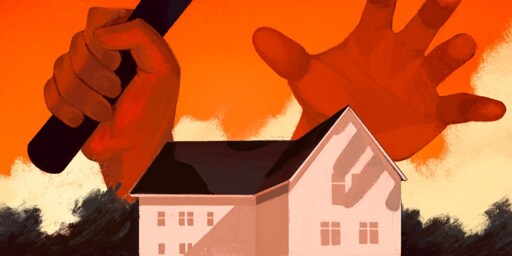
In 1992, Donald Scott, the eccentric owner of a large Malibu estate, was killed in his home by an ad hoc team of raiding cops. The Los Angeles County Sheriff’s Department led the raid, but a panoply of state and federal police agencies participated too. Police claimed Scott was operating a large marijuana grow on the property. Scott, who always feared the government would take his land, actually repudiated the use of illegal drugs.
No marijuana or any illicit drugs were found on his property. A subsequent investigation by the local district attorney confirmed Scott wasn’t paranoid: The LA County Sheriff’s Department was motivated by a desire to take Scott’s property under civil asset forfeiture laws, auction it off, and keep the proceeds for the department. Bizarrely, Scott’s home wasn’t even in LA County. Despite recent reform efforts, the promise of forfeiture continues to be a major motivating force in drug policy across the country.
Transcript
Radley Balko: In the early hours of October 2, 1992, a wealthy, eccentric Californian named Donald Scott and his younger artistic wife Frances were up late drinking, as they often were. The couple eventually passed out in the bedroom of their large cabin in Malibu at around 2 or 3 a.m.
As they fell asleep, they may have heard the waterfall that splashed down onto their sprawling 200-acre property. They called it “Trail’s End Ranch.” And then just before 9 a.m., Frances Plante Scott awoke with a start.
Frances Plante Scott: We were in bed asleep, and the house started shaking, and the dogs were going crazy and … [sigh]
Radley Balko: That’s Plante in an ABC “20/20” interview from 1993, describing the morning that ruined her life.
Frances Plante Scott: I got up as fast as I could to get dressed. And I was going to the door, and I see this face looking at me. At that point, the door burst open, and I just saw all these guns. These men had guns, and I didn’t know who they were or what they were doing.
Radley Balko: As Plante threw on a shirt and pair of overalls, a team of 30 law enforcement officers loomed near the entrance to her home.
The raid team was an alphabet soup of police and government agencies, including officers from the Los Angeles Sheriff’s Department, the Drug Enforcement agency, the California Bureau of Narcotics, the U.S. Forest Service, the Los Angeles Police Department, the National Park Service, the California National Guard — and there were even a couple of researchers from NASA’s Jet Propulsion Lab. Notably, the raid team didn’t include a single police officer from Ventura County, where the ranch was actually located.
The motley crew of heavily armed officials had made their way up the winding road to the ranch in 15 different vehicles. Now they were inside Plante’s home, with their guns drawn.
Frances Plante Scott: I just screamed, “Don’t shoot me, don’t kill me,” and I was backing into my living room. My husband heard me. He came running out of the back of the house into the living room. I heard him say, “Frances, are you all right?”
Radley Balko: Unsure of what was causing all of the commotion, Plante’s husband Donald Scott grabbed the .38 revolver on his nightstand. He was groggy, and his vision was likely still foggy from recent cataract surgery.
Frances Plante Scott: He had his gun pointed above his head. He looked at me, and the next thing, someone yelled, “Put your gun down, put your gun down, put your gun down.” Bang, bang, bang. My husband fell down right in front of me.
Capt. Richard DeWitt: Looks like 927D here.Dispatch: At the location?Capt. Richard DeWitt: Yeah.Dispatch: Some bodies there?Capt. Richard DeWitt: No, we put ’em down.Dispatch: We killed him?Capt. Richard DeWitt: Yeah.
Radley Balko: That’s Capt. Richard DeWitt of the Los Angeles County Sheriff’s Department, on the phone with his commanding officer. You can hear the surprise on the other end of the line, as the commander learned that someone had been killed.
What had Donald Scott done? What merited this sort of overwhelming police response? Scott wasn’t a murderer or an arms dealer. He wasn’t an escaped felon or a dangerous fugitive. Instead, the police claimed on their search warrant affidavit that he was growing marijuana.
Bill Aylesworth: They couldn’t care less about the weed if there was any there. Basically, they wanted the land.
Radley Balko: In the years leading up to the raid on his home, Donald Scott’s friends and family said that he had grown increasingly paranoid that the government wanted to take his property from him.
Frances Plante Scott: He had a feeling that, it was just a feeling that they were going to try to get the land from him somehow. He thought that they wanted the land to the point of where they would kill him for this land.
Radley Balko: It turns out that Donald Scott was right. The government really did want his property. A lengthy Ventura County District Attorney investigation confirmed Scott’s suspicions and concluded that seizing his ranch was one of the motivating factors for obtaining and serving the search warrant.
The lead LA County Sheriff deputy on the case filed an affidavit claiming that there was a marijuana grow on the property. If the agency uncovered it, they might be able to seize all 200 acres of Trail’s End Ranch under civil asset forfeiture laws, and then they could auction it off. The millions of dollars in proceeds would go right back to the LA Sheriff’s Department and the other participating agencies. The raiding officers would be heroes. It was the sort of bust that could make a cop’s career.
Except that isn’t what happened. There was no major marijuana operation. In fact, there wasn’t a single marijuana plant anywhere on the property.
Dan Alban: At the end of the day, they were just looking for an excuse to invade his ranch, search everything, and find some basis for the seizure — which, in this case, they didn’t find.
Radley Balko: For the next decade, the dispute over what exactly happened that morning at Trail’s End would fuel countless national news stories, lawsuits, and defamation claims. It would pit the Ventura County district attorney’s office against the LA Sheriff’s Department and the state attorney general’s office. Those latter two agencies would issue their own findings exonerating the sheriff’s deputies for Scott’s death.
It would also spur a furious debate over the policy of civil asset forfeiture, and would become just the latest in a series of corruption and brutality scandals to rock the largest sheriff’s department in the country.
From The Intercept, this is Collateral Damage.
I’m Radley Balko. I’m an investigative journalist who has been covering the drug war and the criminal justice system for more than 20 years.
The so-called “war on drugs” began as a metaphor to demonstrate the country’s fervent commitment to defeating drug addiction, but the “war” part quickly became all too literal.
When the drug war ramped up in the 1980s and ’90s, it brought helicopters, tanks, and SWAT teams to U.S. neighborhoods. It brought dehumanizing rhetoric, and the suspension of basic civil liberties protections. All wars have collateral damage: the people whose deaths are tragic but deemed necessary for the greater cause. But once the country dehumanized people suspected of using and selling drugs, we were more willing to accept some collateral damage.
In the modern war on drugs — which dates back more than 50 years to the Nixon administration — the United States has produced laws and policies ensuring that collateral damage isn’t just tolerated, it’s inevitable.
This is Episode Eight, “Legalized Takings: The Land Grab That Killed Donald Scott.”
[
Collateral Damage Podcast
Collateral Damage](https://theintercept.com/podcasts/collateral-damage/)
Donald Scott led a privileged life.
He was raised in Switzerland, attended elite prep schools in New York, and he lived off of a trust fund.
The Scott family fortune was fueled by his grandfather’s invention: Scott’s Emulsion, a cod liver oil supplement marketed as a cure-all. It took off in the U.S. and Europe, and it’s still popular in parts of Asia.
Scott’s Emulsion ad: Scott’s Emulsion, I like you. You help me to grow. Mmm, I like it!
Radley Balko: Scott’s jet-setting life was eccentric, worldly, tumultuous, and saturated with booze. He consorted with Hollywood stars and starlets, raced Ferraris, and generally relished the role of an international playboy. He bounced all over the globe.
In the 1960s, he had a six-year relationship with the glamorous French actress Corinne Calvet. That relationship ended badly, as did his next marriage. But later in life, Scott settled down with Frances Plante, an aspiring country music singer 23 years his junior.
Frances Plante Scott’s song “Drunk on Pain” plays: I’m drunk on pain. / It’s driving me insane.
Bill Aylesworth: Frances was from Texas, Galveston. She was a red-headed, hot-fired, wild, high-energy lunatic and absolutely gorgeous as well. Just an amazing person.
Radley Balko: That’s Bill Aylesworth. Nearly a decade after Donald Scott was killed, Aylesworth met and became romantically involved with Plante, Scott’s widow. And from her, Aylesworth became intimately familiar with the story of Trail’s End.
Bill Aylesworth: Spending that much time with her, four and a half years. I wrote a treatment for the whole thing. All I would hear is her all day long talking about it. She was obsessed with it.
Radley Balko: Aylesworth also collaborated with Plante professionally and produced some of her music.
Frances Plante Scott’s song “I Tried It” plays: I wanna shake more than your hand, Tammy Wynette.
Radley Balko: Donald Scott bought the lush Malibu property known as Trail’s End in the 1960s. Over the years, he’d converted it into a hideaway, transforming it into a surrogate of the grand mansion he grew up in Geneva. It was also a sanctuary for his eclectic collection of books, Persian rugs, and ancient maps.
Friends said Scott could also be incredibly generous to those he trusted. For example, gifting a collector’s model 1959 Cadillac Eldorado to a friend and family attorney named Nick Gutsue. But Scott was also worn down by years of legal fights with his ex-wives over money. He grew reclusive and began drinking more heavily. He also became increasingly distrustful of the government. Scott had stopped filing federal income tax returns, and he was worried that the government had designs on the property that had become such an important part of his identity.
Bill Aylesworth: So it’s 200 acres. I mean, just unbelievable, right? And it’s so attractive that the park service, National Park Service, owned all of the property on either side of Donald’s property.
Radley Balko: Trail’s Ends Ranch was hidden by a dense thicket of heavily vegetated forest dominated by oak and sycamore trees. It sat in the Santa Monica Mountains, about 4 miles from the Pacific Ocean.
Scott and Plante lived in a 1,000-square foot stone and wood ranch-style cabin about a quarter mile in on the property. It also included a bunkhouse and a barn. On three sides, Trail’s End was framed by towering cliffs, streams, and a 75-foot waterfall. But amid all of that canopied tranquility, the creeping border of federal parkland was causing Scott persistent anxiety.
The Santa Monica Mountains National Recreation Area had acquired parcels bordering Scott’s ranch. His relationship with the park’s administrator, the National Park Service, had been contentious. Scott complained that visitors were harming his property. He said hikers would throw or kick rocks into the waterfall. Scott also suspected that the government wanted to absorb Trail’s End into the parkland.
Bill Aylesworth: It wasn’t paranoia because they were actually coming up, making offers to buy it. That’s not paranoid, saying, “They want to take my land.” They want to take your land!
Radley Balko: The National Park Service denied it offered to buy the ranch or had any plans to seize or condemn it. Additional reporting over the years hasn’t supported that claim. But a former park ranger and a superintendent of the park revealed Scott’s land was of interest.
Bill Aylesworth: They wanted his land, and he didn’t want to sell it. So they came up with a scheme to get it for free: Just take it from him.
“They wanted his land, and he didn’t want to sell it. So they came up with a scheme to get it for free: Just take it from him.”
Radley Balko: And Scott’s land wasn’t just beautiful; his 200 acres in Ventura County was worth millions. And according to a subsequent report by a Ventura County district attorney, police agencies in the area had also taken notice.
Dan Alban: This is pretty classic policing for profit.
Radley Balko: Dan Alban is a senior attorney at the libertarian law firm the Institute for Justice. He co-directs the firm’s national initiative to end forfeiture abuse.
Dan Alban: There was a $5 million estate. There was an eccentric millionaire who was suspected of somehow being involved in growing marijuana plants. And the idea was, if we can catch him in the act — catch him with these marijuana plants — then regardless of what the penalty would be for having 50 to 100 marijuana plants, we could seize the entire estate and then sell it off to someone and pocket the $5 million.
Radley Balko: The LA County Sheriff’s Office spent nearly a year investigating Scott’s alleged marijuana operation. In the end, they found nothing. Not a single plant.
At the core of their strategy was a legal concept called civil asset forfeiture.
Dan Alban: Asset forfeiture law has its origins in 17th-century English maritime law. England was in a trade war at the time with various other countries, including Spain.
Radley Balko: England passed laws saying they could seize ships or cargo that had been involved in smuggling or piracy.
Dan Alban: And the reason was if a ship was smuggling goods into your port, and you’re England, you want to prosecute the owner of the ship, but the owner of the ship is very rarely on the ship. The owner of the ship is back in Lisbon or Madrid or somewhere. And so there’s no way to actually exact justice on that person or deter them from behaving badly in the future. And so, because you didn’t have jurisdiction over the actual people committing the criminal acts, or at least not all of them, the way to resolve that and to enforce these various customs laws that England was trying to enforce was to seize the ship, or to seize the goods, or both, and forfeit them to the crown.
Radley Balko: The early American colonies adopted similar asset forfeiture laws. And while the Supreme Court expanded them during the Civil War, they were used only sparingly. But that changed with alcohol prohibition in the 1920s.
Dan Alban: The originally very narrow concept of forfeiture that was used in maritime law was expanded during Prohibition. Because during Prohibition, people weren’t just smuggling in rum and alcohol by ships, but they were also bringing it over the Canadian border and the Mexican border by trucks. And so it was a natural analogy to say, “Oh, well, you know, they aren’t ships exactly, they’re sort of ships of land that have wheels on them. We’re going to seize those too.”
And then when the war on drugs really began in earnest in the ’70s and ’80s, forfeiture was pulled out again as, “Oh, here’s a tool that we can use to scoop up as much property as we can, and anything that was somehow involved in drug trafficking or that we think was somehow involved in drug trafficking is now forfeit to the state.”
Radley Balko: And this is where asset forfeiture really starts to go off the rails. Under the old common-law rules, law enforcement agencies could take the property of someone who had been convicted of a crime, on the theory that criminals shouldn’t be enriched by ill-gotten gains. Known as criminal forfeiture, it thus required a criminal conviction.
The practice of civil forfeiture — in which a conviction is not needed, just probable cause — was rarely used until the 1970s.
The practice of civil forfeiture — in which a conviction is not needed, just probable cause — was rarely used until the 1970s. That’s when Congress passed bills that allowed police to seize narcotics and anything used to manufacture or distribute them.
As the drug war ramped up in the early 1980s, Congress introduced additional bills to expand civil forfeiture. The Comprehensive Forfeiture Act, signed into law by Ronald Reagan in 1984, allowed for a wider range of property to be eligible for seizure. It also empowered law enforcement to confiscate property like cash, vehicles, and homes, without even an arrest. A property owner would then have to contest the seizure in court in order to get their stuff back.
Dan Alban: They don’t have to be charged with a crime. They don’t have to be convicted.
Radley Balko: But even under that 1984 law, any forfeiture proceeds still went into the U.S. Treasury’s general fund. It was in 1986 that Congress added an amendment that would dramatically change drug policing in the United States — and ultimately would lead to the death of Donald Scott.
Under the 1986 amendment, federal law enforcement agencies themselves could keep any cars, cash, or other assets that they seize. Or they can auction them off. The cash and proceeds from those auctions would then go back to both the federal law enforcement agency, and to any state or local police departments involved in the case. In Donald Scott’s case, because the LA Sheriff’s Department was the lead agency in the investigation, they stood to benefit the most.
In 1986, President Ronald Reagan championed civil asset forfeiture, arguing that it was a powerful weapon against drug dealers.
Ronald Reagan: You can increase the price by cutting down on the supply, by confiscation of the means of delivery, and so forth. The government, right now, already owns quite a fleet of yachts and airplanes and trucks and so forth that have been involved in that trade and that we have already intercepted.
Radley Balko: Police now had a clear financial incentive to seize property and to devote more resources to drug policing. Every drug bust now brought the potential for new police gear, office improvements, and “professional development” trips to conferences at sunny destinations.
Dan Alban: The money is sent to a dedicated fund that’s controlled by DOJ and the law enforcement agencies under DOJ, like DEA and FBI, and can only be spent on what they call “law enforcement purposes” — which is essentially anything they want to spend money on because they’re law enforcement.
Radley Balko: This change to incentivize police to seize property has wrought a sea change in drug policing, and it was the brainchild of a couple familiar names. One of them was an up-and-coming U.S. attorney in New York.
This change to incentivize police to seize property has wrought a sea change in drug policing.
Dan Alban: And so that change, which, yes, was championed by Rudy Giuliani.
Radley Balko: And another architect of the policy was a senator from Delaware named Joe Biden.
Joe Biden: We changed the law so that if you are arrested and you are a drug dealer, under our forfeiture statutes, you can, the government can take everything you own. Everything from your car to your house, your bank account. Not merely what they confiscate in terms of the dollars from the transaction that you just got caught engaging in. They can take everything.
“It suddenly became this free-for-all where any property that you could find that you thought was somehow connected to a crime, you would seize and try to forfeit because at the end of the day, your agency … got the proceeds.”
Dan Alban: That law, as well as a few others that were passed around the same time in the early to mid-’80s, really changed how civil forfeiture was used in the United States. Instead of it being this kind of obscure area of law that was very rarely used and only in exceptional circumstances when you can’t actually bring the perpetrator within your jurisdiction, it suddenly became this free-for-all where any property that you could find that you thought was somehow connected to a crime, you would seize and try to forfeit because at the end of the day, your agency — or at least DOJ, which your agency was under — got the proceeds from that forfeiture.
And so this created this huge off-budget slush fund that DOJ and its agencies could use to fund all sorts of things. And many states followed suit, creating their own funds or allowing counties to create their own funds, so that at the state and county levels, this same profit incentive was replicated all across the country. And that led to a huge explosion in forfeiture.
Radley Balko: Forfeiture proceeds are basically slush funds for police and prosecutors. In many jurisdictions, there’s little oversight or accounting. Over the years, police officials have spent forfeiture funds on purchases that you might say aren’t exactly critical to the practice of law enforcement.
One district attorney in Texas used forfeiture money to purchase kegs of beer, bottles of rum and tequila, and a margarita machine for his office. A South Carolina sheriff’s office spent $26,000 investigating a strip club — just good old fashioned police work involving lap dances and $300 bottles of champagne.
When the investigation of Donald Scott began, California police agencies were operating under this forfeiture-driven drug policy. Whatever they could seize, up to 80 percent of it would essentially become theirs.
As reporter Lynn Sherr reported in her “20/20” investigation into Scott’s death, there were plenty of reasons for the sheriff’s department to be looking for sources of revenue.
Lynn Sherr: LA County was in a fiscal crisis. With the upcoming budget a billion dollars short, the sheriff’s department was being hit hard. So like other law-enforcement agencies around the country, it relied more on the proceeds of drug investigations to supplement the budget.
Radley Balko: The investigation of Trail’s End unfolded over the course of a year. But six months after Scott’s death, the Ventura County District Attorney’s Office, led by Michael Bradbury, released a report that began to connect the dots.
The ABC News show “20/20” also played a key role in bringing public attention to the missteps by the LA County Sheriff’s Department. We’ll refer back to that episode throughout this story — not only because of its reporting, but because it includes one of the few in-depth interviews Frances Plante gave at the time.
We made numerous attempts to reach Plante for this story, but we were unable to track her down. And then, as we were producing this episode, we learned that she had recently passed away.
Plante’s “20/20” interview will be the only account from her that you’ll hear.
The investigation of Trail’s End began with an LA sheriff’s department deputy named Gary Spencer. District Attorney Bradbury’s investigation found that Spencer claimed to have received an anonymous tip that a woman named Frances Plante had been acting suspiciously around town in Malibu.
Plante hadn’t broken any laws, but Spencer claimed that the informant told him Plante was carrying lots of cash, paying for small items with $100 bills, and had been tipping generously.
Of course, Malibu is filled with eclectic and extraordinarily wealthy people. So it seems unlikely that tipping well and flaunting wealth would be unusual there. But Spencer saw these as signs of possible drug dealing. Spencer would later falsely assert in an affidavit that Plante’s car was registered to Donald Scott. Plante’s car was actually registered in Nevada, and Scott’s name was nowhere in the paperwork.
In September 1992, 10 months after the tip about Plante, Spencer claimed he received another tip from an informant who was never publicly identified. The informant told him there were 3,000 to 4,000 marijuana plants growing on Scott’s property. Spencer also claimed to have learned that Frances and an associate were allegedly linked to investigations into heroin and other narcotics smuggling.
So Spencer started investigating.
Bill Aylesworth: The lead was Gary Spencer. The whole thing was orchestrated by him. And he’s the guy who ended up killing Donald Scott. It was this guy who thought it would be a feather in his cap, his star would rise. The department needed money at the time. He was very ambitious.
Radley Balko: On September 10, 1992, Spencer and two deputies hiked to the top of the waterfall on Scott’s ranch to look for those thousands of marijuana plants. They found nothing.
Spencer then requested a California Air National Guard plane fly over the ranch to look for a pot farm and to snap photos. Those photos didn’t show much. At best, a DEA analyst named Charles Stowell said there might be some visual evidence of a small illegal water system. But even an unlawful set of water pipes could have been used to grow any number of perfectly legal plants. And as it turns out, there was really no irrigation system at all.
On a second flight two weeks later, DEA Agent Stowell claimed to have seen 50 marijuana plants. But for reasons that aren’t clear, he didn’t take any photos. Finally, Spencer asked a Forest Ranger to assemble a ground team to hike onto Scott’s property to find the plants. And for some reason, they contacted the U.S. Border Patrol to assist.
This new ground team got within 150 feet of Scott’s house but told Spencer that they saw no marijuana. They also said it was extremely unlikely that there were 3,000 plants growing on the property.
According to Bradbury’s investigation, as Spencer was building his case, he also sent a park ranger and a sheriff’s sergeant to Scott’s property under false pretenses. The ranger had previously responded to a complaint Frances Plante had made to the National Park Service.
Spencer told them to pretend to be interested in adopting a puppy from the Scotts.
Spencer told them to pretend to be interested in adopting a puppy from the Scotts. In reality, they were there to provide a threat assessment on the property. In other words, he wanted them to tell him what sort of force he would need to use when serving his search warrant.
Spencer finally got his search warrant on October 1, 1992, but only after telling the DEA that his mysterious informant’s story had changed. Forget the thousands of plants — the informant now reportedly said that Scott was growing only enough plants to yield about 40 pounds of pot. By DEA estimates, that would have amounted to about 50 plants. So the new story conveniently aligned with what the DEA agent improbably claimed to have spotted during his flight.
The informant would later deny that this particular conversation ever happened, though that was also disputed by the sheriff’s department. Bradbury’s investigation found other problems with Spencer’s search warrant affidavit. For example, Spencer had omitted the fact that two ground teams had visited the property and failed to spot any marijuana.
Spencer also wrote that DEA Agent Stowell had used binoculars when he claimed to have spotted the 50 or so pot plants. But there were no binoculars. Stowell claimed to have seen them from 1,000 feet in the air with the naked eye. A Forest Service employee with extensive aerial surveillance experience would later say that to do so from a plane like that would be like “seeing a corn dog sticking out of the ground.”
Michael Bradbury: There is virtually no way that Stowell could have seen through that canopy of trees. It’s like a rainforest. It’s impenetrable.
Radley Balko: That’s Ventura County District Attorney Michael Bradbury picking apart Spencer’s case with “20/20” reporter Lynn Sherr.
So to summarize, Spencer obtained a search warrant based on a DEA agent’s improbable claim to have spotted 50 pot plants from 1,000 feet with the naked eye. But he failed to photograph it, and he wasn’t certain about what he’d seen.
Spencer then corroborated that with an unidentified informant who revised the number of plants he claimed to have seen on Scott’s property from several thousand to just 50.
While Spencer claimed that the DEA agent had spotted the plants, he failed to note that two ground teams failed to find any plants when they visited the property in person.
Michael Bradbury: He provided misinformation to the magistrate, and he left out a lot of very material facts that would have indicated to the magistrate that in fact marijuana was not being cultivated there.
Radley Balko: But with the warrant in hand, Spencer then began planning his raid. Remember how he had previously sent those park rangers to visit the property and make a threat assessment?
Well, those rangers concluded that a SWAT team wasn’t necessary. “Just drive up to the house and the Scotts would let them inside.”
But that isn’t what happened.
Bill Aylesworth: This guy was a cowboy, Gary Spencer. He’s not a guy who’s gonna hang around and talk about procedures, you know, “We’re gonna go in, we’re gonna arrest him, we’re gonna take his weed and his property.”
Radley Balko: There’s other evidence that forfeiture was a prime motivator in Spencer’s investigation. About a month before the raid, deputies had also been given documents that included a property appraisal of the ranch, and that included a handwritten notation that an 80-acre plot of land nearby had recently sold for $800,000. It also pointed out that the Trail’s End Ranch covered 200 acres.
[Break]
Radley Balko: Just after sunrise on October 2, 1992, 31 people from at least eight government and law enforcement agencies gathered in the Malibu office of the LA Sheriff’s Department for a briefing. At least two people at that briefing heard it mentioned that if the raid produced marijuana plants, the police agencies could seize Scott’s entire property under asset forfeiture laws.
So the 15-vehicle caravan then made its way to Trail’s End. At 8:30 a.m., they cut a padlock off the outer gate. Several of the officers would later say that they had knocked and announced themselves for somewhere between 1 and 4 minutes. According to police, when no one answered, a team of five deputies then forced their way into the home with a crowbar and a battering ram.
Spencer was the first one through the door.
Bill Aylesworth: And she starts screaming. So, you hear your wife screaming. Obviously, you’re gonna grab your gun and go down and see what’s happening.
Radley Balko: According to Spencer, Scott came out holding a .38-caliber snub-nosed revolver. He was holding it above his head, in his right hand, as if he were going to hit someone with it, not shoot it. According to Plante, Scott was still recovering from an eye surgery he’d had a few days earlier, and he couldn’t see well.
Bill Aylesworth: They tell him, “Put down the gun. Put down the gun.” And so literally, the order they gave him is also the reason they used for killing him. Because he had a handgun, as he was putting it down, they blew him away.
Radley Balko: Spencer said he told Scott to drop the gun three times, though he admits he never identified himself as a police officer once Scott entered the room. According to Spencer, as Scott brought the gun down, he rotated it until it was pointing at Spencer. That’s when Spencer fired. Deputy John Cater fired next. Then Spencer fired another round. According to Spencer, Scott lurched backward, stammered, and fell. He died instantly.
Capt. Richard DeWitt: Captain DeWitt here. Dispatch: Yeah.Capt. Richard Dewitt: I’m on a search warrant with the Hidden Hills crew on this marijuana eradication thing.Dispatch: Yes.Capt. Richard DeWitt: And they just — Looks like 927D here.Dispatch: At the location?Capt. Richard DeWitt: Yeah.Dispatch: Some bodies there?Capt. Richard DeWitt: No, we put ’em down.Dispatch: We killed him? Capt. Richard DeWitt: Yeah.
Bill Aylesworth: They’re basically saying, “Yeah, we killed him.” And then you could hear how surprised they were on the other end. They’re like, “You mean the property owner?” They were just, like, shocked. “The property owner? He’s dead? You shot him?”
Radley Balko: Frances Plante would later use that recording in a song she created and produced with Aylesworth. They called it “I’m Going to Stop You.”
[Frances Plante Scott’s song “I’m Going to Stop You” plays]
Bill Aylesworth: At the very beginning of the song before a song even starts, we have the actual recording to the headquarters.
Verse from “I’m Going to Stop You” plays: We killed him, we killed him. We killed him.
Bill Aylesworth: Malibu sheriff headquarters saying, “Yeah, we killed the subject.” “Killed the subject? What do you mean?” on that record we recorded and released. And I named the album “Conspiracy Cocktail” because all the songs she wrote were about the government and what happened to her.
Frances Plante Scott’s “I’m Going to Stop You” continues playing:
I’m going to stop you
Do we defend ourselves from you
Protect and serve you’re supposed to do
I’m going to stop you …
Radley Balko: There were a number of inconsistencies about where Donald Scott’s hand and gun were pointing when he was shot. What’s undisputed is that the subsequent search of Scott’s property not only turned up no marijuana plants, or other narcotics, it also turned up no unusual or illegal irrigation systems. There were no ropes. There was nothing hanging from the trees that could have supported a grow operation. Frances Plante would later say, dryly, that when the police asked where the plants were, she responded, “I’m the only Plante here.”
Spencer later claimed deputies found a cigar box with marijuana stems, two charred joints, and some residue that may have been pot. But there’s no mention of that on the evidence return sheet, which is supposed to list everything seized during the search. And Spencer later couldn’t say where the box was found.
Trail’s End was in Ventura County, yet the investigation into Donald Scott’s nonexistent marijuana farm and the raid that ended his life were conducted by the sheriff’s office in neighboring Los Angeles County. The fallout from his death would pit two veteran California law enforcement officials against each other in a way that became very nasty and very public.
Soon after Scott’s death, Ventura County District Attorney Michael Bradbury announced that he’d be launching an investigation. Six months later, he issued his scathing report.
It was about as damning a document as one law enforcement agency could publish about another. Bradbury then defended his report in the media.
Barbara Walters: This week, investigators examining the case issued their report. The findings are explosive, as you are about to hear in the conclusion of Lynn Sherr’s report.
Michael Bradbury: Donald Scott did not have to die. He should not have died. He’s an unfortunate victim in the war on drugs.
Radley Balko: Bradbury’s report said that the U.S. Border Patrol had no jurisdiction to be involved in the case and criticized its agents for trespassing on Scott’s property. He was also hard on DEA Agent Charles Stowell, saying, “He was either lying or not sure that he saw marijuana.”
But Bradbury saved most of his criticism for Deputy Gary Spencer, writing, “This search warrant became Donald Scott’s death warrant.”
“This search warrant became Donald Scott’s death warrant.”
After outlining the numerous discrepancies in Spencer’s affidavit, Bradbury’s report concluded, “the misstatements and omissions discussed above are material and would invalidate the warrant.”
Bradbury also wrote that there were numerous reasons to doubt Spencer’s version of events. Although, he advised against perjury charges for the deputy.
He also questioned the LA County Sheriff’s Department’s motives. When Bradbury’s report came out, the Los Angeles County sheriff was a reserved man named Sherman Block.
In a written statement, Block condemned the report, which he said was filled with “conjecture and supposition” and reeked of “sensationalism.” He also accused Bradbury of having “a complete lack of understanding of the nature of narcotics investigations.”
And Block questioned Bradbury’s motivations, pointing out that the report was released just as ABC News was airing that “20/20” report on the Scott case.
Announcer: Tonight, a Lynn Sherr investigation: Why did Donald Scott die?
Radley Balko: Block conducted his own internal inquiry into the raid, which disputed all of Bradbury’s findings. He completely exonerated Spencer, his deputies, and DEA Agent Stowell, and argued that a 1,000-foot aerial naked-eye sighting of marijuana plants is both possible and “ideal.” According to Block, Bradbury’s own tape-recorded interview with the informant revealed that the informant never denied telling Spencer about the 40 pounds of marijuana on the ranch.
Block concluded that Spencer did not lie to obtain the search warrant, and wrote, “It is not true that the interest in forfeiture dominated or even rivaled the criminal concerns in this investigation.” He accused Bradbury of “willful distortions of fact” and of attacking “the integrity of veteran law enforcement officials.”
But Bradbury wasn’t the type to needlessly attack law enforcement. He was a law-and-order Republican. His memoir, published a few years ago, included photos of himself with Ronald Reagan, George H.W. Bush, Margaret Thatcher, and various other conservative luminaries of the 1980s and 1990s.
What’s most striking about Block’s investigation is that it lacks any introspections. Three months before the Scott raid, Block’s department was strongly criticized for a series of fatal shootings. A 359-page report commissioned by the Los Angeles County Board of Supervisors found “deeply disturbing evidence of excessive force and lax discipline.” The report described a culture of lawlessness among sheriff’s deputies and a reluctance by Block and his top aides to hold them accountable.
Now, Block’s deputies had killed another innocent man. And even assuming everything his Deputy Gary Spencer put in the original affidavit was correct — and we know that it wasn’t — Block’s officers had gunned down a man in his own home over 50 marijuana plants that they never found.
Block’s officers had gunned down a man in his own home over 50 marijuana plants that they never found.
After his investigation, Block continued to reject Bradbury’s conclusions. He expressed no remorse or willingness to examine the policies that allowed the killing of an innocent 61-year-old man over what was at most, a few dozen pounds of cannabis. He never questioned the appropriateness of deploying a huge raid team with personnel from several agencies who had never worked together. Even if they had found the pot they claimed Scott possessed, the manpower that morning would have amounted to one law enforcement officer for each 1.7 marijuana plants.
Block even sent his report to the California attorney general, and requested an inquiry into Bradbury for abusing his powers. Despite the botched raid and death of an innocent man, the state attorney general backed Sheriff Block. He also cleared Spencer and disputed Bradbury’s report, accusing him of using “unsupported and provocative language.”
Law enforcement officers have killed a lot of people in the name of the war on drugs. And it probably goes without saying that most of them aren’t rich, white, eccentric millionaires. Studies have consistently shown that the people targeted by these policies — from forfeiture to aggressive home invasions by police — are disproportionately poor and Black. But it tends to be cases like Scott’s that attract media and public attention, because the public tends to find them more sympathetic.
Dan Alban: Although the Donald T. Scott case is one of the maybe more extreme or memorable examples, it’s one that I think hits home for a lot of people — because they realize, “That could have been me.” Like, if police come charging into my house, and I don’t know that they’re there, and I hear my wife screaming, am I going to try to come to her aid? And if so, am I going to get shot? And could it be over something that I had no fault in? Absolutely it could.
Radley Balko: Civil asset forfeiture policies gave Deputy Spencer a strong incentive to conclude that Donald Scott was guilty. It also incentivized him to look for evidence to support that conclusion — instead of the other way around. Bradbury called it a “fishing expedition.”
Throughout making this episode, we tried to get a comment from Spencer, but we were unable to reach him through publicly available information.
Donald Scott had no criminal record. And after his death, friends and acquaintances told media outlets that he wasn’t fond of illicit drugs. That’s something they might also have told investigators if they had bothered to ask.
The possibility of civil asset forfeiture pushes drug cops in one direction: to produce evidence of a target’s guilt. There’s little incentive to search for exculpatory evidence, especially once they’ve invested some time and resources in the investigation.
Dan Alban: So forfeiture absolutely distorts the priorities of law enforcement agencies and drives a lot of activities that they would not otherwise engage in.
Forfeiture “diverts all kinds of resources into things that have nothing to do with actual crime prevention and are instead are much more oriented toward revenue generation.”
Radley Balko: Alban says there’s data showing that when law enforcement revenue increases due to forfeiture, there’s a corresponding decrease in the rate at which they close crimes like murder or robbery.
Dan Alban: One of the things that folks who are really sort of pro-law enforcement or pro-law-and-order often fail to fully appreciate about the dangers of the profit incentive in forfeiture is, it’s not just something that gives the police more tools to fight crime. It’s something that distorts law enforcement priorities, distracts them from what they’re supposed to be doing, and diverts all kinds of resources into things that have nothing to do with actual crime prevention and are instead are much more oriented toward revenue generation.
Radley Balko: That means more unsolved violent crimes. Which means less public confidence in the police. And that only feeds the cycle of mistrust between cops and marginalized communities.
Dan Alban: There are a number of studies that have shown that civil forfeiture and the aggressive use of civil forfeiture has caused distrust in minority and low-income communities because it’s viewed as enabling the police to just steal from people — and particularly to just steal from the poorest, the people who have the least resources and who are most vulnerable. Not only are they the ones who are sort of hit hardest by it, but they’re also the ones least able to defend themselves because they have less access to attorneys or to the political system that might enable them to call some of these things into question or have politicians start investigations.
Radley Balko: The city of Philadelphia is a particularly compelling case study. That city has been home to a long-running forfeiture abuse scandal first exposed in 2014.
[Content truncated due to length…]
From The Intercept via this RSS feed