

Drop Site is a reader-funded, independent news outlet. Without your support, we can’t operate. Please consider making a 501©(3) tax-deductible donation today.
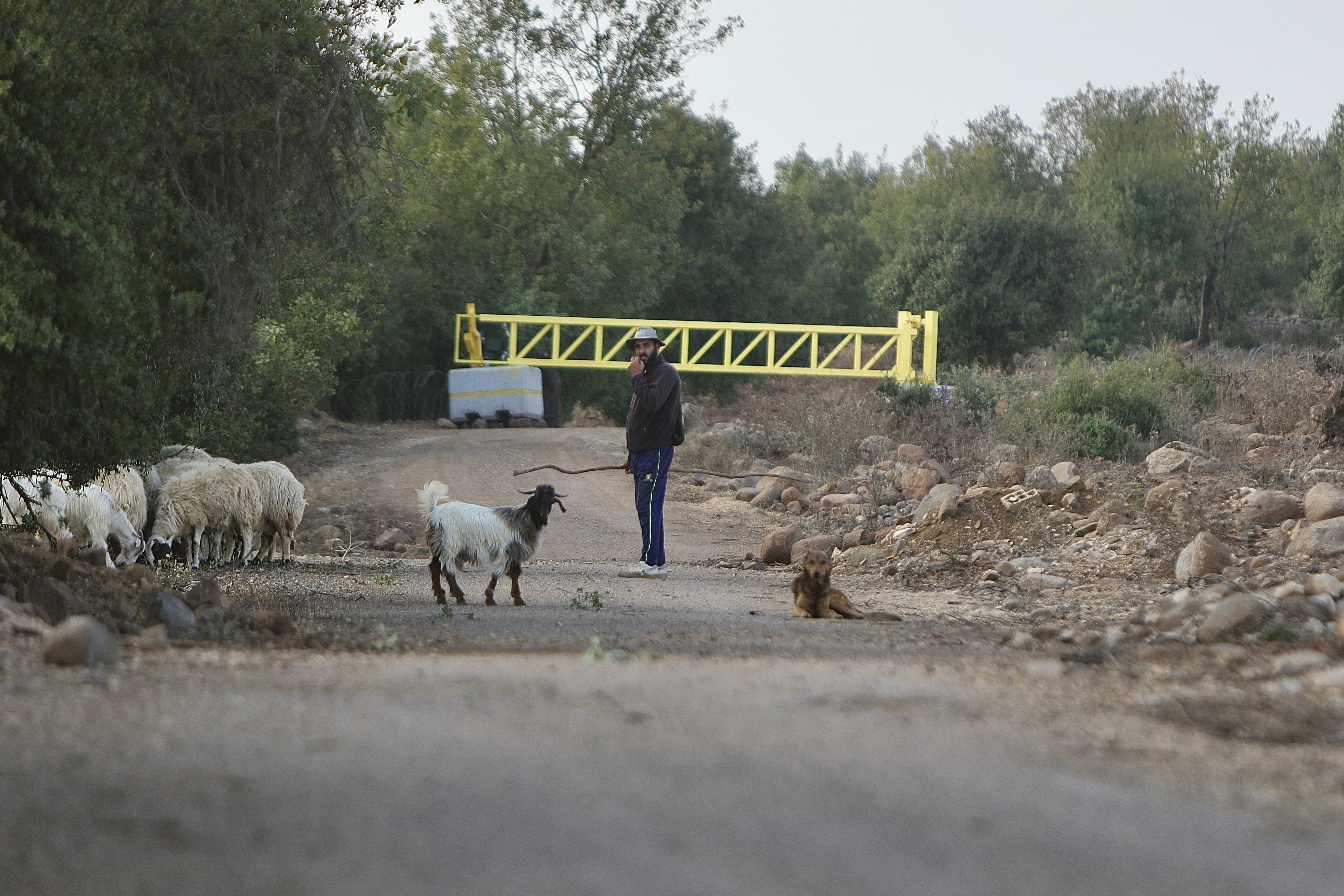
A small flock of sheep is seen in front of an iron security barriers erected by the Israeli army in the countryside of Quneitra province in southwestern Syria on November 05, 2025. (Photo by Bakr Al Kasem/Anadolu via Getty Images)
QUNEITRA, SYRIA—In what has become a regular occurrence in southwest Syria, Israeli tanks and troops stormed the Quneitra countryside on Monday, taking up positions in the village of Saida Al-Hanout. As drones flew overhead, Israeli military units set up a temporary checkpoint and searched civilians before eventually withdrawing.
Over the past year, Israeli forces have established nine military posts in southern Syria; constructed military installations less than one kilometer from villages; demolished at least 12 buildings in al-Hamidiya; razed over 45 hectares of the Jubata al-Khashab forest; and seized thousands of dunams of agricultural land, cutting off access to farmers’ livelihoods. Local officials told Drop Site News that, in total, Israel has illegally seized between 600 and 800 square kilometers of southern Syrian territory through more than 200 incursions.
Israeli military operations in the area have escalated in recent weeks, with Israeli troops displacing residents, destroying farmland, snatching people off the streets and taking them across the border to Israeli detention centers.
In the deadliest attack over the past year, thirteen Syrians were killed, including two children, and dozens more wounded in an Israeli military raid on the southern village of Beit Jinn on Friday. Residents confronted Israeli forces who entered the village after shelling the area, leading to “violent clashes,” according to Syrian state news agency SANA.
The border area in southern Syria was previously a UN-patrolled, demilitarized buffer zone established in a 1974 disengagement agreement that officially ended hostilities between Israel and Syria. Israel seized most of the Golan Heights from Syria in the 1967 war, eventually building illegal settlements and unilaterally annexing the area in 1981—a move unrecognized by the international community. Since Syrian President Bashar al-Assad’s ouster last December, Israel has occupied more Syrian territory—including the whole of Jabal al-Sheikh, a mountain that overlooks northern Israel and southern Syria—and has been further entrenching itself in recent weeks, advancing to the outskirts of Damascus in what critics say is nothing more than a land grab.
On Tuesday, Israeli Prime Minister Benjamin Netanyahu said he wants a new “buffer zone” on Syrian land stretching to the capital. “What we expect Syria to do is, of course, to establish a demilitarised buffer zone from Damascus to the buffer area, including the approaches to Mount Hermon and the Hermon peak,” Netanyahu said, using the Israeli name for Jabal al-Sheikh.
Last month, Israeli soldiers installed a permanent yellow gate without warning at the entrance to al-Samadaniyah al-Gharbiyah, a small farming village. The gate is located four kilometers (2.4 miles) (2.4 miles) from the center of Quneitra governorate, cutting the village off from neighboring towns and obstructing the main road that that residents rely on to reach markets, schools, and hospitals. It marked the fifth permanent gate erected by the Israeli military across Quneitra since Assad’s fall last year. Israeli soldiers now regularly stop and harass residents, turning daily life into an ordeal.
“They are trying to impose a new reality, so that they can exploit later,” Hayel al-Abdullah, the village head of al-Samadaniyah al-Gharbiyah, told Drop Site.
Netanyahu visited Israeli military positions in Syria last week in a publicized trip that prompted widespread condemnation. Accompanied by top defense and security officials, Netanyahu reviewed deployments, received operational briefings, and argued that Israel’s continued presence in the cross-border buffer zone was essential for national security. The Syrian government condemned the move as a “serious violation” of its sovereignty and called for a full Israeli withdrawal and return to the 1974 agreement though it has taken no other action.
Life Under Occupation
Israel’s military expansion in southern Syria has been accompanied by systematic intimidation, with troops raiding homes in the middle of the night, setting up flying checkpoints without warning, and isolating villages behind military barricades and gates. Dozens of families have fled the area, according to residents and local officials, and over 40 Syrians have been detained.
A number of residents told Drop Site News that they are routinely stopped at both temporary and permanent checkpoints, where soldiers search them, inspect their belongings, and scroll through the contents of their mobile phones.
Majd Azzam, a man in his 20s from the village of Al-Asbah, was hospitalized after Israeli soldiers beat him at a checkpoint in Kudnah in October. His offense was a photograph on his mobile phone with him wearing a keffiyeh, the traditional checkered scarf worn across the region, which the soldiers viewed as “terrorist attire,” Azzam’s father told Drop Site. “Any photo they consider suspicious, they arrest the phone’s owner, or at minimum they beat him,” he said.
The number of home raids has escalated sharply in recent weeks, according to two local residents, Khalil Layla and Abu Kinan Bakr, who said Israeli soldiers frequently order all family members outside before conducting exhaustive searches “turning the home upside down.”
Abd al-Aziz al-Mousa, a driver who navigates the shifting network of barriers daily, said the pressure and harassment on residents is constant. “The patrols and flying checkpoints can appear at any time, anywhere,” he told Drop Site.
Closed roads and rerouted paths have made it difficult for residents to reach jobs, schools, and farmland. In mid-November, the Israeli military installed a temporary checkpoint at al-Samadaniyah al-Sharqiya for five hours, preventing residents from reaching their schools, workplaces, and local markets.
Khaled al-Khalil, a Syrian journalist and an expert on Israeli-Syrian affairs, said Quneitra has become “a second West Bank,” with Israel behaving as a brutal occupying power. “They resort to military aggression to secure their borders, using arrests, incursions and harassment of residents,” Al-Khalil said.
As is the case in the West Bank, the Israeli occupation has also disrupted the olive harvest in Quneitra, a cornerstone of the local economy and cultural identity. The Quneitra governorate is home to 400,000 olive trees, 350,000 of them productive, according to Jamal Ali, the provincial agriculture director. Roughly one-third now lie under Israeli control, with farmers barred from accessing thousands of hectares of agricultural land.
Ahmed Khair Allah—a farmer from the village of al-Esha, located 35 kilometers (21.7 miles) away from Quneitra—said residents are still waiting for permission from Israeli forces to harvest olives on the slopes of Tal al-Ahmar Gharbi, which Israeli forces have occupied and turned into a military base.
With the Syrian state largely absent in Quneitra, residents have used the UN Disengagement Observer Force (UNDOF), which monitors the buffer zone under a 1973 Security Council resolution, as an intermediary with the Israeli military. “We knock on the UN gate and inform them of our request, then wait for a response from the occupation forces,” Khair Allah said.
Mohammed Layla, a resident of Tarinjah, said UN forces retreat when they encounter Israeli forces on the road, and that Israeli tanks have positioned themselves near UN forces who take no action. UNDOF has issued no public statement on the recent incursions.
Jamil Abu Omar, the village head of al-Asbah in the southwestern border strip, said some of his village’s olive groves stretch along the slopes of Tal al-Ahmar Sharqi and Tal al-Ahmar Gharbi, where an Israeli flag now flies. He said twenty families have left the village for Damascus and the surrounding areas in recent weeks, driven out by the military pressure.
Village heads estimate that a total of 60 families have been displaced from al-Asbah, al-Esha, al-Hamidiyah, and Bir Ajam since last December.
Drop Site News is reader-supported. Consider becoming a free or paid subscriber.
At least 46 Syrians have been detained and imprisoned in Israel over the past year according to Sajjel, a platform that tracks Israeli violations in southern Syria. Family members have no information about their whereabouts or conditions of detention and say they have contacted the UN and the Red Cross to no avail.
A young man who spoke to Drop Site on condition of anonymity said he was detained on November 10th along with his father, uncle, and cousin after they went to go check on the family farm. Neighbors had warned them that Israeli troops had raided the property overnight. When they arrived, they found the farm ransacked. After leaving, they were stopped by an Israeli patrol around 500 meters down the road.
“They handcuffed us and blindfolded us,” the man said. Within minutes, they arrived at what he believed was either al-Horriya base or al-Hamidiya base. He was held for a full day and night without interrogation before being released the following day near his home. His father, uncle, and cousin remain in custody. The family contacted the village heads of al-Hamidiya and al-Samadaniyah to try and get more information. When the mukhtar of al-Samadaniyah asked a passing Israeli patrol about the detainees, the soldiers reportedly only said “They are under investigation.” The UNDOF told the family it had no information.
Safa al-Safadi, from Beit Jinn, said seven people from her village were detained in June during a large raid on the area. She described long hours contacting state ministries trying to find out their fate, without receiving any answer.
Khalil Layla’s village of Tarinjah was raided one night in November. His brother Muhammad was taken along with others from Jabata al-Khashab. “We contacted the UN post, which in turn contacted the occupation forces, who acknowledged their presence but provided no additional information,” he told Drop Site.
As with thousands of Palestinians in Israeli custody, Syrian detainees have been swallowed up in Israel’s prison system with no due process. Palestinian lawyer Khaled al-Mahajnah, who is a member of the Commission of Detainees and Ex-Detainees Affairs in Palestine, confirmed that Syrian detainees are being held in Ofer Prison in the occupied West Bank. Separately, lawyer Ahmad al-Mousa, who resides in Germany, has documented the names of 46 prisoners and corresponded with more than a dozen international bodies about the detentions with no recourse.
Across the southern Syrian countryside, occupying Israeli forces have now become a dangerous reality of everyday life. Last month, Um Mohammed Layla was picking olives in her grove close to the village of Tarinjah, as her young children played nearby when a drone appeared overhead. Moments later, Israeli soldiers arrived in the area. “The drones hover above the trees while children play, then soldiers from the occupation suddenly appear among the fields and on village roads, spreading terror and fear,” she said.
This article is published in collaboration with Egab.
From Drop Site News via this RSS feed