

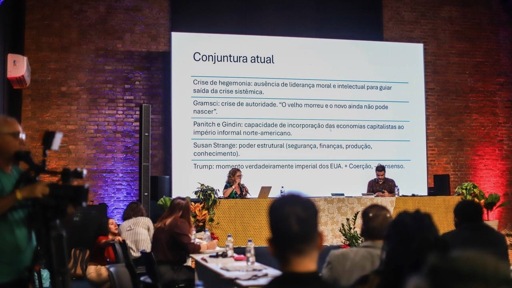
The BRICS People’s Summit launched this Monday, in Rio de Janeiro, and featured a public lecture that addressed aspects of economic cooperation and the construction of multipolarity within the bloc composed of 11 emerging-market countries. During the activity, researchers and representatives of civil society defended cooperation between the countries and the strengthening of internal social struggles on the bloc’s agenda.
“One of the objectives of BRICS, and certainly a Brazilian objective, is precisely the construction of a multipolarity that is based on rules and the interests of the developing world,” argued Ambassador Mauricio Lyrio, Brazil’s sherpa in BRICS.
It is important to consider the role of BRICS in building a new international order. There are internal and external challenges; today, BRICS is a group that causes more discomfort and faces a critical view from the US government, which misinterprets the bloc’s role,” Lyrio stated.
The class also featured Professor Ana Garcia, from the Federal Rural University of Rio de Janeiro (UFRRJ) and researcher at the BRICS Policy Center, who, after presenting a historical overview of the bloc’s formation process, advocated for a critical reorientation of the role and objectives of BRICS, arguing that the bloc should not be limited to the traditional geopolitical dimension or mere interstate disputes as a way to combat US hegemony. “We need to bring social struggles into interstate disputes, otherwise we’re playing the game of the dominant classes,” she challenged.
To confront the structural power of the United States, the researcher defined four strategic pillars: in the financial field, the priority is to seek ways to de-dollarize; in the productive sphere, the expansion of South-South value chains is advocated to diversify partnerships beyond China; in security, the creation of mutual and collective defense systems is proposed; and finally, in the realm of knowledge, the goal is the development of domestic technology, ensuring that all these fronts serve sovereignty and improve the lives of populations.
Representing India, the next country to lead the economic bloc from 2026, Binod Singh Ajatshatru, director of the BRICS Institute and member of the bloc’s people’s council, emphasized that BRICS is moving towards building a new global order and celebrated the performance of the Civil Council as the inauguration of a fundamental “new chapter” in the alliance.
“Brazil, as president of this bloc, has the support of approximately 3 billion people, almost half the world’s population,” said Ajatshatru, reinforcing the magnitude of mutual support within BRICS.
Representing South Africa, Margaret Molefe, executive vice-president of the South African BRICS Youth Association (SABYA), reinforced the current scenario as a “polycrisis,” marked by wars, trade tariffs, and climate emergencies that span from the Global North to the Global South.
Reiterating the demographic strength cited by her Indian colleague (40% of the world’s population), she pointed to the urgent need to expand cooperation beyond governments, promoting cultural and educational exchanges. The activist emphasized that modern challenges, such as the impacts of artificial intelligence, require the direct inclusion of social movements in the conversations, concluding with the maxim: “BRICS is made for the people and by the people,” she declared.
Speaking on behalf of China, Zhu Guijie, deputy secretary-general of the NGO Network for International Exchanges, positioned BRICS as a global example of dialogue and cooperation towards multipolarity. Zhu argued that strategic unity is key to the group’s resilience in the face of global challenges, stating that “the closer we are, the stronger our capacity will be.”
Representing Brazil, Ana Priscila Alves, from the World March of Women (MMM), reaffirmed the centrality of popular movements as an indispensable engine of social participation. Countering the dynamics of competition between nations, the activist defended a logic based on solidarity, extending explicit support to Palestine, Venezuela, and Cuba in the face of sanctions. For her, given the UN’s inability to respond to current conflicts, it is up to BRICS and the articulation of civil society in the Global South to present concrete alternatives to build “a world where life is worth more than profit.”
Also representing Brazil, Jonas Vasconcellos, from the BRICS Studies and Research Center of the Federal University of Bahia (NEPBRICS-UFBA), highlighted that, despite its limitations, BRICS has been the main catalyst for resistance to imperial incursions, positioning itself in favor of multilateralism, the legitimacy of the UN, and the adequacy of the international financial system.
However, he warned that current actions still fall “short of the historic challenges,” requiring bolder and more effective responses to the multiple crises facing humanity.
Assessment of the BRICS presidency
Furthermore, as discussed by the ambassador, Brazil’s BRICS presidency faced the challenge of institutional adaptation to an expanded BRICS, which now has a wider geographic reach, including Southeast Asia and the Middle East, and which, despite being more diverse and complex (incorporating monarchical regimes for the first time), has become an even stronger group by increasing the representation of developing countries.
“The Brazilian government tried to develop, in the best way possible, the adaptation of an expanded BRICS, with 11 members,” the ambassador argued. “The creation of civil society participation and the holding of the first virtual BRICS summit, in addition to the in-person one, are some of the milestones of the Brazilian presidency during this period,” he said.
The ambassador also listed two central themes that marked the bloc during Brazil’s presidency: addressing public health issues common to developing countries, such as neglected tropical diseases, and the application of artificial intelligence tools.
“What we are seeing today is artificial intelligence led by rich countries, but also geared towards the interests of those rich countries. Today, unregulated artificial intelligence poses far greater risks to the developing world, such as in the case of employment and the tendency towards unregulated employment,” commented the ambassador. “We have to think about artificial intelligence from the perspective of the interests of the developing world, public health, the fight against poverty, and addressing climate change,” he added.
First published on the MST website in Portuguese.
The post BRICS People’s Summit discusses cooperation and multipolarity to strengthen developing countries appeared first on Peoples Dispatch.
From Peoples Dispatch via this RSS feed