

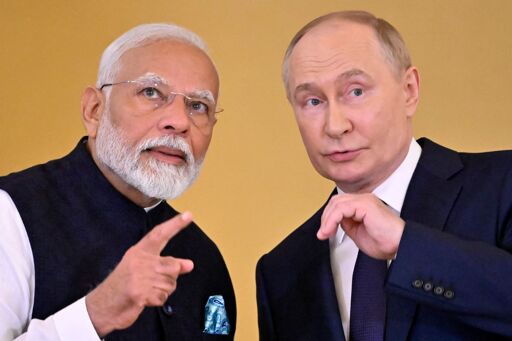
India’s balancing act between Russia and Ukraine faces a key test this week as it hosts Russian President Vladimir Putin amid Moscow’s war against Kyiv.
The Thursday-Friday trip is Putin’s first to India since Russia invaded Ukraine in 2022, and the Kremlin says he and Indian Prime Minister Narendra Modi will discuss their “particularly privileged strategic partnership.” It will test how far Modi will go to preserve India’s energy and defense ties with Moscow while under pressure from Kyiv, Washington, and European capitals to help curb Russia’s war effort.
For Putin, the trip is a chance to show he is not isolated and to shore up vital oil and arms ties with a major power in the Global South.
Analysts in Kyiv are apprehensive and question whether Modi will live up to his August 2024 pledge to Ukraine’s President Volodymyr Zelensky to help bring an end to Russia’s war while meeting Putin. European diplomats also hope that India will take Europe’s security interests into account when engaging with the Russian leader.
What’s at stake for Russia-India ties?
The decades-old friendship between India and Russia dates back to the early years of the Cold War, when the Soviet Union supported India in its 1971 war with Pakistan. Since then, Indian leaders have often referred to Russia as the subcontinent’s most reliable friend.
“Russia is an old relationship, it’s a serious relationship, it’s a strong relationship,” Indian politician and member of the country’s opposition party Shashi Tharoor told journalists in New Delhi on Wednesday, calling the upcoming meeting between Modi and Putin “very important.”
New Delhi is also Moscow’s key trade ally, with bilateral trade totaling $68.7 billion between 2024–25. During the two-day meeting, Russia and India are expected to bolster trade ties and sign new defense, energy, and transportation agreements.
According to Shairee Malhotra, deputy director at the Observer Research Foundation (ORF) in New Delhi, Putin’s visit will reaffirm India-Russia ties and shows that Russia is far from isolated, particularly in the Global South, where countries have their own priorities and may not necessarily share Western or European sentiment toward Moscow.
Since Russia’s full-scale invasion of Ukraine began in 2022, Modi has held talks with both Putin and Zelensky and has called for a cessation of violence. Yet on the global stage, India has remained officially neutral and repeatedly abstained from resolutions condemning Russia’s actions at the United Nations, a position it also maintained in 2014, when Russia annexed Crimea.
Despite Western efforts to sanction Russian oil companies, a key source of revenue funding Moscow’s war, India has continued to import seaborne Russian crude oil.
But after Trump imposed 50% tariffs on Indian exports, including a 25% penalty for buying Russian oil in August, Indian oil imports from Russia fell by nearly a third, according to analytics company Kpler.
Oksana Nesterenko, an international policy and legal analyst and associate professor at the National University of Kyiv-Mohyla Academy, said Putin will use the upcoming meeting “to convince Modi to return to previous conditional oil agreements or even increase oil purchases in the future.
“That can provide serious economic sustenance for Russia with its very weak economy these days,” she added.
What’s at stake for Ukraine?
In August, Modi became the first Indian prime minister to visit Kyiv, where he signed four cooperation agreements, and told Zelensky that he was ready to play a role in bringing peace and added that India respected Ukraine’s “sovereignty and territorial integrity.”
Anil Trigunayat, a former Indian diplomat, who has worked as deputy chief of mission in the Embassy of India in Moscow and has also served as India’s ambassador to EU member Malta, stressed that Modi will reiterate the importance of ending the war with Putin this week.
“During the discussions, global and regional developments will be discussed including Putin’s perspective on U.S. President Donald Trump’s Peace Plan,” he said.
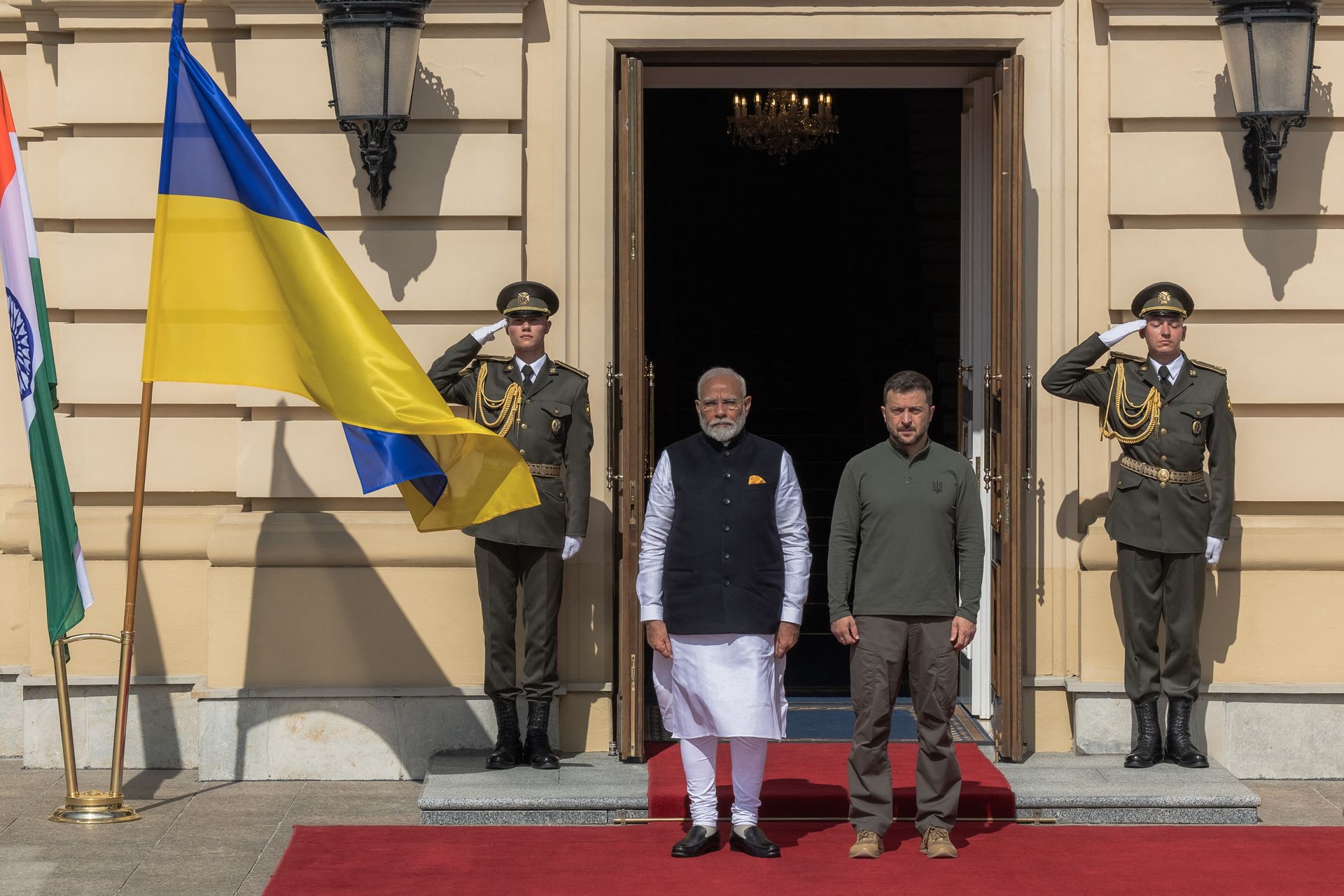
President Volodymyr Zelensky ® and Indian Prime Minister Narendra Modi (L) in Kyiv, Ukraine, on Aug. 23, 2024. (Roman Pilipey / AFP / Getty Images)
But Ukraine will watch how that plays out amidst India’s energy ties with Russia, according to Nesterenko.
“If Putin succeeds [in convincing India to continue importing oil], it is a very bad practical sign for Ukraine because it creates a rational source to continue this war against Ukraine,” she said.
Ukrainian leaders have, however, expressed that Kyiv does not seek to pressure India to stop its purchase of Russian oil.
In an interview with Indian media outlet the Print in August, Ukraine’s ambassador to India Oleksandr Polishchuk said this would not “directly influence” current or long-term ties with India.
After the fall of the Soviet Union, India recognised Ukraine as a sovereign country in 1991, and since then, the two countries have focused on bolstering their economic ties.
Bilateral trade between the two countries totalled $1.22 billion between 2024–2025. According to the Embassy of India in Kyiv, the relationship includes trade in agricultural and industrial goods, while pharmaceuticals account for most Indian exports to Ukraine.
The two countries also have a Joint Working Group on Defense Cooperation and agreed to strengthen their defense cooperation after Modi met Zelensky last August. Trigunayat also noted that New Delhi has also provided significant humanitarian assistance to Ukraine during the war.
According to Malhotra, there is potential for India and Ukraine to “cooperate in high-end defense, cyber, and agricultural technologies, including co-production of drones and electronic warfare systems.”
Currently, at the meeting with Putin, New Delhi seeks to purchase additional S-400 air defense units from Moscow, but Russia’s ongoing war in Ukraine has delayed deliveries.
“The war has accelerated India’s diversification of defense imports. Even while units such as the S-400 and traditional weapons systems will continue to remain important, drone warfare is becoming the new battlefield and Ukraine has emerged as a world leader and innovator in this domain, with lessons and expertise to share with India,” Malhotra said.
She added that in the future, India and Indian companies could also have an opportunity to participate in Ukraine’s post-war reconstruction and bolster ties.
What’s at stake for Europe?
Meanwhile, as the European Union and U.K. seek to end the war, European leaders hope India, while adhering to its strategic autonomy, will keep Europe’s overall security interests at heart.
Herve Delphin, EU ambassador to India, pointed to concrete examples of Russian hostility: “We have cyber warfare, which is waged. We have drones flying off, subsea cables cut off, disinformation operations… all of this is documented,” he said on Wednesday, according to Indian daily The Print. “Russia is an aggressor… hostile to Europe’s interests. So I think India has to factor that in,” he added.
Malhotra said that Putin’s visit to India is bound to ruffle feathers in Europe but may not substantially change the upward trajectory of India’s relations with the EU and its member states, which have strengthened in recent years against the backdrop of India’s balancing act and the Russia-Ukraine war.
“In today’s volatile geopolitical and geoeconomic landscape, both the EU and India view each other as a priority, and therefore, the Free Trade Agreement is being negotiated with urgency, even while the EU’s 19th package of sanctions against Russia included some Indian entities,” she said.
She warned, however, that questions of strategic trust could still limit a deeper EU-India security partnership.
From The Kyiv Independent - News from Ukraine, Eastern Europe via this RSS feed
You must log in or # to comment.