

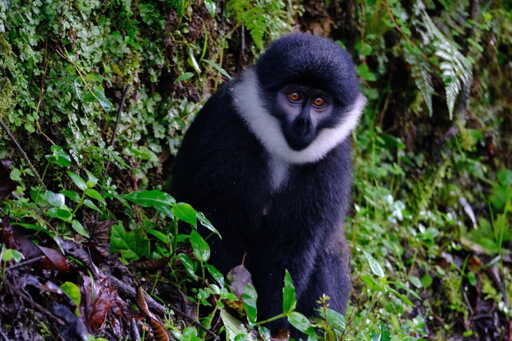
NYUNGWE NATIONAL PARK, Rwanda — It’s a cool morning in the montane rainforest of western Rwanda’s Nyungwe National Park. Sunbeams stream down from the canopy, glowing in the mist. Birdsong pierces the still air. Jacques Habimana, a baby-faced 23-year-old trail guide, stops abruptly, pressing a finger to his lips. He points toward the treetops. A troop of a dozen or so blue monkeys rustles in the leaves, jumping from branch to branch and peering down with eerie orange eyes ringed with gray fur. They skitter back into the shadows. A few meters down, the trail opens into a panoramic view of the hills beyond — dark, undulating waves that roll into the horizon. A blue monkey (Cercopithecus mitis) in Rwanda’s Nyungwe National Park. Image by Ashoka Mukpo for Mongabay. To walk through Nyungwe’s emerald tangles is to be bathe in nature’s quiet majesty. One of the largest montane rainforests in Africa, its treetops host eastern chimpanzees, colobus monkeys, and 11 other primate species. Two hundred different kinds of orchids grow here, upon which one of 300 varieties of butterfly might land. A bird-watcher’s paradise, 30 of its 350 or so avian species are only found here in East Africa’s Albertine Rift. In 2023, the 1,019-square-kilometer (393-square-mile) park was bestowed with World Heritage status by UNESCO. By any measure, it is a special place. Habimana’s shirtsleeve displays a circular patch with two letters in bold embroidering: an A and a P. It’s the logo of African Parks, Nyungwe’s new warden. In…This article was originally published on Mongabay
From Conservation news via this RSS feed
You must log in or # to comment.