

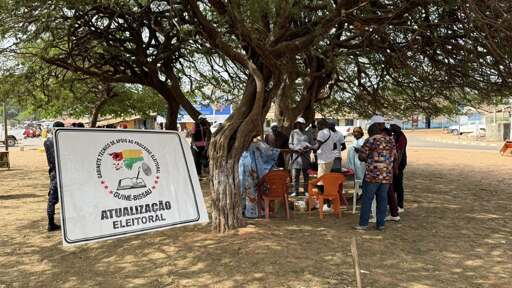
Seizing the ballots, tally sheets, and computers from the offices of Guinea-Bissau’s National Election Commission (CNE), soldiers have destroyed the servers storing the voting data submitted by the various Regional Election Commissions (CREs).
“We do not have the material and logistic conditions to follow through with the electoral process,” Idrissa Djalo, a senior official of the CNE, said on Tuesday, December 2. The CNE’s HQ came under attack on November 26, one day before it was scheduled to announce the results of the Presidential and parliamentary elections held on November 23. However, opposition parties are not convinced by Djalo’s reasoning that the CNE is unable to announce election results under the circumstances.
When the “regional tabulation was concluded at the national level and throughout the diaspora,” on November 26, the “minutes were already in the possession of the… candidates, representatives of the Public Prosecutor’s Office, and the Judicial Police,” said a statement by the National Campaign Directorate for Fernando Dias da Costa.
“Furthermore, a copy of the minutes and all electoral operation documents are delivered to the Regional Governor, who keeps them under his custody and responsibility. [Therefore], it is evident that conditions exist for the conclusion of the electoral process.”
Demanding the “convening of the CNE plenary and the publication of the results”, the statement condemned the “Executive Secretariat of the CNE” for collaborating with the “coup d’état staged by” Embaló in an “attempt to sabotage the electoral process.”
Opposition parties maintain that data submitted by the CREs show that Dias had won with over 50% of the votes. National and international electoral observers had also agreed that incumbent Umaro Sissoco Embaló had been voted out.
Swearing himself in as the president in 2020 at a hotel guarded by soldiers after a disputed election, Embaló has since dissolved the parliament twice. To thwart the return to constitutional order by preventing the transfer of power after losing elections, Embaló staged this coup, according to opposition parties and members of the dissolved parliament.
Read: Guinea-Bissau: A coup staged to protect the neocolonial order?
Claiming to be under arrest while still communicating with the French media, Embaló flew to neighboring Senegal a day after the staged coup on November 27. He was not welcome. Progressive Senegalese protested alongside Guinea-Bissau’s diaspora against hosting him in the country.
Dismissing his claim that he was the victim of a coup as a “sham” orchestrated by himself, Senegal’s Prime Minister Ousmane Sonko said in a parliamentary session on November 28: “We want the electoral process to continue. The [electoral] commission must be allowed to declare the winner.”
On November 29, Embaló flew from Senegal’s capital, Dakar, to Brazzaville, capital of the Republic of Congo.
The following day, Guinea-Bissau’s diaspora population protested in Paris, London, Portugal’s Porto, and Brazil’s São Paulo, demanding disclosure of the electoral results and release of political prisoners held by the military.
Among the high-profile political prisoners is Domingos Simões Pereira, president of the dissolved parliament and leader of the historic African Party for the Independence of Guinea and Cape Verde (PAIGC), which had led the liberation struggle against Portuguese colonialism. He was Embaló’s main challenger, barred from contesting the election at the last moment.
Read: With PAIGC barred, will elections in Guinea-Bissau legitimize a neocolonial dictatorship?
The PAIGC-led coalition then backed the candidacy of the Party for Social Renewal (PRS) leader Dias, who is said to have won the election. Dias himself narrowly escaped capture by soldiers and has found asylum in Nigeria.
On December 2, security forces detained another member of parliament, Marciano Indi, at the Osvaldo Vieira airport, where he was waiting for his flight to Nigeria’s capital, Abuja, to attend a parliamentary session of the Economic Community of West African States (ECOWAS).
Earlier, on November 27, ECOWAS had suspended Guinea-Bissau from all decision-making bodies. Then on November 29, the African Union (AU) also announced its suspension of the country “from all AU activities until constitutional order is restored.”
The post Election results withheld after “staged” coup in Guinea-Bissau; opposition cries foul appeared first on Peoples Dispatch.
From Peoples Dispatch via this RSS feed