

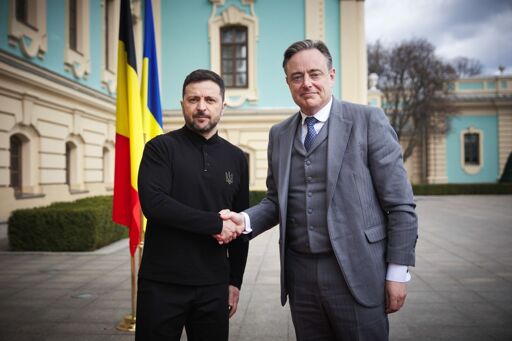
Ukrainians say that Belgium’s Prime Minister Bart de Wever holds the key to Russia’s defeat, after he said that Russia’s loss in Ukraine was a “total illusion.”
De Wever was speaking in an interview with Belgian newspaper La Libre on Dec. 2, the day before the European Commission announced a “reparations loan,” a plan that could lend up to 210 billion euros in immobilized Russian central bank reserves to Kyiv.
“But who really believes that Russia will lose in Ukraine? It’s a fairy tale, a total illusion,” said de Wever.
Ukraine will run out of cash by mid-2026 without additional aid, but de Wever has expressed staunch opposition to the reparations plan, calling it “fundamentally wrong.”
Ukrainian officials, lawmakers, diplomats, and soldiers warn that by opposing the plan, de Wever is protecting Russia more than he is protecting Ukraine’s, Europe’s, and even Belgium’s own security.
“The quickest path to ensure a just and lasting peace in Ukraine and Europe is to make sure that Russia understands that it cannot win a war of attrition,” Iryna Mudra, President Zelensky’s top legal advisor, told the Kyiv Independent.
“The only way that this can be done is to make use of the Russian immobilized assets. The reparations loan is a perfectly legal, economically sound, and politically necessary instrument to ensure Ukraine’s — and Europe’s — defense against Russian imperialist aggression, which will not stop at Ukraine, regardless of the outcome of our war,” Mudra said.
The plan, outlined by European Commission president Ursula von der Leyen on Dec. 3, would secure Ukraine’s defense and budget needs for at least the next two years.
De Wever has repeatedly cited legal and financial risks to the plan, and consistently demanded that other European countries sign up to share the burden of any fallout from the scheme. His arguments about the risks are contested by lawyers and financial experts.
He appeared to soften his stance on Dec. 4, saying that Belgium is “prepared to make sacrifices” and that “we are loyal Europeans, and we are loyal to Ukraine.”
A senior Ukrainian diplomat, who was granted anonymity to speak freely, emphasized that Russia will only negotiate in good faith when Ukraine has adequate resources to pursue peace through strength.
“The key to ending the war is in Brussels right now, not in Moscow, not in Washington, not in Kyiv. It’s in Brussels — both the EU part and the Belgian part,” the diplomat said.
Although de Wever’s approval for the reparations loan might not technically be required under the proposed plan, European leaders are racing to persuade Belgium to get on board.
De Wever also said in the interview with La Libre that Russia has made direct threats against Belgium and him personally, and that he would feel the consequences of any such reparations loan plan “for eternity.”
Brussels Airport — the country’s main airport — was closed last month after drones were spotted nearby. Unidentified drones were spotted over a military airfield housing Belgium’s F-16 fighter jets for three consecutive nights between Oct. 31 and Nov. 2.
“Putin continues to intimidate European leaders — and they continue to be intimidated,” Yaroslav Yurchyshyn, lawmaker from the opposition Holos party, told the Kyiv Independent.
“Ukraine has already proven to the world several times that it can achieve the impossible and has been quite successful in stopping what was once considered the second-strongest army in the world,” he added.
“Free,” a lieutenant colonel serving in Ukraine’s Eastern Air Command, responded to the Kyiv Independent’s request for comment with a link to the Wikipedia page “Belgium in the Second World War,” adding, “Where are your balls?” — the soldier’s pointed way of calling out Belgium for what he perceives as a lack of understanding of the stakes.
Soldiers are not permitted to speak to the press, so the Kyiv Independent is identifying the soldier by call sign only.
De Wever also said that in any war, the losing side must abandon all or part of any frozen assets and compensate the winners.
Several people who spoke to the Kyiv Independent pointed out that the idea that the loser pays has not been relevant for 80 years since the U.N. charter was adopted, and that Belgium was one of 94 countries that voted in November 2022 for a U.N. resolution calling on Russia to pay reparations to Ukraine, which is not conditional on whether Russia wins or not.
Oleksandr Merezhko, member of parliament of Zelensky’s Servant of the People party, called de Wever’s stance “deeply immoral,” adding that “he is trying to find excuses and arguments not to do what is required by international law and justice — to give Russian assets to the victim of aggression.”
Olena Halushka, an activist from the International Center for Ukrainian Victory, said that the actions of the Belgian government were “hypocritical.”
“On one hand, they stress that they defend the rule of law, on the other hand, they explicitly say that countries which have nuclear weapons must be given full impunity for committing genocide, crimes against humanity and war crimes,” Halushka said.
De Wever also said that Russia’s defeat wasn’t a desirable outcome due to the risk of instability in a country that has nuclear weapons. The biggest nuclear power in history, the Soviet Union, disintegrated in 1991.
Several Ukrainians who spoke to the Kyiv Independent expressed they were dumbfounded by Western Europe’s inability to grasp Russia’s motivations and ambitions.
“Russians are terrified of only one thing — that one million people, made up of the worst corners of Russian society like convicts, will come home and start raping, killing, and looting,” said the diplomat.
“There is no way they will ever let the Russian army come home. It’s much scarier than NATO’s Article 5,” noting that “Finland or the Baltics will be next” unless Russia is stopped.
“I have the feeling that an increasing number of people in Europe are tired of a prolonged 1938 — they want 1939,” said Halushka.
Additional reporting by Martin Fornusek.
From The Kyiv Independent - News from Ukraine, Eastern Europe via this RSS feed