

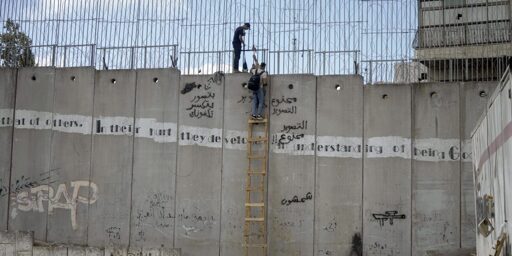
For many years, Arafat Qaddous worked construction jobs in Israel.
He was one of around 130,000 Palestinians living in the occupied West Bank with permits from the Israeli authorities to cross the separation wall into Israeli territory as a laborer. With his lawful employment inside the Green Line, which separates the West Bank from Israel, he was able to go back and forth from his hometown of Iraq Burin, near Nablus in the north, to whichever Israeli city offered work.
Before the Covid pandemic, the 51-year-old Qaddous’s work in Israel sustained his wife and five children.
His brother Qusai said Arafat’s living conditions worsened over the years, as work opportunities dried up during the pandemic, his family’s needs grew, and the West Bank’s economy tanked.
“My brother risked his life because he needed to provide for his family.”
“There are hardly any jobs in the West Bank,” Qusai said, “and prices of food and goods are extremely high.”
Things got even worse after October 7, 2023: Israel indefinitely paused Palestinian workers’ permits after Hamas’s attack, and Qaddous lost his permit. So when an opportunity presented itself — a job in Taybeh, inside Israel — he took a chance.
“My brother risked his life because he needed to provide for his family at a time when the economic situation was difficult,” Qusai said.
The decision to cross the wall would prove deadly for Qaddous.
On April 26, 2024, Qaddous drove to the barrier. Capped with barbed wire, the wall is over 8 meters tall and runs more than 200 kilometers. Qaddous hoped to jump over it and catch a ride from East Jerusalem to Taybeh. He chose a section of the barrier that separates the Palestinian side of the town of Al-Ram from the Israeli section.
Qaddous paid some local Palestinian men 600 shekels, or $186. The men provided the ladder for getting up the wall, a rope for getting down the other side, and transport to the job site. The men served as lookouts throughout the crossing.
Qaddous climbed the ladder, then mayhem broke out. The lookouts spotted an Israeli police jeep. Qaddous fell to the ground.
“The fall did not kill him immediately,” Qusai said. “Israeli police spotted him as he lay on the ground with a serious head injury and prevented an ambulance from reaching him. He bled out. When they were sure he was dead, they allowed paramedics to take his body.”
Shooting Workers
Forty-four Palestinian workers have died trying to cross the wall since October 2023, when Israeli authorities revoked almost all permits, according to the Palestinian Workers’ Union. The deaths, along with serious injuries inflicted by authorities, happened while workers were being chased by Israeli police, beaten, shot at, or fell after jumping off the separation barrier.
The injuries have been growing more serious. Palestinians are increasingly being shot by Israel’s border police, especially in the legs, following an order from far-right Israeli Minister of National Security Itamar Ben-Gvir, according to the Israeli news outlet Walla. Since the start of 2025, at least 106 Palestinians have been shot in the legs by border police at the Israeli separation wall near Jerusalem — including one this week who was shot in the leg when Israeli forces opened fire, according to the Red Crescent.
Israel’s occupation has shaped the West Bank’s economy for nearly six decades, creating a structure in which Palestinians are largely prevented from building a self-sustaining economy and instead pushed into dependency on work in Israel itself or in its illegal settlements.
Before the Gaza genocide got underway in October 2023, almost 20 percent all Palestinian laborers worked in Israel and or its illegal West Bank settlements — mostly in construction and agriculture. That number nosedived to 4 percent immediately after the Hamas-led attack on Israel set off an Israeli onslaught.
Before October 2023, around a quarter million Palestinians, with and without permits, used to commute daily from the Occupied Palestinian Territories, including 19,000 from Gaza, according to Shaher Saad, the secretary-general of the Palestinian Workers’ Union.
Today, fewer than 15,000 Palestinian laborers with permits travel to Israel for work with permits. The drastic reduction cut off a vital liquidity lifeline that provided them with wages 4 to 10 times higher than what they would earn in the occupied territories, where unemployment is more than 50 percent nationally — about 80 percent in Gaza and 35 percent in the West Bank.
[
Related
Trump’s Gaza Ceasefire Deal Is Already Failing Palestinians](https://theintercept.com/2025/10/17/briefing-podcast-gaza-ceasefire-deal/)
Additionally, since October 2023, Israel has staunched the flow of tax revenue to the Palestinian Authority, the home-rule Palestinian government in the West Bank. Israel has withheld and delayed transfers of the revenues back to the Palestinians in contravention of the Oslo Accords, the diplomatic agreement that established the PA and set the stage for a two-state solution whose prospects have all but vanished.
With public salaries hit by the withheld tax revenue and cash running increasingly short, about 40,000 Palestinians with no permits continue to cross into Israel illegally, despite the increased risk of the Israeli crackdown, according to Saad.
[
Read our complete coverage
Israel’s War on Gaza](https://theintercept.com/collections/israel-palestine/)
For years, Israel has regarded Palestinians — many of whom work in low-skilled positions — as a pool of cheap labor.
Bringing them into the Israeli labor market was presented as a way to boost Palestinian living standards, on the assumption that hardship breeds resistance. Economic gains and financial reliance on Israel, on the other hand, would deter Palestinians from challenging the status quo, helping maintain Israeli dominance.
A structure was created wherein any worker can easily be replaced by the thousands desperate for permits.
At the same time, however, Palestinian workers were far from equal in the workforce. With no guaranteed sick leave, no pension, delayed or denied benefits, and with work permits tied to a specific employer, a structure was created wherein any worker can easily be replaced by the thousands desperate for permits. Palestinian laborers were cheap and disposable. And their mistreatment has worsened since October 7, according to Mohammad Blidi, who heads the workers’ union in Tulkarem, a Palestinian city near the separation wall in the northern West Bank.
“As an occupying power, Israel is legally obliged to provide work for Palestinians, and to respect international labor laws,” Blidi said. “What is happening in reality is far from it. On a daily basis, Palestinian workers are subject to humiliation and beatings.”
Laborers From Gaza
On the day of the October 7 attacks, Israel detained thousands of Palestinian workers from Gaza who were in working on permits inside Israel. Although they had the necessary Israeli-issued permission, they were held for a month at least, many beaten and interrogated.
That the detained workers were legally in Israel, with permits and the attendant security vetting, according to Blidi, suggests they were detained mainly because they had come from Gaza.
[
Related
Dozens of Gaza Medical Workers Are Still Disappeared in Israeli Detention](https://theintercept.com/2025/11/10/gaza-doctors-disappeared-israeli-prison/)
The arrests were carried out “secretly and illegally,” according to Gisha, an Israeli group that advocates for Palestinians’ right of movement. There was no legal basis for moving the workers into detention centers, the group said, and they were effectively disappeared, with Israel refusing to disclose the workers’ identities and whereabouts.
Many of the workers described being mistreated in detention — left without food, water, medication, a mattress, or toilet access. They endured harsh violence and psychological abuse, reporting torture and degrading treatment. Israeli soldiers seized all cash and mobile phones from the workers, and two died in Israeli custody.
In one case, a 40-year-old Palestinian man from Gaza City who worked in the Israeli city of Ashkelon on the day of the attack had to flee to Hebron when news came out that laborers from Gaza were being targeted by Israeli police.
Since he could not go back to Gaza, he hunkered down with several other workers in the southern West Bank city awaiting his fate, the man, who requested anonymity for fear of his safety, said in an interview. Then he received word that his pregnant wife and four of his children — two boys and two girls — had been killed in an Israeli airstrike in Gaza City. Only one child survived, but the boy’s leg was seriously injured and he lost an eye in the attack.
Just two days into mourning, the worker was awakened by a loud explosion in the pre-dawn hours. Israeli soldiers blew up the door to the house he was staying in and detained him, along with the others.
“They tied our hands behind our backs and blindfolded us before beating us,” he recalled. “They took us to the Israeli settlement of Kiryat Arba and from there to another prison that they didn’t disclose. For nine days, we endured tortuous interrogations. Every day, they asked different questions about Gaza. I told them I’m just a worker.”
He was once again transferred to another prison for a day — and in the dead of night, he and several other workers were dumped at the border with Gaza. They all entered the Strip by foot.
“I was in the south and couldn’t go back to Gaza City,” he said. “I couldn’t bury my wife and children. I couldn’t say goodbye to them.”
It took 20 days for him to be reunited with his son. They moved into a tattered tent that flooded with the recent winter storms.
He said that, working in Israel, he had been able to save over $10,000.
“It’s all gone now,” the man said. “I only have four shekels” — about $1 — “in my pocket. I used to be able to work and provide for my family. But now, there is no life.”
The post Israel Revoked a Palestinian’s Work Permit. When He Tried to Cross the Wall, They Shot Him and Left Him to Die. appeared first on The Intercept.
From The Intercept via this RSS feed