

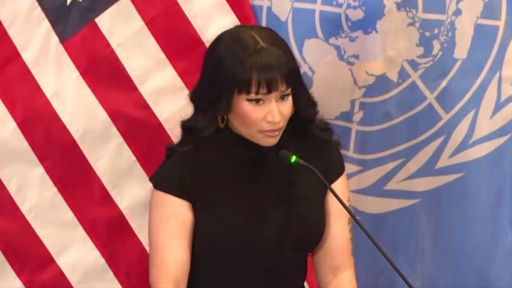
The United States intensified its claims that Nigeria is facing a “genocide against Christians” during a special event at the United Nations held in November called “Combating Christian Violence and the Killing of Christians in Nigeria”. The session, led by US Ambassador Mike Waltz, featured American rapper Nicki Minaj as one of the keynote speakers, and further amplified a narrative that Nigerian officials and regional analysts have repeatedly dismissed as misleading and politically motivated.
The UN event follows a recent wave of rhetoric by US President Donald Trump, who alleged widespread, systematic killings of Christians in the West African nation. Nigeria has rejected the accusations, insisting they are based on distorted reports and selective data that ignore the complex security realities in the country. Officials acknowledge the ongoing threat of Boko Haram and other armed groups but argue that the situation cannot be reduced to a one-sided religious persecution narrative.
Media organizations, including the BBC, have also noted that several of the claims circulating in US political circles cannot be independently verified.
Nicki Minaj repeats Trump’s narrative at UN stage
Nicki Minaj, whose earlier social media statements echoed Trump’s message, reiterated her comments at the UN event. She stated:
“In Nigeria, Christians are being targeted, driven from their homes and killed. Churches have been burned, families torn apart, and entire communities live in fear constantly, simply because of how they pray.”
Her remarks closely mirrored the religious persecution framing popularized in US conservative media, which African analysts argue oversimplifies a multidimensional conflict involving poverty, state fragility, armed groups, climate pressures, and competition over land and mineral resources.
African analysts push back
Journalist David Hundeyin, speaking to BreakThrough News, challenged the US framing, saying the violence in northern and central Nigeria cannot be understood simply as a religious conflict. He stressed that:
Boko Haram and affiliated groups have killed between 50,000 and 150,000 people, though the exact numbers remain unclear. The majority of victims have been Muslims, not Christians, since most violence occurs in predominantly Muslim regions of the north and middle belt.
Armed groups attack both Christians and Muslims, and “everyone is dying in numbers … they’re all poor people and powerless.”
According to Hundeyin, framing the conflict as religious persecution masks a deeper geopolitical struggle over Nigeria’s enormous mineral wealth, including rare earth elements crucial for global technology industries. He argues: Presenting the conflict as “Islamists killing Christians” provides a moral pretext for deeper US involvement in a region with strategic resources.
A key part of Hundeyin’s critique is the near-total absence of Muslim deaths in Western coverage. Although Muslims make up the majority of victims, their deaths rarely appear in narratives circulated in US conservative politics, which instead portray Nigeria as the world’s “epicenter of Christian persecution”.
Read more: Trump threatens war on Africa’s most populous country to “save” “our CHERISHED Christians”
As Pavan Kulkarni wrote in a Peoples Dispatch report last month, “The majority of people killed by the Boko Haram and Islamic State West Africa Province are Muslims, simply because they make up the majority in the northern region these Islamist insurgencies are ravaging. For the same demographic reasons, Muslims are also the majority victims of bandits who kill, loot, and kidnap in the northwest region, where the state is struggling to enforce the rule of law. In the central region, Christian victims of violence are in the majority, not because of their religious identity but because of their occupation: farming. Amid intensifying competition over depleting land and water due to climate change, raids on farmlands by mobile herders, groups of whom are armed, are a serious problem in several African countries suffering desertification.”
The Nigerian government maintains that while terrorism remains a serious challenge, portraying the crisis as a Christian genocide is inaccurate and dangerous. Officials argue that such language obscures the socio-economic drivers of violence, including state collapse in rural areas, the proliferation of weapons, land-use conflicts, and climate-related displacement across the Sahel.
Read More: World Bank acknowledges poverty increase in Nigeria, but doubles down on the reforms causing it
African Union issues statement
The African Union Commission (AUC), released a statement, reaffirming its commitment to sovereignty, non-interference, religious freedom, and the rule of law as outlined in the AU Constitutive Act, and expressed concern over US allegations accusing Nigeria of targeting Christians and threatening military action, emphasizing that Nigeria is a longstanding and vital AU Member State whose sovereign right to manage its internal affairs, particularly regarding security, human rights, and religious freedom, must be fully respected by all external partners.
Nigeria’s struggles with insecurity demand nuanced understanding rather than a blanket accusation of Christians being targeted in the country.
The post US maintains “Christian genocide” narrative at UN special event appeared first on Peoples Dispatch.
From Peoples Dispatch via this RSS feed
You must log in or # to comment.