

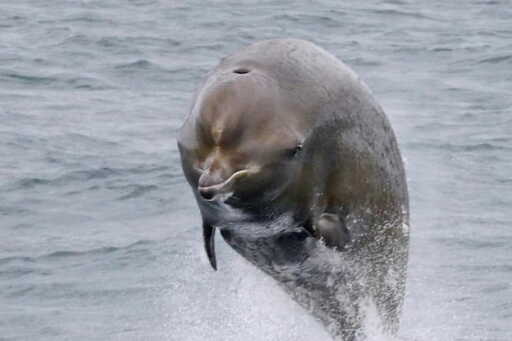
Populations of northern bottlenose whales (Hyperoodon ampullatus), playful animals that resemble large dolphins, stretch across the Atlantic Ocean, with each group of whales living year-round in a particular deep ocean canyon. Historically, commercial whaling targeted these animals, causing their numbers across the basin to collapse. Even as protections against whaling increase, northern bottlenose whale populations struggle to recover globally due to low reproductive rates and ongoing threats such as ship strikes and fishing-gear entanglement. A group of northern bottlenose whales gather at the water’s surface in the Gully, Nova Scotia during a research expedition by the Whitehead Lab in 2017. Image by Deepdivewhales via Wikimedia Commons (CC BY-SA 4.0). But new evidence from a submarine canyon off the coast of Nova Scotia, Canada, known as the Gully, shows a promising rebound. Commercial fishing and vessel traffic are down in the area, and the endangered northern bottlenose whales in this canyon are growing in number after decades of decline, according to a recent study published in the Journal of Applied Ecology. The Gully is one of the few places where scientists have monitored a distinct population long enough to track meaningful trends. Roughly as deep and wide as the Grand Canyon, and with steep walls and channels, it provides critical habitat for a group of northern bottlenose whales known as the Scotian Shelf population. “At the broadest scale, submarine canyons stir up the oceanography, and that typically translates into more productivity, life and food—good for everything!” said co-author Hal Whitehead, a…This article was originally published on Mongabay
From Conservation news via this RSS feed