

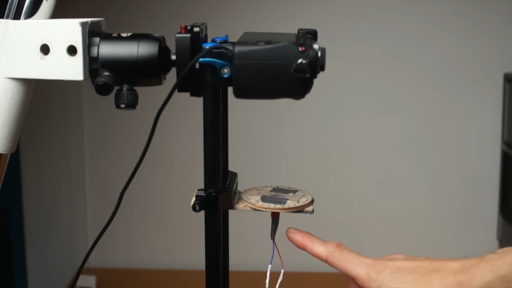
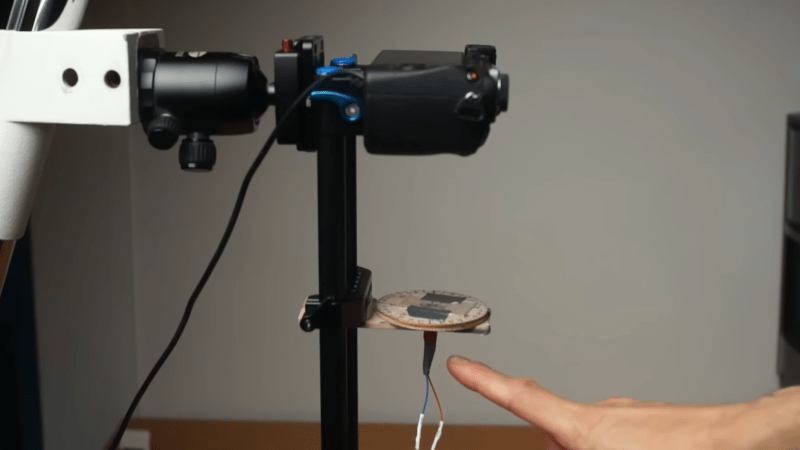
It’s relatively easy to understand how optical microscopes work at low magnifications: one lens magnifies an image, the next magnifies the already-magnified image, and so on until it reaches the eye or sensor. At high magnifications, however, that model starts to fail when the feature size of the specimen nears the optical system’s diffraction limit. In a recent video, [xoreaxeax] built a simple microscope, then designed another microscope to overcome the diffraction limit without lenses or mirrors (the video is in German, but with automatic English subtitles).
The first part of the video goes over how lenses work and how they can be combined to magnify images. The first microscope was made out of camera lenses, and could resolve onion cells. The shorter the focal length of the objective lens, the stronger the magnification is, and a spherical lens gives the shortest focal length. [xoreaxeax] therefore made one by melting a bit of soda-lime glass with a torch. The picture it gave was indistinct, but highly magnified.
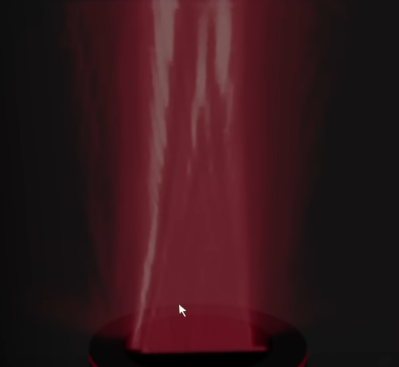
A cross section of the diffraction pattern of a laser diode shining through a pinhole, built up from images at different focal distances.
Besides the dodgy lens quality given by melting a shard of glass, at such high magnification some of the indistinctness was caused by the specimen acting as a diffraction grating and directing some light away from the objective lens. [xoreaxeax] visualized this by taking a series of pictures of a laser shining through a pinhole at different focal lengths, thus getting cross sections of the light field emanating from the pinhole. When repeating the procedure with a section of onion skin, it became apparent that diffraction was strongly scattering the light, which meant that some light was being diffracted out of the lens’s field of view, causing detail to be lost.
To recover the lost details, [xoreaxeax] eliminated the lenses and simply captured the interference pattern produced by passing light through the sample, then wrote a ptychography algorithm to reconstruct the original structure from the interference pattern. This required many images of the subject under different lighting conditions, which a rotating illumination stage provided. The algorithm was eventually able to recover a sort of image of the onion cells, but it was less than distinct. The fact that the lens-free setup was able to produce any image at all is nonetheless impressive.
To see another approach to ptychography, check out [Ben Krasnow’s] approach to increasing microscope resolution. With an electron microscope, ptychography can even image individual atoms.
From Blog – Hackaday via this RSS feed
Says without lenses, then explains how he made a lens