

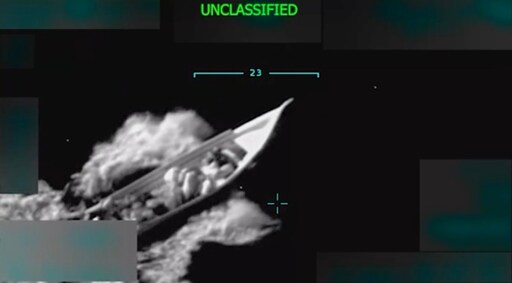
Lawmakers who saw a video of a U.S. attack on wounded and helpless people clinging to the wreckage of a supposed drug boat on September 2 described the footage as deeply disturbing.
A small number of members of the House Permanent Select Committee on Intelligence and the Senate and House Armed Services committees, as well as some staff directors, saw the recording during closed-door briefings Thursday with Adm. Frank M. Bradley, the head of Special Operations Command, and Gen. Dan Caine, the chair of the Joint Chiefs of Staff.
“What I saw in that room is one of the most troubling scenes I’ve ever seen in my time in public service,” said Rep. Jim Himes of Connecticut, the top Democrat on the House Intelligence Committee. “You have two individuals in clear distress without any means of locomotion with a destroyed vessel who were killed by the United States.
Until Thursday, the only video of the attack that had been seen by lawmakers was an edited clip posted to the Truth Socialaccount of President Donald Trump on September 2 announcing the strike. The edited clip captures the initial strike, showing a four-engine speedboat erupt in an explosion. It does not show the second strike on the wreckage of the vessel and the survivors — which was first reported by The Intercept.
Himes said the unedited video clearly shows the U.S. striking helpless people.
“Any American who sees the video that I saw will see the United States military attacking shipwrecked sailors.”
“Any American who sees the video that I saw will see the United States military attacking shipwrecked sailors — bad guys, bad guys, but attacking shipwrecked sailors,” he told The Intercept.
Himes said that Bradley — who conducted the follow-up strike as the then-commander of Joint Special Operations Command — “confirmed that there had not been a ‘kill them all’ order.” The Washington Post recently reported that Hegseth personally ordered the follow-up attack, giving a spoken order “to kill everybody.”
Sen. Jack Reed of Rhode Island, the top Democrat on the Armed Services Committee, also expressed dismay after watching the footage. “I am deeply disturbed by what I saw this morning. The Department of Defense has no choice but to release the complete, unedited footage of the September 2 strike, as the President has agreed to do,” he said on Thursday.
“This briefing confirmed my worst fears about the nature of the Trump Administration’s military activities, and demonstrates exactly why the Senate Armed Services Committee has repeatedly requested — and been denied — fundamental information, documents, and facts about this operation. This must and will be the only beginning of our investigation into this incident,” said Reed.
Trump has said he supports the release of the video showing the second boat strike that killed the remaining survivors of the initial September 2 attack. “I don’t know what they have, but whatever they have, we’d certainly release, no problem,” Trump told reporters in the Oval Office on Wednesday.
Brian Finucane, a former State Department lawyer who is a specialist in counterterrorism issues and the laws of war, told The Intercept that intense scrutiny needs to extend far beyond the first strike in the U.S. operation in the waters near Venezuela.
“Oversight needs to be broader than this one incident. It needs to cover the entire maritime bombing campaign. And it needs to go beyond the Department of Defense,” he told The Intercept. “We need to know how this policy was formulated in the first instance. What was the process by which some aspect of it got legal blessing from the Justice Department’s Office of Legal Counsel? That all needs to be drug out into the open.”
The military has carried out 21 known attacks, destroying 22 boats in the Caribbean Sea and eastern Pacific Ocean since September, killing at least 83 civilians. The most recent strike on a vessel was November 15.
Since the attacks began, experts in the laws of war and members of Congress, from both parties, have described the strikes as illegal extrajudicial killings because the military is not permitted to deliberately target civilians — even suspected criminals — who do not pose an imminent threat of violence. Throughout the long-running U.S. war on drugs, law enforcement agencies have arrested suspected drug smugglers rather than relying on summary executions. The double-tap strike first reported by The Intercept has only made worse a pattern of attacks that experts and lawmakers say are already tantamount to murder.
[
Related
Secret Boat Strike Memo Justifies Killings By Claiming the Target Is Drugs, Not People](https://theintercept.com/2025/11/14/boat-strikes-immunity-legality-trump/)
Sarah Harrison, who previously advised Pentagon policymakers on issues related to human rights and the law of war, cautioned against undue focus on the double-tap strike. “I can understand why the public and lawmakers are shocked by the second strike on Sept 2. The imagery of humans clinging to wreckage, likely severely injured, and then subsequently executed, is no doubt jarring. But we have to keep emphasizing to those who are conducting the strikes within DoD that there is no war, thus no law of war to protect them,” said Harrison, a former associate general counsel at the Pentagon’s Office of General Counsel, International Affairs. “All of the strikes, not just the Sept 2 incident, are extrajudicial killings of people alleged to have committed crimes. Americans should have been and should continue to be alarmed by that.”
The Pentagon continues to argue it is at war with undisclosed drug cartels and gangs. “I can tell you that every single person who we have hit thus far who is in a drug boat carrying narcotics to the United States is a narcoterrorist. Our intelligence has confirmed that, and we stand by it,” Pentagon press secretary Kingsley Wilson said Tuesday.
“There is no such thing as a narco-terrorist,” Himes said on Thursday. “Apparently, we have enough evidence to kill these people, but we don’t have enough evidence to try them in a court of law. People ought to sort of let that sink in and think about the implications of that.”
“Apparently, we have enough evidence to kill these people, but we don’t have enough evidence to try them in a court of law.”
Sources briefed about the video footage say it contradicts a narrative that emerged in recent days that intercepted communications between the survivors and their supposed colleagues demonstrated those wounded individuals clinging to the wreckage were combatants, rather than shipwrecked and defenseless people whom it would be a war crime to target.
The Pentagon’s Law of War Manual is clear on attacking defenseless people. “Persons who have been rendered unconscious or otherwise incapacitated by wounds, sickness, or shipwreck, such that they are no longer capable of fighting, are hors de combat,” reads the guide using the French term for those out of combat. “Persons who have been incapacitated by wounds, sickness, or shipwreck are in a helpless state, and it would be dishonorable and inhumane to make them the object of attack.”
“The notion that radioing for help forfeits your shipwreck status is absurd — much less than it enables them to target you,” said Finucane. “I don’t believe there’s an armed conflict, so none of these people are lawful targets. They weren’t combatants, they’re not participating in hostilities. So the whole construct is ridiculous. But even if you accept that this is some sort of law of war situation, radioing for help does not deprive you of shipwreck status or render you a target under the law of war.”
The post Video of U.S. Military Killing Boat Strike Survivors Is Horrifying, Lawmakers Reveal appeared first on The Intercept.
From The Intercept via this RSS feed