


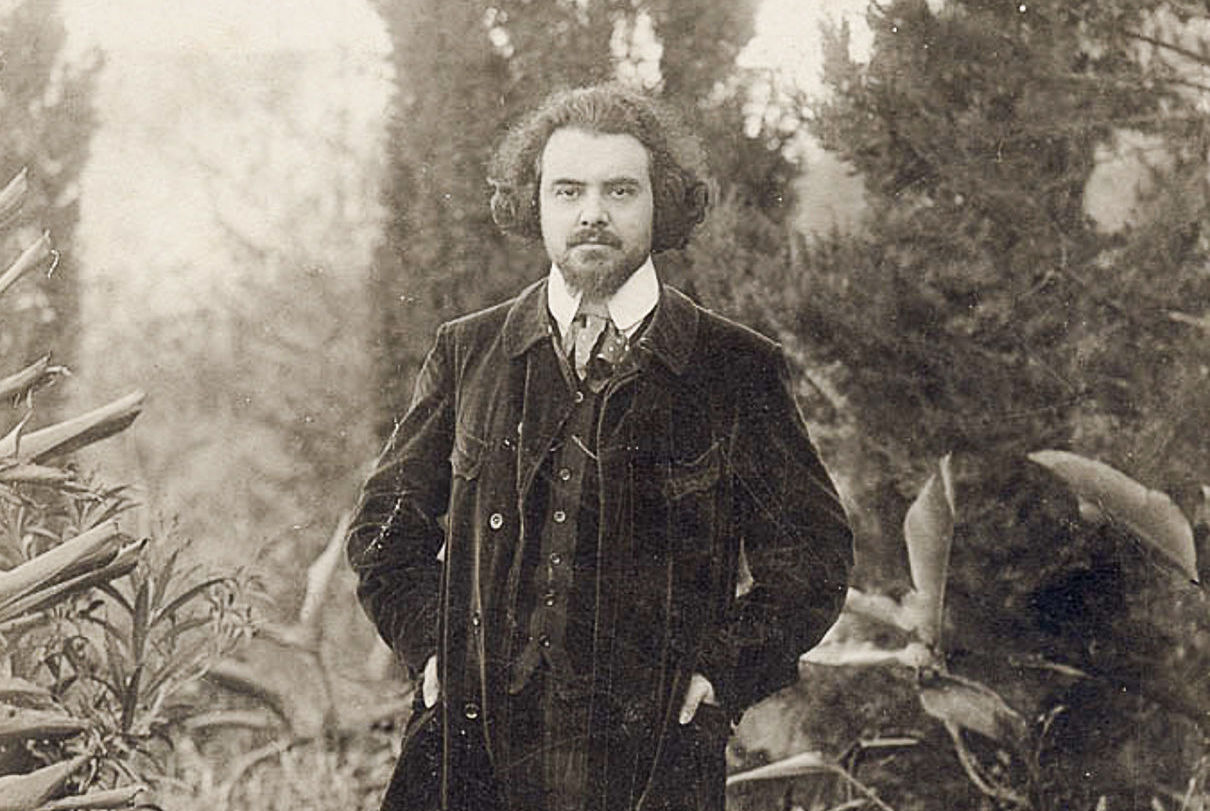
Nikolai Berdyaev in 1912 – Public Domain
You, who saw it all, or who saw flashes and fragments, take from us some example, try and get yourselves together, clean up your act, find your community, pick up on some kind of redemption of your own consciousness, become mindful of your own friends, your own work, your own proper meditation, your own art, your own beauty, go out and make it for your own Eternity.
—Allen Ginsberg, in the movie Rolling Thunder Revue: A Bob Dylan Story (2019)
This mechanical civilization, reducing everything to one level, depersonalizing man and depriving him of value – this diabolically technical civilization now all too closely resembles black magic; it is pseudo-being, illusory being, being turned inside out.
– Nicolai Berdyaev, The Meaning of the Creative Act
The most regretful people on earth are those who felt the call to creative work, who felt their own creative power restive and uprising, and gave to it neither power nor time.
–Mary Oliver, Hunger for Eternity
There’s a crucial historical struggle besides the one against kings and tyrants, oligarchs and plutocrats, though they are connected. The choice one faces appears to be either to save the world or save (redeem) oneself. But for those paying attention, it can now be seen, this is a false distinction. Personal redemption, a spiritual matter, is no longer “just personal.” It too is a standing up to power, not so much a struggle against, as realignment with one’s own creativity. Such a realignment with one’s own creative power effectively “defunds” capitalist power of the source upon which it most depends – the divine spirit from which it vampirishly draws its might.
Poor messenger that I am I do not know how to propagandize persuasively! And – excellent question – why is it even up to me to do so? Better the message come, as it does at the end of Scorsese’s movie Rolling Thunder Revue which I just watched for the first time – from the lips of a real prophet such as Allen Ginsberg – or from Dylan himself – than depend upon a commonplace person like myself for its propagation! If Ginsberg, Dylan and Joni Mitchell , etc, (all of whom appeared in the Revue back in 1975-76) can’t convince people to “pick up on some kind of redemption for your own consciousness…become mindful of… your own art, your own beauty” I very much doubt I can.
In fact, the only way I can see that my doing so makes any sense at all is that I’m not Ginsberg, Dylan, Joni or Joan; moreover, I would not have responded to Ginsberg’s prophetic call to, in essence, change my life back when he spoke those words, if I’d heard them. As is still true for many others, looking around me, I was deaf to such calls. More people than not are “the regretful ones” spoken of by Mary Oliver. The “normal way” is to fall back on worshipping the gods, rather than to be one of them. Nicolai Berdyaev explained this peculiar power of ‘bourgeosity’ (his word) to cause us to deprive ourselves of our human value, as “black magic.” Sorcery’s as good an explanation as we can have for why depersonalizing, dehumanizing techno-bourgeois reality continues to triumph while liberals go on believing if they can get a Democrat in the White House, there can be peace on this troubled earth.
The movie shows how social hierarchy developed naturally around Dylan, the power of his fame, his god-like status having elevated him to the top. Unlike most celebrities, the elevation came in part because he was a prophet, in touch with a mysterious knowing that spoke to peoples’ hearts – especially to young people; connected with his talent and drive his poetic words reached into the popular consciousness that is usually oblivious to poetry and prophecy. But in the movie we see how social hierarchies form even among people who do not believe in them! In a sense, the portent of Ginsberg’s closing words – inviting people to their creativity and their power – cannot reach their target when the hearers have already crowned their king, when the spiritual “dodge” is in. That is, in conscious or unconscious obedience to bourgeois reality, its actual hierarchy hidden behind placating words of democracy and freedom, we remain loyal to its validity over the validity of the heart’s personal truth.
The question this poses is religious: In this secret obeisance to hierarchy, in granting divine/numinous status to another human am I not declining that invitation to pick up some kind of “redemption for my consciousness?” Am I not saying He’s the god, not me, a kind of either/or, zero/sum equation? As I see it, that universal sidestepping of the question posed to each one in her/his soul – with , always its handful of genius exceptions who miraculously heed the call – keeps the disaster of civilization on its hellbent course. But that’s it – we cannot stop the hellbent course by martyr-like thrusting bodies against the barricades – tempting as that kind of heroism is. Or, rather, with an eye toward the words of the prophet Ginsberg, what’s the meaning of that kind of heroic sacrifice if the call to creativity and one’s personal experience of joy has been sacrificed first*?* (And when I speak of creativity I am not so much speaking of that which goes on on Internet platforms; democratic and universally available as it is – that’s more Black Magic; permission granted for following ones’ art in that horizontal world of “all good” is not the act of existential courage I speak of here.)
For what, exactly, am I sacrificing at the barricades if I am one of Oliver’s “regretful ones” who has not known her power or her joy? When in fact the way to the joy of meaning/connection is blocked at every turn, by the complete domination of society by consumer capitalism, in turn which is the logical and only possible outcome in a materialist reality? That is, even those of us who refrain from participating in the consumer insanity of Black Friday, even if I disdain it, in accepting the reduction of reality to materialist, I am fully obeying its rule against my joy.
+++
In Scorsese’s movie, a scene in which Ginsberg and Dylan visit the grave of their hero Jack Kerouac, conveys the sober message that the life of the poets is risky, perhaps it’s there to counter the message of pure triumph in Dylan’s performances! History has flipped many pages since 1975, seemingly dropping us all – except the billionaires and the stubborn believers in progress – deeper into darkness. For a few years, in the early years of our coffeeshop’s existence in Utica, I felt, because of the beautiful vision the Cafe was, I was, truly, “making it for my own Eternity.” With the Cafe now gone, the surrounding darkness deeper, and myself in old age, I’m less sure my case fits the model of the creative life; is my suffering explained by having taken up the creative life? Or is it just my (personal) fate? I try gamely to stick with the “Open Sesame” that worked so well the first time but I get little reassurance in this almost belligerently provincial Utica reality, devoid of the Cafe’s magic, that my creativity – God-in-me – has a chance to redeem me.
It’s entirely possible the vaudevillian touches – the wild hats and clownish make-up, their youth at the time a definite factor – the performers in the Rolling Thunder revue – mislead. The case they make for the freedom of creativity, emphasizing the performance, make art look emphatically counter-cultural. For those of us buried alive in one-dimensional mainstream, for those of us no longer young, maybe we need more prosaic encouragement. This may be why, when I find a fellow kind of more“staid,” conservative promoter of the creative way, as I did in discovering Nicolai Berdyaev, thanks to a reader, I’m so deeply grateful. I leap at the chance to find means to more persuasively shine a light on the pathway out from the “bourgeosity” we’re buried in, in which there can be no challenge to the rise of Trump and increasing fascism, and which is, in fact, why there can be no powerful refutation to fascism.
Because of this personal crisis I’m feeling, I felt I must make a special effort to risk voicing my “barbaric yawp” at the Thanksgiving table last week; that is, in my unbarbaric, civilized, conflicted way, to make the case for the redemptive power of poetry. Having always struggled with giving thanks anyway, my idea was to be honest about that, and to raise up the example of our Cafe as a shared memory we all could celebrate. The event of the Cafe, in the understanding I’m gaining from my reading of Berdyaev’s The Meaning of History, was “both historical and metaphysical… it revealed the depths of life.” While Berdyaev is defining the meaning of Christ’s revelation in history; to me the words precisely fit the miracle our Cafe, with its reckless, beautiful, love energy that changed peoples’ lives. Thus I suggested at the Thanksgiving table to my assembled family the following: we know how phrases like Remember the Maine and Remember Pearl Harbor are used to stir people up for war. Perhaps we who knew the Cafe firsthand should proclaim “Remember the Cafe!” to stir people up to make art “as if you were making something that without your effort and sacrifice is only potential, that is, invisible, having no voice of its own but wanting to exist in this world.”
So you see, I did manage some poetry of my own; to do it was, I submit, a very different experience from sharing on the internet. To make the case for poetry face to face, never sure people share the awareness of that reality with me – or if they do, never speak of it, but will politely hear me out, maybe feeling genuinely glad I spoke, but hearing it only remotely, from across the vast space between given reality and the transcendent one. In the past, I was more sure people were glad I’d spoken, now I’m shakier. But the reward for myself is less ambiguous: I spoke for the unifying reality, put myself on that side against bourgeois sameness, that formulaic, lifeless uttering thanks for this and that – no risk, no change.
In contrast to my family, the merry band of outsiders who still directly serve the Cafe memory through their work for the non-profit The Other Side are more explicitly loyal to poetic reality than my family. (So who is my real family might be asked by some freer spirit than my own! Answer: The more difficult one, of course!) In the Cafe’s aftermath the comrades seem to me to be as uncertain as I am about how to keep the memory alive, to continue to inspire creativity – especially our own! – in soul-deadening bourgeois reality. Where, indeed to go next?
+++
We who’ve been conditioned in the post-metaphysical era have great difficulty treating “the personal” as any kind of elemental need that must be met. In this spiritually reduced context, personally means privately, the private self, often person-as-problem; person as why I’m a failure, or why I can’t quit my job or my addictions, or person who performs to my best and does not ask for more. We do not think of personal as having a legitimate claim on reality; that is, other than being forgiven (our Christian inheritance), we do not know the claim of the personal to know itself as magnificent, exalted, noble, most pleasing in the eyes of the seer. We do not see how we’re conditioned to know only the truth of the collective. But without the personal, through which the depths of life may be revealed, there is only “the false and fictive being.”
However, unbeknownst to ordinary, ego-dominated, conforming consciousness, there is longing in one’s being for exactly this personal recognition! The unrequited longing leads to the constant feeling of misfittedness, for one’s person is misfitted in one-dimensional corporate capitalist materialist reality! The person I am is not real in that reality. Berdyaev ‘Bourgeosity,’ Black Magic, Berdyaev and Bob, in standing up for his own misfittedness in relation to the major social movements of his time, did personal battle with the “Black Magic” he refers to. In maintaining a distance from his fellow socialists although in sympathy with them – he stood up for the spiritual dimension of himself which causes him not to fit in any narrative that excludes it – a crime for which he was twice imprisoned. This heroism on behalf of his own soul (which is the way I would say it), of his being, is what makes Berdyaev, beyond being just brilliant and incredibly erudite, a beacon shining forth from everlasting bourgeois night to hearts forsaken in the modern materialist wasteland.
Reading over Ginsberg’s words once more, I see his repetition of the words “ your own” was intentional; he pointed to the personal. It is a marvelous truth – that in the loveless, soulless material reality, one’s being continues to hold out for recognition and love, and for nothing less – from ourselves. It could just be what save us.
The post ‘Bourgeosity,’ Black Magic, Berdyaev and Bob appeared first on CounterPunch.org.
From CounterPunch.org via this RSS feed
You must log in or # to comment.