

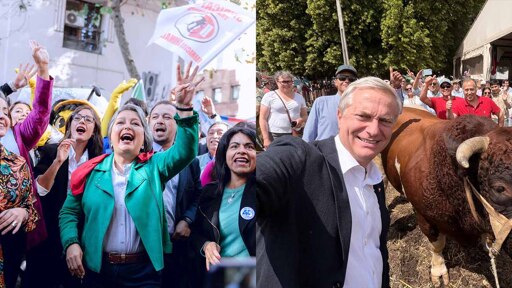
On December 14, Chileans will elect their next president in the second round of presidential elections. The candidates have put forward very different proposals for governance of the Andean country and are positioned ideologically at opposite ends of the spectrum. In the first round, Jeanette Jara, a member of the Communist Party of Chile (PCC) and part of the center-left coalition Unidad por Chile, obtained 26.86% of the votes. On the other hand, the far-right José Antonio Kast obtained 23.93% of the valid votes, not far behind Jara.
In third place was centrist Franco Parisi with 19.71%, followed by right-wing libertarian Johannes Kaiser (13.94%) and right-wing Evelyn Matthei (12.47%).
Thus, going into the second round, many analysts have predicted that the right wing will be able to cobble together a large number of votes, albeit in a fragmented manner. Yet, Jara, who has crafted an extremely moderate discourse, could attract votes from the political center that is resistant to Kast’s ultra-liberal and conservative views. All of that is to say that, the story has not yet been written and there is still room for surprises.
Jara’s social democratic proposals
Jara has declared that she will continue with some aspects pursued by the center-left coalition and deepen others. Her proposal is framed within a strengthening of the state to alleviate and solve some of the problems of Chile’s most needy, without this meaning sacrificing the alliance she proposes with the private sector.
In economic terms, she proposes a minimum wage of 750,000 pesos (about USD 800) per month for workers, thus ensuring a fixed income for their households. She has also proposed “Vital Electricity Consumption” to provide reduced rates that improve the economy of the most impoverished households. She also seeks to strengthen union collective bargaining and sustain the progress made in the pension reform that her coalition recently approved.
In terms of domestic policy, she proposes lifting banking secrecy on several accounts in order to combat money laundering, a growing problem in Chile. She has also said she will tighten gun control to reduce the power that some criminal groups linked to drug trafficking have gained in Chile. Unlike Kast, her immigration proposal does not call for the mass expulsion of foreigners, but rather for immigrants to be registered temporarily for six months. However, she has also said that she will strengthen immigration controls at the borders with the National Police and the Armed Forces if necessary.
In the field of international diplomacy, Jara has taken a very pragmatic stance, promising improved trade relations with the United States, but also with China, Chile’s main trading partner. In addition, after persistent questions from the Chilean press, she said that she considers that there is no democracy in Venezuela and Cuba, which has pleased several actors in the political center, but has also made several leaders of her own party, the PCC, uncomfortable.
Kast’s neoliberal proposals
On the other hand, Kast has articulated his political campaign around criticism of the current Boric administration, calling it inefficient and corrupt, and around a right-wing nationalist anti-immigration discourse.
Economically, Kast, a self-confessed admirer of Javier Milei, proposes a drastic reduction in the size of the state. He has promised a record reduction of USD 6 billion during the first 18 months of his possible government. Added to this measure is the classic neoliberal equation: reducing the tax burden on big capital from 27% to 23%. In addition, he has proposed greater tax breaks for companies that hire workers who may be working in the informal economy.
As for his security policy, Kast, an avowed admirer of the Pinochet dictatorship (1973-1900), proposes increasing the number of police officers and their funding, as well as building several maximum-security prisons. His “Border Shield” plan promises to close border crossings and deport undocumented migrants en masse without delay, a move that has garnered much support from the Chilean right.
This latest proposal has been viewed by several Chilean diplomats and former foreign ministers as cause for concern due to the tensions it could generate with neighboring countries such as Peru and Bolivia, where many migrants originate. In addition, thanks to a harsh right-wing populist discourse, he has declared his rejection and repudiation of the governments of Venezuela, Cuba, and Nicaragua, so diplomacy openly aligned with US interests is expected.
What do the polls say?
Although the runoff election campaign formally began just a few days ago, polls have released initial numbers that predict the tone of the upcoming election campaign.
The media outlet RTVE averaged the most important polls and claims that Kast would have around 51.1% of the vote, while Jara would barely reach 34.9% of the votes if the elections were held today.
Thus, Jara has to fight vote by vote to increase support from the other candidates, while Kast has a better chance of gaining strength, especially from a vote that has clearly been marked by ideological positions (although more out of rejection and antipathy than personal identification).
It is still too early to offer definitive figures, yet analysts warn that the second-round campaign will be fierce and full of personal attacks, suggesting that economic, political, and diplomatic proposals could take a back seat to an electoral campaign steeped in personal passions and hatred.
The post Chile’s presidential runoff: Communist Party Jara vs. far-right Kast appeared first on Peoples Dispatch.
From Peoples Dispatch via this RSS feed