


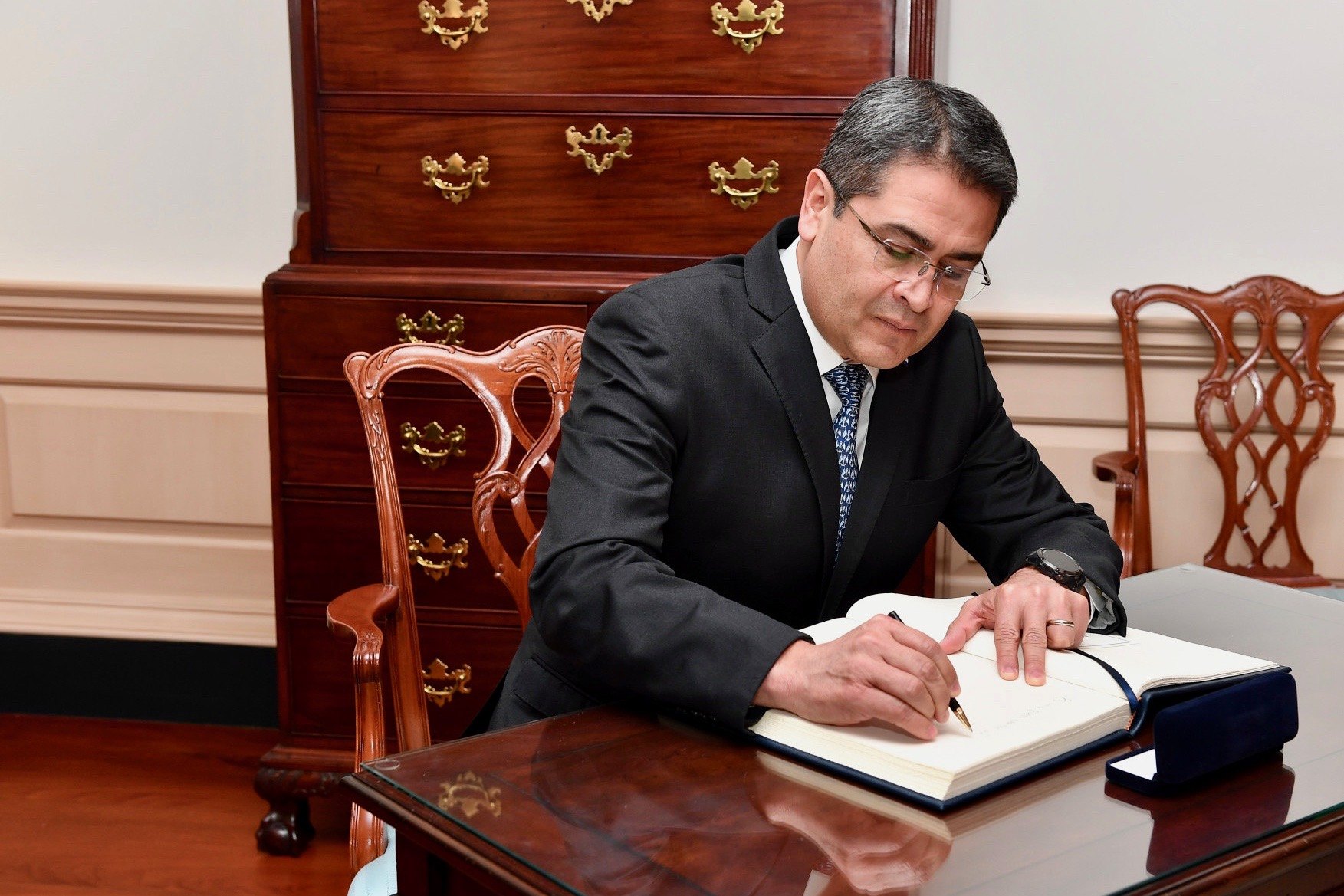
Photograph: U.S. Department of State from United States – Public Domain
The multi-year investigation, prosecution, conviction, and incarceration of former Honduran President Juan Orlando Hernández involved massive costs incurred by the US government that have not been publicly disclosed.
It is known that Juan Orlando Hernández was convicted in a US federal court for drug trafficking and related firearms offenses. He was sentenced to 45 years in prison and ordered to pay a fine of $8 million. The DEA secured his extradition in April 2022. His jury trial lasted for two to three weeks, and he was convicted in March 2024 and sentenced in June 2024.
During his presidency (2014-2022), Honduras reportedly received over $50 million from the U.S. administration for anti-narcotics assistance. The prosecution detailed that Hernández received bribes and drug trafficking proceeds, including $1 million from Joaquín “El Chapo” Guzmán, to finance his political campaigns.
But even beyond the painstaking efforts and financial costs involved, the public should know about the murdereous course central to the drug trafficking conspiracy for which former President Juan Orlando Hernández was convicted.
The evidence presented during the trial showed rampant violence and murder that Hernández facilitated and employed to protect and grow his enterprise. This included “attacking and murdering rival traffickers and those who threatened their grip on the Honduran cocaine trade.”
During the trial, cooperating drug trafficker witnesses admitted to involvement in a staggering number of killings. One witness admitted to having aided in 56 killings. Another witness said he was involved in 78 murders before cooperating with U.S. authorities.
Hernández was convicted not only of the drug trafficking conspiracy but also of conspiracy to use machine guns and “destructive devices” to further the drug conspiracy. The co-conspirators were armed with weapons like AK-47s, AR-15s, and grenade launchers.
One of Hernández’s potential co-conspirators, identified as “CC-2” in court documents, was murdered in a Honduran prison by other inmates after Hernández’s brother was convicted. This was reportedly done to prevent the person from cooperating against others in the conspiracy.
Throughout the trial, the US Justice Department emphasized that the drug trafficking operation was a “corrupt and brutally violent empire.”
And yet. Hernández was considered a strong U.S. ally during his time in office, particularly under the previous Trump administration, due to his cooperation on immigration policies. Hernández’s wife, Ana García, publicly thanked Trump for correcting an “injustice” and drew a parallel between the prosecution of her husband and the legal troubles faced by Trump, claiming both were victims of a “political case” and a “witch hunt.”
The pardon was issued just before the final outcome of a close Honduran presidential election was announced. Trump had also publicly endorsed Nasry “Tito” Asfura, the candidate from Hernández’s conservative National Party, and had suggested that future U.S. support for Honduras was conditional on Asfura winning. The pardon was seen by many as an attempt to boost the morale and turnout of the National Party’s base.
The Federal Election Campaign Act (FECA) explicitly prohibits foreign nationals from making contributions or donations in connection with any U.S. federal, state, or local election. Although FECA does not govern U.S. interference in foreign elections, it underscores a core legal and political principle: the use of money to sway another country’s democratic process is viewed as a threat to sovereignty and fair self-governance.
The first Trump administration publicly endorsed the re-election of Juan Orlando Hernández, despite widespread allegations of fraud and calls from the Organization of American States (OAS) for a redo of the vote.
Honduras has been subject to nearly continuous political and military influence from the United States since the beginning of the 20th century, ranging from direct military landings to quiet diplomatic support for certain regimes.
The 2009 military coup that deposed President Manuel “Mel” Zelaya is typical. While the U.S. government, led by the Obama administration and Secretary of State Hillary Clinton, initially condemned the coup, its subsequent diplomatic actions are widely criticized for effectively legitimizing the post-coup government and prioritizing stability over the immediate return of the democratically elected president, as demanded by the United Nations and the Organization of American States (OAS).
The U.S. decision to back the post-coup elections cemented the power of the conservative faction that supported the coup, ushering in a decade of rule by the National Party (the same party as Juan Orlando Hernández). The post-coup period was marked by an immediate and sustained increase in political violence, human rights abuses, and a skyrocketing murder rate. Many activists and critics of the de facto government were targeted and killed, including the prominent indigenous leader Berta Cáceres.
The political and economic chaos that followed the coup is widely cited by analysts as a major contributing factor to the increased migration of Hondurans seeking asylum in the United States in the years that followed.
In essence, the U.S. justification for its actions was that it was restoring constitutional order and preventing a leftist destabilization of Central America by quickly holding a new election, but critics contend the U.S. effectively blessed a successful coup that created a far less stable and more repressive environment.
The post The Unpardonable Pardoning of Former Honduran President Juan Orlando Hernández appeared first on CounterPunch.org.
From CounterPunch.org via this RSS feed