

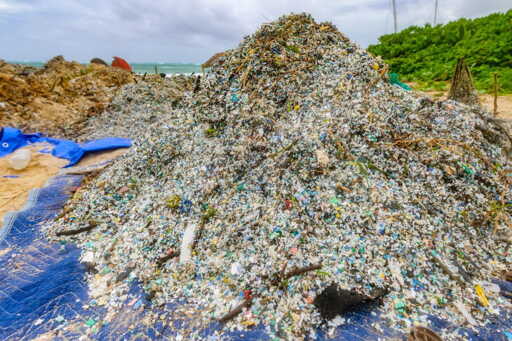
As the sliver of a new moon shines over Kāneʻohe Bay, Oʻahu, millions of tiny orbs ascend from a reef and swirl in the water column. These spheres are bundles of coral eggs and sperm responding to lunar cycles and chemical cues in the water that tell them when to fertilize and where to settle down for their next phase of development. The Hawaiian archipelago’s position near the Pacific Garbage Patch means these bundles often share the water column with microplastics, nefarious little particles that may interfere with these natural chemical cues. Most previous research on corals and microplastics has focused on the effects on adult corals of ingesting or absorbing plastic particles. Few studies have addressed larval stages of coral development or the impact of water contaminated with plastic residue, known as leachate. A coral head in Kāneʻohe Bay, Oʻahu. Image courtesy of Ocean Image Bank/Toby Matthews. The effects of leachate on coral reproduction are complex, according to coral biologist Keiko Wilkins, a researcher at the University of Hawaiʻi at Mānoa. Her most recent study, published in Frontiers in Marine Science, details how leachate affects two different phases of coral reproduction. “The effects that we’re seeing on the fertilization and the effects that we’re seeing on the larvae settling are very different,” Wilkins said. Corals reproduce sexually through one of two methods: spawning or brooding. Spawning coral species release eggs and sperm into the water for external fertilization, while brooding species release larvae that have already fertilized internally. Plastic…This article was originally published on Mongabay
From Conservation news via this RSS feed
You must log in or # to comment.