

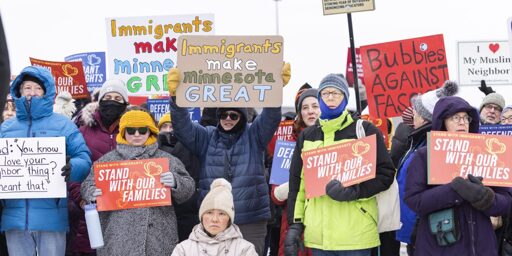
As dozens of agents from U.S. Immigration and Customs Enforcement surged into Minnesota’s Twin Cities this week as part of a federal crackdown targeting the Somali diaspora, it struck fear in the hearts of community members.
It’s not just immigrants, however, worried over ICE’s presence. The rhetoric behind the operation — notably racist rants from Donald Trump about Somalis at large — prompted legal residents of Somali descent to reel from fear.
“I’ve had a number of people reach out to me who are actually U.S. citizens who are wondering if they can have their citizenship revoked for a traffic ticket, or asking how they can prove their citizenship,” said Linus Chan, the faculty director of the University of Minnesota Law School’s Detainee Rights Clinic. “People are worried about their family and friends and neighbors, but even citizens are worried for themselves.”
“This is absolutely a racist weaponization of ICE against an entire community.”
The operation, announced this week amid a rising tide of vitriol aimed at Minnesota’s Somali diaspora, isn’t likely to result in booming deportations from Minneapolis and Saint Paul. The Somali community is largely made up of American citizens and permanent residents.
“Ultimately this isn’t going to yield results in terms of numbers of arrests or removal of people,” said Ana Pottratz Acosta, who leads the Immigration and Human Rights Clinic at the University of Minnesota Law School. “This is absolutely a racist weaponization of ICE against an entire community.”
Though many Somali residents cannot be legally deported, some community members are at risk. In some cases, however, the number of potential immigrants with issues doesn’t accord with the scale of the crackdown.
Take temporary protected status, or TPS, which is bestowed on some refugees in the country. The ICE raids came on the heels of a decision by Trump last month to rescind TPS for Somali residents, effectively depriving them of legal status in the country. While previous moves to rescind TPS for refugee communities have affected hundreds of thousands of refugees from Haiti and Venezuela, the number of Somalis with TPS stood at just 705, according to a congressional report earlier this year. Minnesota Gov. Tim Walz said about 300 Somalis previously receiving protected status are living in Minnesota.
Still, things are tense as reports of ICE raids pop up across the city, according to Luis Argueta, a spokesperson for Monarca Rapid Response, a community group that tracks ICE.
“We’re really feeling it,” Argueta said. “We have cases where ICE is showing up at three or four locations across our Twin Cities.”
Argueta said an observer with Monarca Rapid Response had witnessed an incident in which federal agents grappled with a man of East African descent in front of a house, telling onlookers they were trying to identify the man. In a video of that incident posted to TikTok by MPR, the local NPR affiliate, agents can be heard saying they will release the man if he gives them the information they’re looking for.
“They literally just profiled an East African man.”
“We are identifying who he is,” an agent is heard saying. “We will let you know if there is a warrant.”
Argueta said, “They literally just profiled an East African man.”
According to MPR, the agents left the scene shortly thereafter without anyone in custody. In video captured by a local Fox affiliate showing a similar scene, two men from Somalia were questioned by masked ICE agents before showing their papers and being let go.
And with a dearth of deportable Somalis to detain, ICE agents have been going after Latino immigrants in their stead, Argueta said.
“The rest of the immigrant community in the Twin Cities is on alert,” Argueta said. “It really feels like this administration is going to use whatever narrative that it wants to spin up to justify the damage and the hurt.”
Targeting All Somalis
Minnesota is home to the largest Somali diaspora community in the country, with steady growth since the 1990s, when a civil war drove refugees to the state as part of resettlement programs. In the decades since, Somalis have become a significant minority and a political force, with Democratic Rep. Ilhan Omar as their most visible face.
Omar has been a constant thorn in the side of Trump, who singled her out by name in comments this week justifying the crackdown.
The remarks about Omar were part of escalating rhetoric from the right against Somalis. Last week, Trump made baseless claims in a social media post that “Somalian gangs” were “roving the streets looking for ‘prey.’”
He continued his tirade at a Cabinet meeting on Tuesday, at which he reportedly awoke after dozing off to rage against Somalis, whom he described as “garbage.” Trump spoke of immigrants but also showed little compunction about addressing Somalis at large. Even the New York Times, usually hesitant to directly ascribe bias to right-wing rhetoric, said the “outburst was shocking in its unapologetic bigotry.”
The racist rhetoric from the president and his allies has prompted a sense of “continual pain” in the Somali diaspora, said one community activist, who requested anonymity for fear of retaliation.
“The response from families in the community is one of overwhelming fear, based on what the president is saying,” the activist told The Intercept. “What did our families run to safety for if we’re just going to be attacked in our new home?”
Even in nearby states with significantly smaller Somali populations, the rhetoric has played out in real life, the activist said.
“I was speaking to one young brother in Omaha, Nebraska, who said that the energy had really shifted in that state,” they said. “Even at the local grocery store, he said, people don’t treat him the same. It’s just bias.”
[
Related
America’s Racist, Xenophobic, and Highly Specific Fear of Haiti](https://theintercept.com/2024/09/12/trump-springfield-haiti-cats-dogs-racism-immigration/)
Trump has made anti-immigrant language a centerpiece of his platform since he announced his first run for the White House in 2015. His comments against the Somali community of Minnesota may have been the most specific broadside against a single ethnic group, said Chan.
“I can’t think of a time in recent U.S. history that a sitting U.S. president has called the people from an entire country ‘garbage,’” Chan said. “Even where there is a historical precedent, it’s one that we thought we were beyond.”
Twelve Arrests?
It’s unclear how many arrests have been made so far. ICE and its parent agency, the Department of Homeland Security, have refused to give specifics.
In one press release on Thursday, however, Homeland Security officials said that at least 12 people had been arrested so far. As with other recent immigration sweeps across the country, Homeland Security labeled the detainees as the “worst of the worst,” saying the arrestees included people with convictions for sexual assault of a minor.
Many, however, had minor criminal infractions, including driving while intoxicated. And others still had checkered pasts that they had long since made amends for.
[
Read Our Complete Coverage
The War on Immigrants](/collections/the-war-on-immigrants/)
Among the detainees picked up this week by ICE was Abdulkadir Sharif Abdi, whom the agency described in a press release as a gang member.
Abdi’s wife, Rhoda Christenson, told The Intercept that she was driving to pick up a prescription for her mother on Monday when she received a call from a neighbor telling her that Abdi had been arrested by ICE.
Christenson acknowledged her husband’s criminal past — which led to a deportation order during the first Trump administration — and his struggles with addiction, but said he’s been sober for more than 15 years. He now works at a homeless shelter and has become a staple of the local recovery community.
“He’s such a light in the community,” Christenson said in an interview Friday morning. “He has so much to offer and shows so much love and respect for the homeless population he works with.”
Christenson was sent reeling again Thursday when she saw the allegations from Homeland Security that her husband was an active gang member, something she categorically denied.
“How can they just lie like that?” she asked. “I know social media is crazy, but a government website is something we have to be able to rely on for accurate information. It’s really disheartening and it makes me worried for how they will treat him.”
The post U.S. Citizens With Somali Roots Are Carrying Their Passports Amid Minnesota ICE Crackdown appeared first on The Intercept.
From The Intercept via this RSS feed