

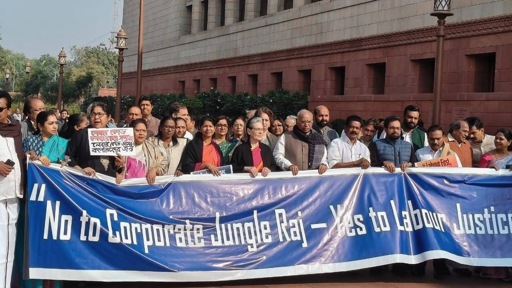
Indian opposition parties and their members of parliament staged a joint protest in front of the parliament building on Wednesday, December 3, demanding the immediate withdrawal of the four labor codes formally enacted last month.
Elected members of the parliament from the Indian National Congress (INC), Samajwadi Party, and left parties gathered outside the main entry of the Indian Parliament in Delhi carrying banners and shouting slogans against the new codes.
The four new labor codes were “rammed” through the parliament five years ago and recently “unilaterally notified”, claimed M A Baby, general secretary of the Communist Party of India (Marxist) in a post on X.
Baby refuted the government’s claims that the codes were introduced to facilitate the “ease of doing business”, claiming they were introduced to promote the “ease of exploitation” of workers and are “yet another proof of the new fascist drive” of the extreme right-wing Bharatiya Janata Party (BJP) government led by Narendra Modi.
The four new codes are the Code on Wages, 2019, the Industrial Relations Code, 2020, the Code on Social Security, 2020, and the Occupational Safety, Health and Working Conditions Code, 2020. They were adopted by the parliament in 2020 without much discussion with the stakeholders and in the absence of the opposition. They were kept in abeyance until November 21 when they were suddenly enacted in a surprising move.
The government has claimed the new labor codes were introduced to simplify the existing laws and to provide universal benefits to all the workers in the country. However, the Central Trade Unions (CTUs), a joint platform of all major trade unions in the country have already rejected the codes, calling them a “deceptive fraud committed against the working people of the nation” and staging a nationwide protest on November 26.
Aniyan P V, Delhi state secretary of the Center for Indian Trade Unions (CITU), spoke to Peoples Dispatch about the codes and why they have sparked such broad-based mass opposition.
Government is lying about labor welfare
Aniyan argues that the new minimum wage law enacted by the union government claims to provide a universal floor wage, however, it does not provide a mechanism to implement the statutory wages.
Aniyan claims more than 95% of workers in Delhi are already not getting the announced minimum wage.
He also questions the rationale behind proposing a floor wage at Rs 178 per day (less than two US dollars) saying it is much lower than the minimum wage already introduced by most of the state governments across India. For example, in Delhi it is Rs. 710 per day (USD 7.90).
Unions also object to the remission of nutritional and consumption standards in the new wage law which was laid down by the country’s top court in 1992 as an integral factor to decide wages. Given this, the new law “will only institutionalize poverty wages rather than a living wage,” claims Aniyan.
The definition of wages does not include overtime allowance, unused leave payouts, holiday wages, and other benefits, and therefore workers have no legal remedy under the new law in case the employer fails to include them in their wages.
Unions also question the lack of any punitive measures in the new code if the employer fails to pay the wages on time.
Despite the government claiming that historic advances were made for the welfare of gig and platform workers under the new social security code, it leaves them out of the definition of employees “without any minimum wage protection, overtime pay and other basic rights,” Aniyan claims.
The unions also question the government’s claims of introducing social security for all workers, calling it tokenism. As per the new law, for example, all platforms need to contribute 1 to 2% of their total turnover to a welfare fund which will cover over 400 million workers.
“Without embarking any budget provision for social security” this proposed welfare fund would be paltry with no real benefit to the workers and amounts to tokenism, Aniyan argues.
The new law also leaves out several other categories of workers, such as shop assistance, domestic help, agricultural workers as well as workers in the IT sector, from the definition of “worker”, depriving them of any benefits of the wage law.
The new laws introduce concepts and leave loopholes which can be exploited by the employers to extend working hours without any consequence, Aniyan claims.
Codes provide employers more coercive powers
The question of the status of women workers has also been a main point of contention with regards to the labor codes. Women workers have already raised complaints about lack of equal wages and denial of basic facilities such as toilets and creches at their workplaces. With the introduction of so-called “safe night shifts”, the government fails to recognize that women’s basic needs are already not complied with and now allowing night shifts for women workers without adequate security and other arrangements “will only lead to employers coercing [women] workers to undertake them” and increase their grievances.
The new law introduces the concept of “fixed term employment” with the government claiming it will provide better job security to contractual workers. However, the unions are claiming that it will lead to increased contractualization as employers are now free to introduce “needs-based fixed tenures”.
Aniyan questioned the introduction of “gratuity” for all workers who have worked for at least a year, saying “what is the use of gratuity even for a year if your job security and service period is compromised” under the new laws?
The new labor codes have introduced drastic changes in the legal obligations of the employers towards the workers with making changes in their registration rules. For example, a contractor employing less than 50 workers no longer needs registration, which Aniyan claims will give the principal employer an opportunity to fragment its workforce to escape compliance.
Companies employing less than 300 workers, i.e. 90% of all workspaces in the country, are now allowed to carry out mass layoffs without any prior government approval. This one provision deprives the majority of India’s workforce of any idea of job security.
New codes compromise workplace security
Noting how most of the existing workplaces in India lack safety standards and are already overcrowded, unions question the logic behind allowing the doubling of the threshold number of workers in factories working with or without electricity in the proposed Occupational Safety, Health and Working Condition Code.
“This would make 95% of the factories in Delhi-NCR, for example, graveyards for the workers,” Aniyan claims, citing numerous cases of factory fire and other accidents in the region in just the last few years that killed over a hundred workers.
The code’s undermining of workers’ right to collective bargaining through strikes is the provision which has sparked the most outrage. According to the new provisions in the codes, “workers will now have to give 14 days’ advance notice” for strikes. However, the catch is that “strikes are prohibited during conciliation proceedings.”
“Since the labor department can prolong conciliation indefinitely, the legal window to stage a lawful strike is effectively closed,” Aniyan claims.
The new codes provide substantial legislative powers to the executive and state governments to frame rules.
Aniyan claims that, given the experiences in the last three decades since the neoliberal economic reforms have been unleashed in the country, “it is very likely that most of the state governments, while framing these rules, will ensure a race to the bottom as far as the rights of the workers are concerned, in their bid to attract capital.”
Aniyan claimed that from a republic that once pledged to narrow the capital-labor conflict after its independence from British colonial control, India now has changed to a republic “that widens it in the name of ease of doing business.”
He is hopeful that the working classes in India will resist these “machinations by bringing up the widest possible unity and by campaigning against the divide and rule, a time-tested British strategy adopted by the BJP.”
The post Indian unions claim labor codes seek to “ease exploitation” in the name of business appeared first on Peoples Dispatch.
From Peoples Dispatch via this RSS feed