

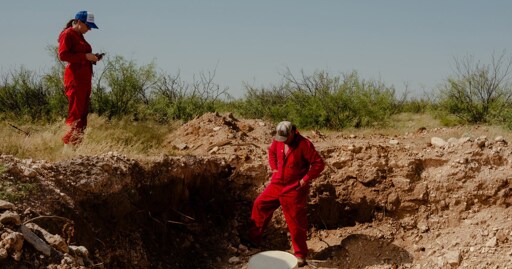
Hawk Dunlap isn’t used to being cold. On a gray day last January when I visited him in West Texas to tour abandoned oil wells, Dunlap—in his mid-50s with a James Brolin vibe—was bundled up, a sweatshirt pulled over his signature red coveralls.
As we drove, Dunlap told me, with a note of sorrow in his deep Texas drawl, that he used to live in Bali, where he went days without wearing a shirt or shoes and swam in a pool he’d installed with the shape of Texas tiled on its bottom. Outside the windshield of his white pickup was an endless expanse of desert scrub and red dirt. Sweeping his arm toward the flat land and looming sky, he laughed and asked, “You see any blue water out here?”
For me, a climate journalist interested in the wreckage of oil and gas drilling, Dunlap is a microcelebrity. For a few years, I have watched videos from him and his partner, lawyer Sarah Stogner, on TikTok. They have gained an avid following by documenting the environmental disasters caused by abandoned wells here in the Permian Basin, one of the most productive oil and gas fields in the world. The two make the blight charming—even funny. One of the first posts that I recall seeing showed Dunlap visiting a sea of wellhead wastewater in the middle of scrubland, wearing that same red boiler suit he donned in January, set over the 2002 hip-hop anthem “Ooh Ahh (My Life Be Like).”

A well being plugged in the Permian Basin, one of the most productive oil and gas fields in the worldBrenda Bazán
For more than a century, oil companies have sunk wells in this desert looking for liquid gold, leaving countless scars behind. Dunlap showed me wells ensconced by rusted-red pipes and decrepit pumpjacks strewn about the desert. These thousands of forgotten wells are not just inert fossils of economic history. Many emit methane—a greenhouse gas that’s nearly 30 times more potent than carbon dioxide—and leach chemicals, including benzene, a human carcinogen. Recently, another problem has emerged: Old, dormant wells have begun mysteriously leaking—oozing brine onto the land—and shooting geysers of toxic water into the sky.
So far, well cleanup efforts have been haphazard. Many of the original owners never registered their drilling and abandoned their wells when they ran dry. The more conscientious owners plugged them as best they could, but early attempts sometimes used sand or wood—far from the best practice today. Ideally, wells should be plugged with cement deep in the ground, and pumpjacks removed. But landowners say state regulators weren’t motivated enough to make sure that happened. The result has been a mess.
Dunlap is well acquainted with the problem. For 30 years, he worked for oil and gas companies to fix and plug wells all over the world. “I enjoy the outdoors,” he explained. “I used to hunt. I fish, I scuba dive, I play golf. I’m not housebroke, so I’m not inside an awful lot. I care about land, I care about landowners’ rights, I care about water. If that makes me an environmentalist, then so be it. That’s a label that, you know”—his tone turned mocking—“‘Oh, you’re an environmentalist.’ Yeah, okay, I’m a tree hugger. I’ll hug any tree that doesn’t have thorns.”
Dunlap has become part of an unlikely band of folks living in West Texas who are trying to force the government and industry to address the abandoned oil well catastrophe. There’s Ashley Watt, the owner of Antina Ranch, who’s suing oil companies, including Chevron, for the damage they allegedly did to her land. There’s Laura Briggs, whose family runs two local newspapers and who has been a critic of state regulators for years. There’s Schuyler Wight, a fourth-generation rancher, who for the past three years has traveled hundreds of miles to Austin almost every month to give officials a piece of his mind. And there’s Stogner, a take-no-prisoners attorney whose talent for making viral videos—including a campaign ad she filmed of herself straddling a pumpjack wearing nothing but star-shaped pasties and a cowboy hat—has gotten tens of thousands of people to pay attention to this complex issue.

Dunlap drives on Antina Ranch.Brenda Bazán
This small crew has spoken to national and local news outlets, spent hundreds of hours on social media, traveled around Texas raising awareness and nagging regulators, and even run for office. Far from being stereotypical lefty climate activists, they have a uniquely Texan approach to safeguarding the land. Each wants the oil industry to thrive. But the lack of accountability has turned them into reluctant, if determined, warriors.
In Texas, where landowners often do not control the rights to the minerals under their property, and oil and gas companies regularly do, a unique political identity has emerged. “I’m not necessarily an environmentalist on all land, but I’m definitely an environmentalist on my land,” Watt said. “That is a very common flavor of West Texas landowner. As you can imagine, West Texas ranchers skew conservative. From an environmental perspective, they could probably care less about saving the whales, but they care a whole lot about their land.”
For Dunlap, it is personal. He is determined to hold an industry that has provided four generations of his family with employment to account. “We’ve been doing things wrong for a very long time,” he said, “and now that we know we’re doing things wrong, we need to start fixing it.”
The exact scope of the abandoned wells problem is hard to pin down but is undeniably enormous. The Environmental Protection Agency estimates the number of abandoned oil and gas wells in the US at about 3.9 million, with 2.2 million unplugged. The Environmental Defense Fund (EDF) says that tackling the abandoned well problem could be equal to removing up to 4.3 million cars from the road for a year.
In recent years, attending to old wells seemed like a rare practical climate solution that everyone could agree on. In 2021, the Biden administration pledged $4.7 billion to help states remediate their orphan wells, more than $300 million of which has been slated for Texas.
Still, that is not nearly enough to address the problem. Regulators report there are more than 10,000 orphan wells—sites with no known owner who could be held responsible for cleaning them up—in the Lone Star State alone. That’s on top of more than 147,000 inactive wells with an identified owner.
“We’ve been doing things wrong for a very long time, and now that we know we’re doing things wrong, we need to start fixing it.”
The state should be ahead of the curve, with a program created in the 1980s to plug abandoned wells, funded by fees collected from producers. But landowners say Texas continues to be slow in plugging some wells, while refusing to touch others that cause massive problems, from leaks to blowouts.
A big issue is cost. Plugging runs into the mid–five figures, or more, per well. The money needed to tackle the country’s well problem “is staggering,” noted Adam Peltz, a lawyer and director of EDF’s energy program. “It’s at least an order of magnitude more than we have set out now.”
The initial $25 million federal grant given to Texas paid for just 737 wells. When I visited Texas last January, regulators reported the 82 wells it had plugged that month cost more than $2.7 million.
This void has left room for people like Dunlap. After flying from Bali to visit his mother in Houston in late 2021, coronavirus travel restrictions prevented him from returning. An old colleague, with whom Dunlap still talked, had been contacted by residents in Crane County, where a well drilled in the 1940s suddenly shot out a 100-foot geyser of brine on New Year’s Day 2022.
One of those residents was Watt, a former Marine and Harvard Business School graduate who owns Antina Ranch, a 22,000-acre property that spans Crane and Ward counties, 45 minutes southwest of Odessa. Watt was increasingly sounding the alarm about busted wells on her property after one owned by Chevron had mysteriously sprung a leak the year before, causing toxic water to gush to the surface.
Dunlap’s colleague, sensing his friend was cooped up in his mom’s house, recommended him as someone who could help with the blowouts. A stir-crazy Dunlap agreed to forfeit his usual fee. “I said, ‘Look, fly me out, put me up, feed me some Allsup’s burritos and some Dr Pepper, and get me what I need to work with, and it won’t be nothing.’”

A rig to plug a well stands on Laura Briggs’ property in Pecos County. At the time of the photo in August 2025, the contractor had been on-site for 84 days.Brenda Bazán
When he first visited Antina Ranch in January 2022, Dunlap began to realize how big the well problem in the Permian Basin really was. Giving me a version of a tour of the ranch he first received from Watt back then, Dunlap showed me one of the things that he first noticed: The mesquite trees—spiny desert scrubs that are nearly impossible to kill—were all dead near sites of the old wells. “When I first put my feet on the ground out here,” he recalled, “I knew something was wrong.”
Watt hired Dunlap to help excavate and investigate the old wells on her property. It was a far cry from what he was used to earning from helping major industry players plug wells. But, he explained, “I wanted to understand what was happening.” From there, the interest grew. “Once I understood what was happening, I started seeing how much of a bigger problem it was across the state—and across the nation.”
Perhaps the most extreme example is a site that locals call Lake Boehmer: a massive, briny, sulfuric, radioactive pool of toxic water springing from a cluster of abandoned wells near the tiny town of Imperial. Lake Boehmer’s original wells were drilled in the 1950s for oil, then later repurposed for water to irrigate farmland—a not-uncommon practice for unproductive oil wells.
All was quiet until the early 2000s, when the wells suddenly began churning up a poisonous mix of oil, arsenic, refuse, and water saltier than the ocean from deep underground. Over the past two decades, the lake, named after its absentee owner, has grown into a 60-plus-acre bright cerulean sea, noted even on Google Maps. In the lake, you can see one well bubbling up like a massive jet of a Jacuzzi, spewing 200 gallons per minute.

Lake Boehmer, a vast radioactive pool created by an abandoned oil wellBrenda Bazán
Lake Boehmer is perhaps the most visually shocking disaster in the region, but it’s far from the only one. In October 2024, residents in Reeves County smelled rotten eggs. Soon after, a 100-foot geyser shot out of an old well. (It took almost three weeks to seal it.) In Upton County, a 200-foot-wide, 40-foot-deep sinkhole appeared around a well—the air around it stunk like crude oil.
Experts suspect that fracking, which ramped up significantly in the Permian in the 2010s, is the cause. At drill sites, the fracking process involves pumping millions of gallons of water—along with sand and chemicals—down into tight rock formations. The water pressure creates cracks and releases natural gas and oil; the wastewater then travels back up to the surface. In Texas, most of that wastewater is reinjected underground. Initially, frackers sent this water deep into the earth. But geologists said that practice caused earthquakes. So oil and gas companies began to reinject the water closer to the surface, which, growing research suggests, causes the leaks and blowouts in old wells, as the wastewater travels unpredictably through geological faults. (A 2024 study in the journal Geophysical Research Letters found that the 2022 New Year’s Day geyser was likely the result of overpressurization of a local aquifer, thanks to wastewater injection several miles away.)
The wells on Antina Ranch present yet another aspect of the problem around the Permian. Many of the wells on Watt’s property are technically not orphaned. In fact, most have been registered as plugged and fixed in state databases. But, for the most part, owners of those wells haven’t been required to do maintenance or check on them. Dunlap discovered, when he started digging on Antina, all of the wells he looked at that the state counted as plugged were leaking. The plug jobs had steadily eroded after decades in the elements, and trash had been poured down some of them. Dunlap calls these “zombie wells.”
“[Some of] these wells are 70 years old,” he explained. “If you take a 70-year-old man, and he’s in the hospital and he’s having multiple failures, you’re not going to be able to heal him for cheap. It’s going to be days in the hospital, treatments, it’s going to be medication, it’s going to be surgery…and it’s going to run into the millions. You can’t really just give him a can of Gatorade and a can of Vienna sausages [and say], ‘Take one of these, drink one of these, you’ll be fine.’”

A close-up of Lake BoehmerBrenda Bazán
Despite the varied issues, the problem of the wells can be traced back to an original sin. “We’ve drilled a lot of wells that we didn’t take proper care of,” said Peltz, the EDF attorney. “If you don’t deal with them, you get stuff like Boehmer Lake.”
When Stogner first came to West Texas, she couldn’t believe what she was seeing. She visited Lake Boehmer and “was like, ‘What the fuckity fuck is this?’” she recalled. “How are we all not like, ‘This is not okay, guys’?”
Like Dunlap, Stogner also used to work for the industry, providing legal services for oil and gas companies for more than 10 years in Louisiana before moving to Texas in 2017. During the first wave of Covid, she befriended Watt on Twitter. As Stogner went through a separation from her husband, Watt let her move into her pool house in 2021. Living on Watt’s ranch, Stogner, now in her early 40s, started making TikToks about bad plugging jobs and the ensuing pollution, which began amassing views.
She soon focused on what she saw as a key problem: the Texas Railroad Commission (RRC), the confusingly named state regulatory body that oversees oil and gas production and the plugging of wells. Officially, abandoned wells are plugged in order of urgency, determined by the risks they pose to the environment and human populations. But because the RRC lacks serious enforcement mechanisms—critics say there are minimal fines and a lack of monitoring for lax operators—few incentives exist for companies to clean up their messes. Bigger operators often end up selling aging wells to smaller entities as less oil is produced; those smaller firms tend to lack resources to clean things up.
The RRC has said in the past that it is working “aggressively” to plug wells and that it enforces strict rules and stringent regulations around plugging. In a statement, the agency also told me that officials “remain steadfastly committed to addressing issues related to produced water injection through diligent monitoring and scientific research.” Still, landowners and advocates I spoke with believe the agency is far too cozy with the industry to be an effective regulator. A 2023 Texas Monthly investigation found that the family of Christi Craddick, who has served on the three-person RRC board since 2012, raked in $10 million in 2022 alone from oil and gas royalties.
By late 2021, Stogner was pissed off enough to challenge RRC Commissioner Wayne Christian for office. With little to lose, she filmed the campaign video of herself, nearly nude, straddling a pumpjack—an approach, she told me, that was thought up over a couple of beers on Super Bowl Sunday. The spot went viral and caused an uproar: The San Antonio Express-News even pulled its endorsement of her. But Stogner didn’t much care what the public thought of her, so long as her message was getting out.
“My only regret is that I didn’t do it sooner,” she told me at the time. “I thought, ‘I am confident that I’ve got the substance behind me, so if I can just get their attention, I’ll win them over.’ Like, ‘Vote for anybody but Wayne [Christian]—take a look.’” She was right. A month later, the San Antonio Express-News re-endorsed her, contrasting Stogner’s solid critiques of the orphan well problem with Christian’s “heavy ethical baggage” in taking funds from polluting companies.
Stogner lost the primary in 2022, but by then, she had a fan base. Her TikTok videos about old wells had amassed tens of thousands of followers. She was now a force to be reckoned with. Using evidence Dunlap was collecting on the ranch, Stogner helped Watt file a lawsuit alleging that Chevron and other operators had left behind hundreds of improperly plugged wells on Antina. Stogner thinks the companies should clean up the wells and compensate owners for the damage. The lawsuit is set to go to trial in 2026 and, if successful, could open the door for other landowners to hold big oil companies accountable.

Sarah Stogner and Hawk Dunlap examine the pressure from an oil well being plugged.Brenda Bazán

Dunlap checks a leaky oil well with a knife.Brenda Bazán
When I first got to Antina Ranch, Dunlap and Stogner took me out to the remnants of a well drilled in the 1950s and later plugged. It’s a big hole surrounded by chunks of crumbled concrete; at the bottom, a rusted pipe sticks a foot up from the dirt, vile liquid pooling around a cap in the top. Dunlap dipped in his pinkie, and it came away black and slick with oil.
“They need to spend about a million dollars on this just to replug it,” Stogner said. “Then they need to spend probably another million or $2 million delineating and remediating the extent of pollution…If they’d done it right in the first place, they probably could have done it for a couple hundred thousand. But because they tried to do it for $5,000 or $10,000—this is what we get.”
After examining the well, Dunlap and Stogner drove me to a low-slung ranch house on Antina that they refer to as the “headquarters” for its well operations. Over Topo Chicos, they told me the story of how they first started working together in early 2022. Following Dunlap’s first visit to Antina, as Stogner’s RRC campaign heated up, she began peppering him with questions over text about various issues with wells on the ranch. Dunlap, who’d returned to his mom’s house back in Houston, had all the time in the world to answer.
“Hawk had nothing else to do, and he was very knowledgeable—he was bored,” Stogner explained. “He was responsive, and I trusted what he had to say. I knew that he wasn’t trying to mess with me.”
Dunlap, in turn, found himself with an unexpectedly eager wellhead pupil. “She was running around out here, putting her fingers in wellheads and stuff—well, I was telling her to,” he remembered. “She’d send me a picture and say: *What is this?*Well, put your finger in it.” He was surprised, he said, when she took the joke literally: “She’d go, wait a minute, I’ll be back. No, no, no—don’t do that.”
Dunlap’s jobs overseas kept getting canceled due to Covid. Eventually, he figured he’d tag along on Stogner’s campaign and give her a crash course in abandoned wells. They hit it off on the road. Stogner told me later that she knew she had a potential social media darling on her hands, comparing him to famous oil well firefighter Red Adair.
“People loved the well stuff, but they hated me because I was a woman—what do I know?” she said. “But when the messenger is him, and his accent, and the lip of tobacco, yes, I knew he was going to hit.”
Stogner encouraged Dunlap to begin making his own TikToks. Now, his account has nearly 120,000 followers. The two began to design their own online gags together, too. They put up signs near Lake Boehmer labeling two leaking wells as Lake Craddick and Christian Springs, after the RRC commissioners. They filmed mock tourism videos of the sites for TikTok. They put Dunlap up on a pumpjack in a callback to Stogner’s infamous campaign video, his red boiler suit pulled seductively down to his waist.

Stogner holds a volatile organic compound detector next to a well.Brenda Bazán
Stogner also helped Dunlap launch his own bid for an RRC seat. In 2024, he ran as a Libertarian against Craddick, a Republican. Craddick won handily, raising $10 million, with hefty donations from oil and gas powerhouses.
But the pair did not give up on politics. That same year, Stogner ran for office again, courted by the local GOP despite her criticisms of Big Oil and distaste for President Donald Trump. With a tough-on-crime platform that highlighted her bona fides in protecting landowner rights, she challenged the long-serving Democratic district attorney in Texas’ 143rd Judicial District—and won.
Talking in the living room, where a cozy fire was burning to offset the chill of the day, the pair clearly were exhausted. As Stogner stretched out in front of the fire, the toll of driving hundreds of miles each week for her new job, which covers three counties and entails an intense caseload, was apparent. Stogner now only has time to work on oil well issues in her spare hours.
“We excavate [a well],” she said. “We’re like, wow, that’s clearly fucked. And then Chevron’s like, ‘Nothing to see here.’ And the Railroad Commission [is] like, ‘We’ll get back to you.’ I’m tired, because it’s like, okay—and now I’m having to deal with little girls [who] are getting raped. So I come back and [Chevron’s] lawyers are bitching about something and I’m just like, get over yourselves. Like, we have real problems in the world. Why can’t you just admit that this was a fuckup and fix it and do the right thing?”

A sinkhole in Pecos County formed by an abandoned oil wellBrenda Bazán
And then she answers her own question: “They can’t, because it bankrupts the industry as we know it.”
Until coming to Texas, I wasn’t prepared for the scale of its landscape, how empty the desert can feel driving between the ranches and tiny towns, with little except gas stations. As I made my way toward Laura Briggs’ property, about a half-hour from Antina Ranch, I could barely focus on the road. I was so distracted by what I could see out of my car: ancient pumpjacks toiling away, bobbing slowly up and down as they produce small amounts of oil for tiny operators. Tall, spindly flare stacks dotted the horizon, some topped with bright flames as excess gas burned off into the sky in a fiery smear.
So many political ideas collide in this part of Texas: the desire to preserve the rights of landowners, the eagerness to offer subsidies and favors to an industry that provides jobs and tax revenue, and an almost religious commitment to a hands-off government. When a business that controls the mineral rights deep underground wrecks a property, the owners of the land above have few options. For residents like Briggs, that means dealing with strangers routinely coming onto her land, sometimes leaving messes of equipment; spills of mysterious, toxic liquids; and poorly plugged wells.
Briggs and her husband, Smokey, live on 900 acres they bought in the late 2000s after the previous owner died when an old pumpjack fell on him as he attempted to escape a group of aggressive hogs. When I pulled up to the bright, chaotic ranch house—which the couple built themselves—friendly dogs rushed up to greet me; pens containing goats, pigs, and cows surrounded the driveway. A slight woman with a mass of blond hair tucked into a braid, Briggs has the welcoming smile of a favorite elementary school teacher. Inside the kitchen, she offered me raspberries she freeze-dried herself. Her new Chihuahua puppy, Amigo, nipped at my feet. As we talked about her various well problems, Briggs dug into a file cabinet full of binders, pulling out court filings and reams of correspondence with regulators.

Laura Briggs stands next to a deteriorating tank of oil.Brenda Bazán

Cattle wander near an orphaned well.Brenda Bazán
Briggs noticed that long-dormant wells on their property were leaking. Noxious water seeped out of the ground. Smears of oily liquid muddied the loose dirt. In 2024, a sulfuric spring appeared a few hundred yards from their house. “It is like whack-a-mole,” she said of trying to clean up the wells. Briggs laid the blame on careless fracking: “All the orphan wells [weren’t] a problem until this produced water injection started.”
During our conversation, Briggs, who seemingly can make a friend everywhere she goes, rattled off a list of names of RRC inspectors who have been on her land. “I used to bake cookies and hang them on the gate and be like, ‘If my cows are any problems, please let me know,’” she said. But to date, she said the RRC has plugged only six wells on her property—leaving more than two dozen untouched.
With so few folks around, it’s important to get to know your neighbors. And when the Earth itself seems to be revolting beneath your feet—when the big industry in town won’t clean up its messes on your land and regulators seem to be deliberately unresponsive—people tend to start talking to each other about how to fix it.
In 2022, Briggs and Smokey traveled to report on a leaking well for their newspapers. On the trip, they met Watt and Stogner. A few months later, Briggs’ neighbor, Schuyler Wight, asked her to host some of his ranch hands for Thanksgiving. Briggs invited Watt, Stogner, and Dunlap to dinner. That night, over turkey and wine, the neighbors all compared notes about the well problems on their land.
“We realized this wasn’t just something happening on my property—it was happening on Schuyler’s property, it was happening on Antina, it was happening on neighboring ranches,” Briggs said. “I was like, ‘You know, God put us all together for a reason, so we should work on this together.’”
Briggs has been bugging the RRC for years about her well problems; she’s spoken to national and local media and driven to Austin to talk with regulators directly. But working alone, she was “easy to write off.” As we drove to look at the mess of wells on her land, the dogs trailing behind her truck, she told me that it was their collective power that was now making a difference. “I tell you what, it was so nice meeting people who understood what I was talking about,” she said. “I think what the Railroad Commission didn’t count on was somebody with Schuyler’s time and knowledge and somebody with Ashley’s money.” (In addition to funding the lawsuit, Watt put $2 million into Stogner’s first campaign for the RRC.) “And I’m grateful for the media coverage.”
In August 2024, after yet another well on her property sprang a leak, Briggs started her own TikTok series. And she called Dunlap, whom she’d come to rely on for help. The RRC has a 24-hour emergency hotline, but Dunlap was able to get there first to dig an emergency pit to divert the flow of oily water. (The RRC eventually plugged the well.)
“It’s kind of gotten to the point where people will call me before the Railroad Commission, because I’ll come,” Dunlap said. “I’ll answer the phone. It’s kind of an honor that they do that, but at the same time, it’s sad.” (The RRC has said it “takes immediate action to eliminate any pollution threats” from leaking wells.)
In May, the well near Briggs’ house—on the orphan list for 23 years—sprang another leak, creating another pool of murky water; Dunlap was again one of the first on the scene to help stem some of the damage. It took the RRC almost four months to permanently plug the well. “This should be illegal,” Briggs told me. “Like, somebody should be in trouble for this.”

Schuyler Wight stands in front of an orphaned oil well by the Pecos River that was installed in 1938.Brenda Bazán
I wanted to see for myself how the RRC worked, so I hopped on a plane to Austin to attend its monthly public meeting. They are usually overwhelmingly dry affairs, packed with updates on permit applications and waste reports. But the public comment period can get heated, especially when Wight shows up.
Which he has, nearly every month, for the past three years. On the day I was there, Wight, a fourth-generation rancher, wore neat Wrangler jeans and a button-up checked shirt, his white cattleman’s hat tucked next to his briefcase on the chair next to him. A few people came over to shake his hand, updating him on their own business or simply asking how he was.
Wight’s family has been working as ranchers in West Texas since the late 1800s. He knew there were abandoned wells scattered over the thousands of acres he owns. But he kept discovering more over time. Many are leaking briny water or letting off toxic emissions—and some aren’t on the official RRC lists of orphan wells.
When I visited his property a year earlier, we stopped by a crater in the desert, with a dusty waterslide running into the parched ground. Wight pulled up photos on his phone of the same spot from less than a decade ago, when the crater was a lush swimming hole fed from a local spring; in the photo, his daughter swam happily in the water. He suspected that the water-thirsty process used in certain fracking techniques was responsible for depleting the groundwater that fed his spring. (Stogner made a TikTok of the site with the voiceover: “When you use all the fresh water for fracking instead of recycling it, you lose Redneck Riviera.”)
“I don’t think they’re gonna get serious about policy until we flat run out of water,” he told me. “I don’t want to sound like, ‘The world’s falling, the sky’s falling, we’re all gonna die.’ But just in my lifetime since I’ve been down here ranching, I’ve seen it change so much.”
Wight isn’t typically a man of many words. Standing before the RRC commissioners, he got right to the point. “Why do I have to do your job for you? Why is that?” he said, before adding, “That’s a rhetorical question, and I’m not asking that in a mean way.” (RRC Commissioner Craddick, accustomed to Wight’s presence at these meetings, thanked him for his time before moving on to the next public commenter.)
“One thing’s for sure, I’ve got them stirred up,” he told me flatly. “They’re not happy with me.”

Stogner and Dunlap stand next to an excavated well.Brenda Bazán
All the hard work this band of neighbors has put in seems like it is starting to yield some results. In 2025, Texas passed a law forcing companies to plug or reactivate wells that have been dormant for more than 15 years. The legislature also allocated $100 million to help plug wells and an additional $1.3 million to establish a team to investigate issues with underground water injection.
The law was drafted with support from an oil and gas industry coalition. “It’s a marker that industry has said, ‘Okay, this is a real problem and we need to curb our worst excesses here,’” EDF lawyer Peltz said.
But the law has industry-friendly loopholes, too. Operators can delay plugging their wells until the early 2040s. Experts worry the next 20 years could see many of the same problems. And while the RRC also passed new restrictions that could help to stop injected water from blowing out old wells, fracking itself isn’t going away anytime soon. Meanwhile, the Trump administration has loosened the Biden administration’s original requirements around the well-plugging grants, removing environmental reviews and methane measurement requirements. Texas regulators applauded the move, saying it will help speed up well plugging.
But Dunlap is dismissive of the new Texas law, describing it as “nothing.” He’s running again against RRC Chair Jim Wright in 2026, this time as a Republican. (Dunlap’s TikTok bio now reads: “4th generation TX Oilfield Republican Candidate Texas Railroad Commission.”) He posted his campaign announcement video on—where else?—TikTok in early August. “Fuck it! I’m running again for Railroad Commission in 2026,” he announced. The video has more than 33,000 likes.
He was further frustrated after talking with landowners in East Texas, where the RRC had granted permits to build an oil field waste site to an operator with a lengthy list of violations. “I just woke up pissed off one morning and I said, ‘Okay, that’s it. I’m running. I’ll give it one more shot to fix this.’ Texas is waking up to the Railroad Commission. There are things that Sarah and I have been raising hell about for the last three years—I think people are starting to see it.” He chuckled. “If it doesn’t work, I’ll go back to Bali and play golf again.”

Here’s How Other Groups Across the Country Are Finding and Capping Old Wells
By Henry Carnell
The Moms in Pennsylvania
In 1859, Edwin Drake sunk a well in Northwest Pennsylvania and kicked off the world’s first oil boom. Back then, “people would go out literally in their backyard and just start drilling,” says Patrice Tomcik of Moms Clean Air Force, which searches for orphan wells. Today, Pennsylvania has 30,000 documented abandoned oil wells. (Experts think the total could be up to 700,000.) To do this work, Moms Clean Air Force has teamed up with the Environmental Defense Fund and state regulators with plans to use everything from drones equipped with magnetometers to college students with backpacks full of monitoring equipment. So far, even without all of these upgrades, these sleuths have discovered 250 orphan wells.
The Kids in North Carolina
In 2024, three high schoolers in Cary, North Carolina, raised $11,000 to plug an orphan well more than 500 miles away in Ohio. Sebastian Ng, one of the students, says the project made him realize that “we could help make a real difference.” The plug was completed by Montana’s Well Done Foundation, a nonprofit founded by retired oil executive Curtis Shuck. “We hope that our work inspires people to find their own ways of creating positive impacts,” Shuck says.
The Grad Student in Alaska
University of Alaska Anchorage graduate student Hoyt Thomas uses lidar—the terrain-scanning tech behind most self-driving cars—and a machine learning algorithm to locate orphan wells that cannot be caught otherwise. “Not all of these wells are emitting methane, and they still pose risks,” Thomas says. The next step? Make the algorithm scalable so it can be applied in other communities.
The Scientists in California
At Lawrence Berkeley National Laboratory, geochemists have scoured through old maps for evidence of abandoned wells. It’s like “finding a needle in a haystack,” says Charuleka Varadharajan, a scientist involved with the project. Researchers trained an AI model on handmarked US Geological Survey maps to find more than 1,300 potential orphan wells in California and Oklahoma, where they’re working with the Osage Nation to document wells in their territory.
The Lost Satellite in Space
MethaneSAT, a satellite launched in March 2024 by the EDF and the New Zealand Space Agency, tracks global methane pollution—in part to “name and shame” the world’s worst polluters. Its data, freely available online, reveals previously untraceable emissions across the world. A major setback occurred in July 2025, when the satellite was declared lost in space. But even as scientists aim to replace it, they’re sifting through the enormous data set from MethaneSAT’s 15 months in orbit. “It’s early days yet,” principal investigator Steven Wofsy told the Harvard Gazette.
From Mother Jones via this RSS feed