

This article by Arturo Huerta González originally appeared in the December 2, 2025 edition of La Jornada de Oriente, the Puebla edition of Mexico’s premier left wing daily newspaper. The views expressed in this article are the author’s own and do not necessarily reflect those of Mexico Solidarity Media*, or the Mexico Solidarity Project.*
On November 26, 2025, the country’s President stated that “there is no money to pay what the farmers are demanding ” and that “you can’t promise what you can’t deliver.” The government has indicated that “the producers’ request to set a price far above the current market value for all national corn exceeds the government ‘s financial capacity ” and that the farmers ‘ demands “must be adjusted to budgetary availability, as public finances have limits.”
This rhetoric is the same as that of the neoliberal presidents who have governed us since the 1980s. By limiting public spending relative to revenue, the government seeks to curry favor with international rating agencies , the International Monetary Fund, and the national and international financial sector. This has led to a reduction in the size and participation of the government in the economy and a neglect of growth objectives for the productive sector, such as job creation, which the population demands. It is a crime to cut public spending in a context where the economy is not growing and the demands of large segments of the population are not being met.
It should be noted that a sovereign government has no financial limits. Financial resources are available. It’s simply a matter of amending the Organic Law of the Bank of Mexico so that it can purchase government debt directly at a low interest rate. This would allow the government to expand its spending and investment to meet the demands of farmers, promote the substitution of agricultural and manufactured imports, and generate employment. This would not be inflationary, as it would increase production, reduce the foreign trade deficit, and generate revenue to cover debt payments. The government could also reduce funding for failed projects such as the Maya Train, the Isthmus of Tehuantepec train , and the Dos Bocas refinery, and allocate those funds to support basic grain producers, a strategic sector essential for ensuring food self-sufficiency in these areas.
Upon learning of the demands from Mexican farmers, US congressmen sent a letter to the US chargé d’affaires stating that he must defend US agricultural exports to Mexico, as it is their primary market. If the Mexican government agrees to continue importing these products, it will continue to favor US producers at the expense of domestic producers, further jeopardizing self-sufficiency and increasing Mexican dependence on foreign imports.
The government says that the requested guaranteed price of 7,200 pesos per ton for corn is far above the market price and that absorbing the difference is very costly for the government. The problem is that the national price should not be set based on the open market, determined by the Chicago Mercantile Exchange, as this has led to cheap imports displacing domestic production and jeopardizing food self-sufficiency in basic grains. This not only affects agricultural producers but also increases the foreign trade deficit and makes the economy more dependent on capital inflows, which requires setting high interest rates to stimulate them. This, in turn, increases the cost of servicing debt for the government, businesses, and households, and restricts investment, spending, and economic activity.
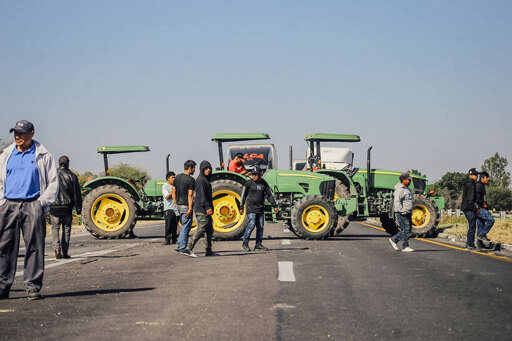
Farmers are not mobilizing to defend any privileges, as the government claims ; they are demanding the implementation of policies to boost Mexican agriculture and advance food self-sufficiency. Therefore, they are demanding an end to importing basic grains, the provision of affordable credit, and the establishment of fair prices for these products.
The government refuses to do so for fear of inflation and devaluation, which would affect the financial sector, which requires low inflation and currency stability to safeguard its capital. Since the economy lacks the conditions to lower inflation, given low productivity and production lags, it has resorted to stimulating capital inflows to lower the dollar’s value and thus imports in order to reduce inflation. All of this benefits the financial sector and producers from the US and other countries who flood the domestic market with their products at the expense of displacing national producers and without implementing policies that promote economic growth.
The government must work for the benefit of the country, not against it. Domestic production and employment must be incentivized , even if this seems more expensive in the short term, because it would boost economic growth and employment, reduce the foreign trade deficit, and provide workers with income to cope with higher prices. This would prevent the current practice of lowering inflation to benefit the financial sector and US producers of imported goods, which has led to a decline in our industry and production of basic grains. This, in turn, has stifled economic growth, increased unemployment and underemployment, and lowered the population’s standard of living.
The government opposes the farmers’ request to remove staple grains from the USMCA trade agreement because it fears the US will impose further restrictions on Mexican exports to that country. Upon learning of the demands from Mexican farmers, US congressmen sent a letter to the US chargé d’affaires stating that he must defend US agricultural exports to Mexico, as it is their primary market. If the Mexican government agrees to continue importing these products, it will continue to favor US producers at the expense of domestic producers, further jeopardizing self-sufficiency and increasing Mexican dependence on foreign imports.
The President said that “we must be very responsible about what can and cannot be done,” and in this regard, it must be said that economic policy must be responsible in order to satisfy the demands not only of agricultural producers, but also of those who clamor for well-paying jobs, just enough to address the growing poverty and crime plaguing the country. To achieve this, the government must abandon budget cuts and ensure that the central bank serves the growth of the productive sector and employment. Furthermore, trade liberalization must be reviewed, and protectionist policies implemented to favor domestic production. If the government does not increase investment and spending to boost private investment, production, and employment, and if the central bank does not lower interest rates, the economy is headed for a crisis.
Without growth in production and employment, there is no growth. Neoliberal policies must be abandoned . If the government fails to meet the needs of the population and continues to act in favor of the interests of the US and the financial sector, economic and social problems and discontent among affected sectors will worsen, leading to increased protests.
Continuing Neoliberal Policies Over Farmers’ Demands
December 8, 2025December 8, 2025
If the government fails to meet the needs of the population and continues to act in favor of the interests of the US and the financial sector, economic and social problems and discontent among affected sectors will worsen, leading to increased protests.

Palestinian Solidarity Movement Condemns Genocide Supporter Visit to Mexico’s Chamber of Deputies
December 7, 2025December 7, 2025
Last week, Morena Deputy Pedro Haces attempted to secretly reinstitute a friendship group with israel, but was denounced by other deputies from Morena and the Workers Party.

600k in Mexico’s Zócalo for Seven Years of the Fourth Transformation
December 6, 2025December 6, 2025
Photos of the anniversary commemorating the Mexican party Morena & social movement the Fourth Transformation forming government.
The post Continuing Neoliberal Policies Over Farmers’ Demands appeared first on Mexico Solidarity Media.
From Mexico Solidarity Media via this RSS feed
You must log in or # to comment.