

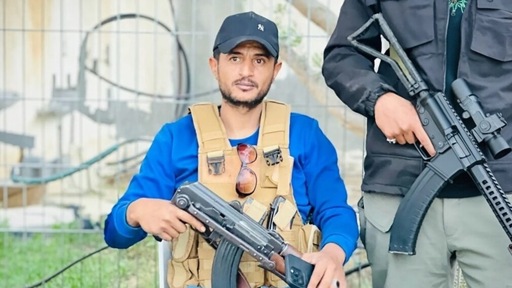
The leader of the infamous Israeli-backed militia the Popular Forces, Yasser Abu Shabab, was killed on Thursday, December 4, near Rafah in the southern Gaza Strip, months after his betrayal of his own people had been widely exposed.
Conflicting narratives regarding the circumstances of Abu Shabab’s death were reported by Israeli media outlets.
Israeli Army Radio first announced that the gangster was killed in clashes with unidentified armed men in Rafah. The radio added that Abu Shabab’s deputy, Ghassan Duheini, was also wounded in the same incident and was transferred to Israel’s Soroka Hospital in Beersheba.
Meanwhile, Israeli Channel 12 cited a security source, saying that Abu Shabab was transferred to Soroka, where he succumbed to injuries that he sustained during an “internal dispute” with his gang members.
Israeli newspaper Yedioth Ahronoth later reported that he was beaten to death by one of his aides as a result of infighting within the militia. However, other Israeli media reports indicated that Abu Shabab was killed in an ambush carried out by Hamas fighters.
For its part, the Popular Forces mourned its commander in a post on its Facebook page on Thursday evening, claiming that he was shot while he was trying to resolve a dispute within the local Abu Suneima clan.
Palestinian grassroots: Abu Shabab’s death is a “well-deserved end”
Regardless of the true reason for his death, the Palestinian grassroots considered Abu Shaba’s killing a “well-deserved end”, due to his involvement in looting aid and massacring Palestinians in Gaza during Israel’s deliberate starvation and genocide, among other crimes.
Videos circulated online showing Palestinians going out to the streets in the Gaza strip and refugee camps in Lebanon to celebrate the death of Israel’s “number one collaborator”.
Abu Shabab’s death dispels Israel’s security and military delusions about the “yellow line” zone
The death of Abu Shabab seems to have caused frustration within Israeli circles, who believed that recruiting Abu Shabab’s gang and a few other militias would spread chaos and provoke infighting in Gaza during Israel’s genocidal aggression, and even in the post-war phase.
For many, the location and timing of Abu Shabab’s assassination reveal the fragility of Israel’s security system, because he was killed in Rafah inside the Israeli-controlled “yellow line” zone, which the Israeli Occupation Forces (IOF) thought was unbreachable. His death came one day after the IOF announced that five of its troops were killed by Palestinian resistance fighters in Rafah.
The two events mark a crucial development that has sufficiently dispelled Israel’s military and security delusions, which had become greater in recent weeks, after the IOF eliminated dozens of Al-Qassam fighters trapped in tunnels in Rafah.
In this regard, Israeli political analyst, Amit Segal, wrote on X:
“This is a bad development for Israel. Hamas viewed him as a strategic threat to its rule. If it turns out to be the case, Israel will also have to investigate how Hamas operatives crossed the yellow line and assassinated him.”
Hamas: Abu Shabab’s death is the “inevitable fate” of a traitor
In a statement issued on Thursday, Hamas called the killing of Abu Shabab “the inevitable fate of anyone who betrayed his people and his country”, without confirming its possible responsibility for his assassination.
The group further insisted that the crimes, which the head of the so-called Popular Forces committed in coordination with the IOF, “constituted a blatant departure from the national and social identity.”
The post Israeli-backed militia leader Abu Shabab killed in Rafah appeared first on Peoples Dispatch.
From Peoples Dispatch via this RSS feed
You must log in or # to comment.