

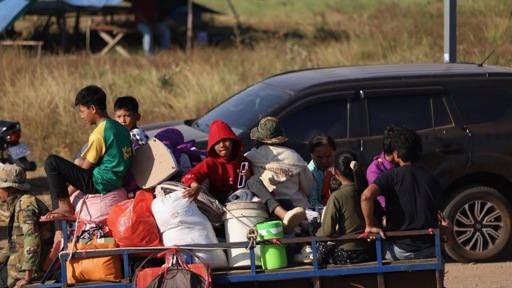
At least four people were killed and dozens of others were injured in a series of airstrikes carried out by Thailand inside Cambodia on Monday, December 8. The airstrikes, which started in the early morning, continued throughout the day causing massive displacement of civilians and destruction of civilian infrastructure.
Thailand claimed its military actions were in response to Cambodian air strikes a day earlier, in which two of its soldiers were killed and several others were injured. The Thai army called the attacks a threat to its national security.
According to Reuters, over 350,000 people were evacuated from the border districts of Thailand following Cambodian strikes on Sunday.
Cambodia has denied Thai claims, instead accusing it of violating the ceasefire agreement signed between the two countries under the mediation of US President Donald Trump in October. It also accused the Thai forces of deliberately targeting civilian infrastructure and UNESCO heritage sites.
In turn, Thailand denied allegations of targeting civilians, claiming that its airstrikes were only focused on eliminating military threats inside Cambodia.
Neth Pheaktra, information minister of Cambodia, confirmed the death of citizens in a social media post on Monday. He also announced the shutdown of all schools and other educational institutions near the bordering regions, and the evacuation of civilians.
Hun Manet, Cambodian prime minister, called for respect of the ceasefire agreement and denied Thai claims of military preparations, appealing for national unity to protect the country’s sovereignty.
Cambodia has also claimed that Thai aggressions are unilateral and it has not responded to any of its military provocations yet, expressing hope for peace.
Call for peace
Meanwhile, Thailand’s prime minister, Anutin Charnvirakul, claimed Thai forces are doing what is necessary in self defense and warned of more such strikes, accusing Cambodia of initiating the attacks on Thai sovereignty and territorial integrity in a press conference on Monday.
Meanwhile, some regional leaders called for the cessation of hostilities and offered mediation. Malaysian Prime Minister Anwar Ibrahim called for restraint and the opening of dialogue between the two countries.
“Thailand and Cambodia are close partners of Malaysia and key members of ASEAN. We urge both sides to exercise maximum restraint, maintain open channels of communication and make full use of the mechanisms in place,” Ibrahim urged.
Ibrahim was one of the key persons involved in the ceasefire agreement, which was announced following days of similar clashes between the two countries in July. At that time, Thailand recalled its ambassador from Phnom Penh following a mine blast on its border that injured one of its soldiers.
This triggered a deadly fight involving F-16 jets between the two countries. At least 48 people, mostly civilians, and over 300,000 were displaced.
A temporary ceasefire was called on July 28 following interventions from China, Malaysia, and the US.
Both countries had similar clashes in 2011 as well. The recurring clashes are reportedly related to a prolonged dispute over the demarcation of borders between them.
The 817 kilometer-long borders between the two South-East Asian nations were drawn by the French in 1907, when it ruled Cambodia as a colony.
The ceasefire agreement signed between the two countries in October in Kuala Lumpur under Trump’s mediation called on both sides to withdraw their troops from the border areas and start confidence-building measures, including direct negotiations.
However, it has been pointed out that the pact did nothing to address the long-standing issues related to the boundary dispute. This was reflected in the eruption of fresh clashes and disputes within weeks of signing of the agreement.
Clashes broke out despite Cambodia denying that Thailand suspended talks in November, this time accusing it of laying new landmines on the border, Reuters reported.
The post Thailand launches airstrikes inside Cambodia after accusing it of violating ceasefire appeared first on Peoples Dispatch.
From Peoples Dispatch via this RSS feed