

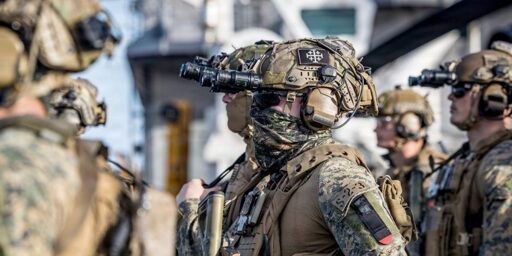
An official U.S. military social media account on Monday shared a photo collage that included a symbol long affiliated with extremist groups — and Secretary of Defense Pete Hegseth.
In a post on X trumpeting the deployment of troops to the Caribbean, U.S. Southern Command, or SOUTHCOM, shared an image that prominently displayed a so-called Jerusalem cross on the helmet of a masked commando.
The Jerusalem cross, also dubbed the “Crusader cross” for its roots in Medieval Christians’ holy wars in the Middle East, is not inherently a symbol of extremism. It has, however, become popular on the right to symbolize the march of Christian civilization, with anti-Muslim roots that made it into something of a logo for the U.S. war on terror.
Tattoos of the cross, a squared-off symbol with a pattern of repeating crosses, have appeared on the bodies of people ranging from mercenaries hired by the Gaza Humanitarian Foundation to Hegseth himself.
Now, the symbol has reared its head again to advertise President Donald Trump’s military buildup against Venezuela — an overwhelmingly Catholic country — and boat strikes in the Caribbean.
U.S. military forces are deployed to the #SOUTHCOM area of responsibility in support of #OpSouthernSpear, @DeptofWar-directed operations, and @POTUS’ priorities to disrupt illicit drug trafficking and protect the homeland. pic.twitter.com/vLvg9fQ5Lx
— U.S. Southern Command (@Southcom) December 8, 2025
“As with all things Trump, it’s a continuation, with some escalation, and then a transformation into spectacle,” said Yale University historian Greg Grandin, whose work focuses on U.S. empire in Latin America.
The social media post came amid rising controversy over a series of strikes on boats allegedly carrying drugs off the coast of Venezuela, dubbed Operation Southern Spear.
[
Read Our Complete Coverage
License to Kill](https://theintercept.com/series/license-to-kill/)
Hegseth is alleged to have ordered a so-called “double-tap” strike, a follow-up attack against a debilitated boat that killed survivors clinging to the wreckage for around 45 minutes. The U.S. has carried out 22 strikes since the campaign began in September, killing a total of 87 people.
The Pentagon’s press office declined to comment on the use of the Jerusalem cross, referring questions to SOUTHCOM. But in a reply to the X post on Monday, Hegseth’s deputy press secretary Joel Valdez signaled his approval with emojis of a salute and the American flag. In a statement to the Intercept, SOUTHCOM spokesperson Steven McLoud denied that the post implied any religious or far-right message.
“The graphic you’re referring to was an illustration of service members in a ready posture during Operation SOUTHERN SPEAR,” McLoud told The Intercept. “There is no other communication intent for this image.”
The original image of the masked service member appears to have come from an album published online by the Pentagon that depicts a training exercise by Marines aboard the USS Iwo Jima in the Caribbean Sea in October. The photo depicting the cross, however, was removed from the album after commentators on social media pointed out its origins.
Amanda Saunders, a spokesperson for the Defense Visual Information Distribution Service, the Pentagon-run photo agency, said she was unable to comment directly but forwarded the request to the Marine unit involved in the exercise.
“Content on DVIDS is published and archived directly by the registered units,” she said, “so we don’t have control over what is posted or removed, nor are we able to comment on those decisions.”
Hegseth and the Cross
The Jerusalem cross’s popularity on the right has surged in part thanks to featuring in various media, including the 2005 Ridley Scott film “Kingdom of Heaven” and video games, according to Matthew Gabriele, a professor of medieval studies at Virginia Tech and a scholar of Crusader iconography.
“It supports the rhetoric of ‘defense of homeland.’”
“It supports the rhetoric of ‘defense of homeland,’” Gabriele told The Intercept, “because the crusaders, in the right’s understanding, were waging a defensive war against enemies trying to invade Christian lands.”
The symbol’s position of prominence in official military communications is just the latest example of a trollish extremism by the Trump administration’s press teams, which have made a point of reveling in the cruelty wrought on its perceived enemies at home and abroad, or “owning the libs.”
[
Related
Team Leader at Gaza Aid Distribution Sites Belongs to Anti-“Jihad” Motorcycle Club, Has Crusader Tattoos](https://theintercept.com/2025/08/06/gaza-aid-security-contractor-mulford-ghf/)
Monday’s post may also be intended as Hegseth putting his thumb in the eye of the Pentagon’s old guard. Hegseth’s embrace of the symbol — in the form of a gawdy chest tattoo — once stymied, however temporarily, his ambitions in the military.
Folling the January 6 insurrection, according to Hegseth and reporting by the Washington Post, Hegseth was ordered to stand down rather than deploy with his National Guard unit ahead of the 2021 inauguration of Joe Biden. The decision to treat Hegseth as a possible “insider threat” came after a someone flagged a photo of a shirtless Hegseth to military brass, according to the Washington Post.
“I joined the Army in 2001 because I wanted to serve my country. Extremists attacked us on 9/11, and we went to war,” Hegseth wrote “The War on Warriors,” his 2024 memoir. “Twenty years later, I was deemed an ‘extremist’ by that very same Army.”
Hegseth was hardly chastened by the episode and has since gotten more tattoos with more overt anti-Muslim resonance, including the Arabic word word for “infidel,” which appeared on his bicep sometime in the past several years. It’s accompanied by another bicep tattoo of the Latin words “Deus vult,” or “God wills it,” yet another slogan associated with the Crusades and repurposed by extremist groups.
The use of the image to advertise aggressive posturing in a majority-Christian region like Latin America may seem odd at first glance. In the context of renewed U.S. focus on Latin America, however, it’s a potent symbol of the move of military action from the Middle East to the Western Hemisphere.
“They’re globalizing the Monroe Doctrine.”
The post comes on the heels of the release of the Trump’s National Security Strategy, a 33-page document outlining the administration’s foreign-policy priorities that explicitly compared Trump’s stance to the Monroe Doctrine, the turn-of-the-century policy of U.S. dominance in Latin America in opposition to colonialism by other foreign powers. Grandin, the Yale historian, described the document as a “vision of global dominance” based on a model of great-powers competition that can lead to immense instability.
“They’re globalizing the Monroe Doctrine,” Grandin said. “I’m no fan of the hypocrisy and arrogance of the old liberal international order, but there’s something to be said for starting from a first principle of shared interests, which does keep great conflict at bay to some degree.”
The post Official Propaganda for Caribbean Military Buildup Includes “Crusader Cross” appeared first on The Intercept.
From The Intercept via this RSS feed
You must log in or # to comment.