

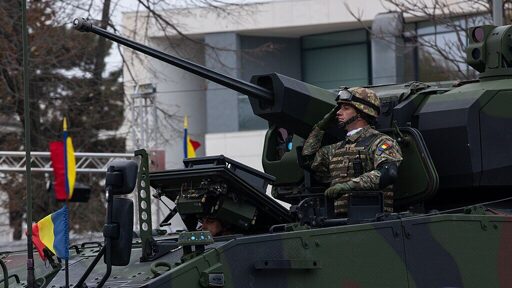
There are decades when nothing happens, and then decades happen in a few weeks. This was the feeling among Bucharest officials when the news broke in late October that the US would withdraw part of its troops from the military bases it operates on Romania’s territory and especially those on the Black Sea coast. What an excellent opportunity to convince a sceptical population that it should now support rearming and preparing for war with Russia. Once the Americans are gone, we are a lot more vulnerable to the always imminent Russian attack, commentators warned, influencers cried, politicians nodded sternly. This fearmongering discourse is similar across Europe, as the continent has entered an intense period of fast-track militarization funded with public money. States now resort to public funds and loans to derisk the military-industrial complex, both by financing military manufacturing and by creating and maintaining conflict.
Hybrid threats, hybrid regimes
Re-arming is touted as a way to reindustrialize and to create jobs for a precarious proletariat experiencing mass layoffs from the few remaining non-military industries. In the first half of 2025, there were almost 12,000 lay-offs in the automotive and petrol industry in Romania, more than double the previous year, with more scheduled in the near future. Companies are starting to leave the region, as recession looms and energy prices increase following the progressive decoupling from cheap Russian gas and oil and the adoption of expensive US fuels, as agreed in the recent tariffs negotiations between the European Commission and Donald Trump. States have few levers at their disposal to stop the corporate exodus, despite having offered these companies favorable tax regimes as well as suppressed workers’ rights and loosened climate rules. But capital moves away when the accountants say so.
The objective to see the Ukraine war linger on in order to justify and create a market for the products of military reindustrialization also helps explain why democracy was so quickly sidelined during the 2024 Romanian presidential elections, after which Romania was downgraded from functional democracy to hybrid regime in the Economist index. Prior to the second and final round of the election, polls indicated the impending victory of a far-right, euro-sceptical candidate, Călin Georgescu. When taking the unprecedented decision of cancelling the election, the government cited Russian interference in the campaign, for which, however, it is still struggling to produce conclusive evidence. It is more likely that Brussels feared Georgescu would enter alliances with other right-wing EU contrarians, such as Hungary’s Orban and Slovakia’s Fico, who consistently oppose EU military and economic support for Ukraine and sanctions on Russia.
There was also intense electoral interference from Brussels and other EU capitals during the recent general elections in the Republic of Moldova, a non-EU country that borders both Romania and Ukraine. There, forces in favor of EU accession by 2028 faced a political bloc arguing for more sovereignty. Germany’s Merz, Poland’s Tusk and France’s Macron, unpopular in their home countries, went to get their love fix in the peripheries. They even learned Romanian, the country’s official language, to address the crowds in the capital Chișinău and reassure them of the necessity of a European path. Meanwhile, the pro-EU government hoping to hold on to power cited Russian hybrid threats in order to ban opposition parties and disrupt the vote in the large Moldovan diaspora settled in the Russian Federation. The pro-EU party won.
Over in Romania, the various war ministers, holding the portfolios of defense, foreign affairs and the economy, as well as the Prime Minister and the President, insist militarization is an existential matter. The anti-Russian discourse is relentless, often copying the one produced by Brussels. The news across Europe is replete with sightings of alleged Russian drones and aircraft, and recently even helium balloons smuggling cigarettes have prompted Brussels to issue high-pitched calls for a drone wall on the Eastern Flank. The propaganda often reaches caricatural levels, as was the case with the alleged GPS jamming of Ursula von der Leyen’s plane, easily debunked by an analysis of public flight data.
The 5% robbery
In June 2025, NATO countries pledged to submit to Donald Trump’s request to increase their defense expenditure to 5% of GDP so the US could concentrate on other military ambitions, notably around China. To this end, the European Commission is mobilizing €800 billion through its recently launched ReArm Europe policy, later renamed Readiness 2030 in response to criticism from people concerned with the optics of warmongering. The plan suspends EU rules regarding the 3% cap on government deficits, but only for defense expenditure, offers €150 billion of defense loans through the Security Action for Europe (SAFE) mechanism, redirects EU funds from civilian budgets to defense, allows the European Investment Bank to lend to military companies, and looks to mobilize private capital for militarization purposes.
SAFE is not free money. The European Commission uses its favorable credit rating to borrow on the financial markets and transfers the loans to Member States. These will start repayments in ten years, a debt burden that further affects already fragile economies. Romania, one of the poorest countries in the EU, is on the brink of recession and operates with a public deficit above 9% of GDP, which it seeks to rebalance by cutting deeply into social expenditures in public sectors, from health to education to infrastructure. Social protection is always the first to suffer cuts when the European Commission threatens Member States with penalties for spending above the arbitrary 3% of GDP budget deficit it imposes through the Growth and Stability Pact. But overspending is now tolerated and encouraged if the money goes to military ends.
Read more: What are European leaders going to choose: people or war?
The almost €2 trillion Multiannual Financial Framework 2028-2034 recently proposed by the European Commission and due for negotiation with the other European institutions follows the same direction: security spending, which means militarization; competitiveness, which means giving up on the climate and labor protections; centralization of funding, which means less leeway for Member States, especially those in the poorer regions of Eastern Europe, to formulate their own development policies by taking into account their own material conditions.
Romania has requested a SAFE allocation of EUR 16.7 billion, second only to Poland, and submitted its application at the end of November, with funding expected to start in early 2026 and aiming for 2030 to complete the provision of new equipment. The government has classified the details of the application but indicated that 75% of the loans will go to military acquisitions and 25% towards developing road infrastructure towards the Republic of Moldova. This puts to rest any claims that rearmament will bring reindustrialization, since Romania does not seem to have other ambitions than to remain a market for other economies’ products. The time frame until 2030 is in any case too short to develop any significant local production. This is not surprising, but is in line with Romania’s peripheral status for European and global capital. Manufacturers such as Rheinmetall, Hanwha Defense or Elbit Systems will likely not go further than producing parts in the country, to be assembled elsewhere, thus using the territory for extraction of cheap labor and resources, but carefully limit a transfer of technological know-how. Romania will then buy the finished products from these manufacturers, indebting itself to do so.
The drone bubble
The European Commission has clarified what the SAFE applications should prioritize via the EU Defense Readiness Roadmap, published in October 2025 and subtitled Preserving Peace. The Roadmap is a derisking instrument offered to the military industry, meaning public money is made available to socialize losses and investment costs, while profits remain private. It is coupled with the European Defense Industry Program (EDIP), presented on the same date. In both these documents, there is an explicit emphasis on drones and drone production. Europe will try to reindustrialize by overspecializing its industry in a certain type of military equipment that is cheap, can be mass produced and has relative novelty value as compared to more established weaponry.
Read more: United right in European Parliament votes to weaken labor and environmental protections
But EDIP also institutes a supply and security crisis framework that will likely allow companies to violate workers’ rights in the name of security of supply. This has the potential to rapidly expand and become the norm in a range of dual-use sectors that supply arms factories with components and other adjacent services. Using the trick of a presumed forever-looming war, everything can be categorized as dual use. In addition, climate rules are also under attack, through the clause that allows disregarding public interest when planning, constructing and operating military production facilities.
War capital thrives
The war bonanza is already proving a great success for European military manufacturers, such as the aforementioned Rheinmetall. The German group has posted record profits in 2025, with its defense business growing by more than a third. It plans to steadily expand into Eastern Europe, closing deals to build weapons factories in Romania, Bulgaria, Lithuania, Latvia and even Ukraine. Low labor costs and weak unions, along with tax breaks, represent a solid incentive to move production to the region. The environmental costs are thereby also outsourced, circumventing the nuisance of organized environmental activism in the home country. The implicit commitment of the European Commission to keep the Ukraine war going through a multi-year funding program for Ukraine’s “defense needs”, thus ensuring a market for military equipment, is an additional guarantee for war capital that it is safe to accelerate production.
The genocide connection
Readiness 2030 claims to want to develop the European military industry and contains clauses against non-EU purchases. But these are easily avoided via subsidiaries such as those operated in Romania by Elbit Systems, Israel’s largest weapons manufacturer. This means loans taken out by the Romanian government, through SAFE and elsewhere, and then paid for by the entire population, also flow into the Israeli economy developed on genocide and apartheid. Romania is also one of the top ten countries to supply Israel with arms and ammunition, according to a report by UN rapporteur Francesca Albanese released in October. This makes the government complicit in the Gaza genocide and the colonization of Palestine and in breach of international law.
Read more: Amid mass protests in the West, Israel’s military footprint expands in Eastern Europe
But the growing intertwinement with the Israeli war industry now deepening across Eastern Europe also locks the region into a dependent relation with their proprietary ecosystem of drones, air missiles, spare parts and software support. As a recent investigation shows, Romania and other states in the region are “importing dependence on US-Israeli geopolitics, on volatile wartime supply chains, and on an industry whose growth is inseparable from the ongoing annihilation of a people.”
What is to be done?
Opposition to militarization is growing, such as for example through the recently launched national grassroots campaign ELBIT OUT!, against the Israeli company’s presence in Romania and the government’s complicity. The Palestinian cause is starting to bring together a hitherto disorganized anti-imperialist and anti-capitalist left. In its absence, proletarian support had migrated towards the far right, which opportunistically co-opted the discourse of peace and criticism of the EU as part of its strategy, not to emancipate the working class, but to strengthen local capital in its losing competition with global capital. But workers’ parties in Romania and elsewhere in Eastern Europe face serious obstacles that prevent their coagulation, ranging from sustained anti-communist propaganda in mainstream discourse, bureaucratic hindrances and even the threat of illegality. The local bourgeoisie, weakened by the capitalist crisis and the competition with global capital, is worried about the memory of the former proletarian state that endures amidst the general population, as recent polls indicate workers remember that the proletarian state offered them better lives.
Meanwhile, the Western left organizes for peace and Western trade unions join the antiwar movement with an understanding that reindustrialization through militarization is not the way forward. But trade unions in Romania, largely non-militant and priding themselves on being apolitical, mostly embrace militarization, and therefore the perspective of war, and merely try to negotiate a share of the war industry profits on behalf of their members. However, jobs in the war industry are few, weakly qualified and therefore expendable. They don’t bring prosperity to communities but impact the environment and the quality of life of all those in the proximity of the factories while diverting funds from public investments. Their products require a market. And that market is war. And it is workers who die in wars, not the capitalists, and that is why the pro-peace sentiment is widespread among the population. Polls show that a majority of Romanians think Ukraine should negotiate peace even if territories are lost, oppose compulsory military service, and do not think Russia will intentionally attack the country.
The way forward from the perspective of the proletariat and the aspiring proletariat is never war but radical peace, even more so for nations that are geopositioned between great powers. Peace has three key components: diplomacy, trade and multilateral disarmament. No peace negotiations take place between Romania and Russia. Trade is undermined by successive EU sanctions packages that Romania supports. And disarmament is a distant illusion when war capital receives injections from public funds at the expense of social programs and shared prosperity.
To obtain peace, trade unions, in close consultation with their rank-and-file members and their positions mirrored in the polls cited above, need to embrace their historic role, necessarily militant and political, and join the antimilitarization drive mobilized by trade unions elsewhere in Europe that takes the form of strikes, blockades and boycotts. The long-term goal of the workers’ struggle is a state in which the dominant class is the working class and the capitalists first become disorganized, then disappear. Resisting imperialist war and fighting for peace is part of that struggle. To win it, workers must be ready to mobilize when history calls. And it is calling now.
The post Hybrid threats: Romania continues to self-sabotage through militarization appeared first on Peoples Dispatch.
From Peoples Dispatch via this RSS feed