

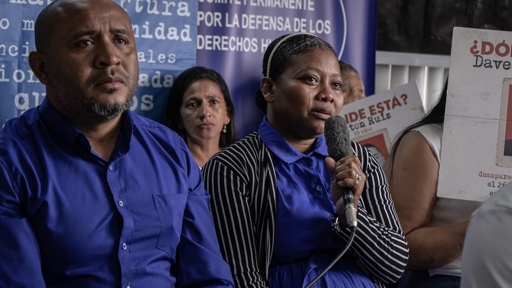
One year after the murder of four Afro-Ecuadorian children in Las Malvinas, Guayaquil, the Ecuadorian prosecutor’s office requested the maximum sentence for the soldiers who are accused of torturing and murdering Steven Medina, Nehemías Arboleda, Josué Arroyo, and Ismael Arroyo. In addition, the Prosecutor’s Office requested that each of the soldiers pay USD 100,000 to the children’s families for the crime of “forced disappearance”.
The closing arguments in the trial have shocked the public. According to the Prosecutor’s Office, on December 8, 2024, the four children, who had been playing soccer with their friends, were illegally detained by a National Army patrol south of Guayaquil, after which they disappeared.
A video posted on social media showed how the children were loaded into a truck and beaten by the military, which caused outrage in the country. A few weeks later, the bodies of the tortured, burned, and dismembered children were found.
The military’s defense claimed that after being detained, the minors were abandoned alive near Taura, so they allegedly do not know what happened to them. After that, a media campaign (waged by several journalists, influencers, and high-ranking politicians, including the Minister of Defense) sought to divert attention by claiming that the children were thieves and that was why they were apprehended. No reliable evidence was ever presented to support these accusations.
The testimonies that have shaken the country
Initially, the 17 soldiers implicated in the crime maintained the same story and remained silent. However, as the months passed, some soldiers began to change their version of events. According to some of those involved, after the arrest, two soldiers fired shots near the children’s heads and also fired shots into the air to scare them. After that, as one soldier recounted, “everything got out of control in a matter of seconds. [Several soldiers] began kicking and beating the children with their weapons and belts.”
After that, one of the soldiers testified that they took the naked and tortured children to Taura, where the patrol abandoned them in the middle of the night. Some of the children, he said, were unconscious from the beatings, while others were crying and trembling with fear.
If the story is true, it is still unknown how the boys died and were burned. Some hypotheses suggest that they were captured by local mafias and murdered. Others claim, without presenting evidence, that after the patrol returned, several motorcycles left the military base and headed toward the place where the children were, suggesting that there is still a story about the children’s murder that is being hidden. One of the soldiers testified that “the truth is being covered up” and apologized to the families.
Collective condemnation
The case has caused great pain in Ecuadorian society. This is not the first time that children have been detained and murdered by law enforcement. Almost 30 years ago, the case of the Restrepo brothers shook the country due to the proven involvement of the National Police in the torture, murder, and disappearance of two minors, whose bodies are still missing.
The case of “The Four Children of Las Malvinas” has caused enormous collective pain that many strive to ignore, yet continues to provoke widespread societal condemnation. On December 8, in various parts of the country, social organizations gathered to remember the murder of Steven Medina, Nehemías Arboleda, Josué Arroyo, and Ismael Arroyo.
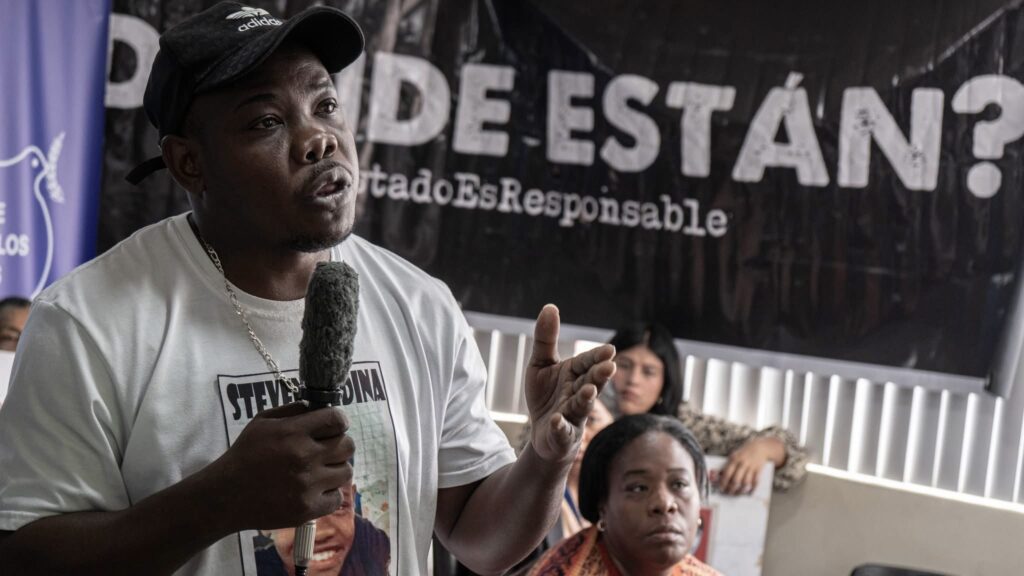
Family members of the disappeared and murdered Afro-Ecuadorian boys from Malvinas, Ecuador. Photo: Committee of Disappeared Family Members
The executive coordinator of the human rights organization INREDH, García Minda, stated that, despite the attempts by the Prosecutor’s Office to individualize responsibility for the crime, the Malvinas case is part of a systematic attack on human rights: “There is a pattern of human rights violations committed by the Armed Forces … The Phoenix Plan [the security plan of Daniel Noboa’s government] has not been audited or monitored [for human rights abuses], so the State has not disclosed what its actual results have been in terms of security.”
For her part, Ana Piquer, regional director for the Americas at Amnesty International, said that so far, in the coastal region of Ecuador alone, 43 people went missing in 2024, and pointed out that these cases are not isolated, but happened in the broader context of Noboa’s security and militarization plan (Phoenix Plan).
“We express our solidarity and admiration for the struggle of the families of the four children who disappeared in Las Malvinas. We are at a decisive moment for the observance of human rights in Ecuador. These forced disappearances not only deeply shocked the country but also highlighted the failure of President Noboa’s security policy. The families of the children and all victims of forced disappearances committed by the Armed Forces on the Ecuadorian coast have the right to justice, truth, and comprehensive reparation,” said Piquer.
Read More: Ecuadorian people deal a crushing blow to neoliberalism in Noboa’s referendum
In a song, the band Mugre Sur, which has stood by the families of the four kids demanding justice, truth, and reparations, says that the crime wasn’t just random, but a clear act of racism that keeps happening to Afro-Ecuadorians: “It seems that being Afro-Ecuadorian is synonymous with having a gun pointed at you, having your head crushed with a leather boot. The average person normalizes this. Today, a wound is opened in the history of a small town of Ecuador. Where children play soccer, and the rifle stops their clock.”
The post One year since the murder of four Afro-Ecuadorian children, soldiers face up to 34 years in prison appeared first on Peoples Dispatch.
From Peoples Dispatch via this RSS feed