

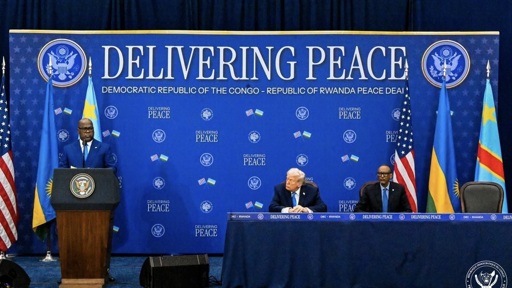
About 200,000 people were forced to flee their homes in the South Kivu province in the eastern region of the Democratic Republic of Congo (DRC), under attack by the M23 militia backed by Rwanda, which only days before had signed a US-brokered peace deal with the DRC.
On December 10, the M23 reportedly advanced into Uvira, to which the provincial administration had relocated in March 2025 after South Kivu’s official capital, Bukavu, was occupied by Rwanda’s proxy force.
With a population of over half a million, Uvira is a crucial commercial hub and a strategic gateway to the Greater Katanga region, hosting one of the DRC’s key economic zones. Between December 5 and 9, almost 38,000 people fleeing the violence have crossed the border, seeking asylum in neighboring Burundi.
Burundi closed its border with the DRC on Wednesday, as its largest city and commercial capital, Bujumbura, is located just about 25 km west across Lake Tanganyika from Uvira.
The M23 has claimed control over Uvira. Refuting this claim, the Armed Forces of the DRC (FARDC) insisted that the “city and its surroundings remain under the control of the loyalist army.” Meanwhile, gunfire continued on Wednesday afternoon.
The UN said on Monday, December 8, at least 74, mostly civilians, were killed in the clashes, and over 80 were hospitalized with wounds.
Accusing the Rwandan army of aiding the M23’s offensive by firing heavy weapons from across the border “on the very day after the signing” of the peace deal in Washington last week, DRC’s president Felix Tshisekedi told the parliament that “Rwanda is already violating its commitments”.
Burundi has also accused Rwanda of attacking its city of Cibitoke on the border with the DRC. Calling for sanctions against Rwanda, Burundi’s Foreign Minister Edouard Bizimana said that its violation of the peace deal is “truly a slap in the face to the United States, a middle finger.”
He added that “signing an agreement and not implementing it is a humiliation… first and foremost for [the US] President [Donald] Trump,” who had proclaimed on December 4, “We’re settling a war that’s been going on for decades.”
Hosting DRC’s President Felix Tshisekedi and Rwandan President Paul Kagame to sign the so-called Washington Accords for Peace and Prosperity, he had said: “They spent a lot of time killing each other, and now they’re going to spend a lot of time hugging, holding hands, and taking advantage of the United States of America economically – like every other country does.”
The US State Department had described the deal as “historic”. The Washington pact was also followed by a so-called Strategic Partnership Agreement, in which the DRC threw open its critical minerals – over which this war is being waged in the eastern region – to the US.
Mining these critical minerals from the DRC’s occupied eastern regions – especially tin, tungsten, and tantalum, critical for electronics, automotive, and aerospace industries – the M23 transports them to Rwanda, from where they are channeled into the global supply chains.
Last December, the DRC filed a criminal case against Apple, accusing the US tech giant of fueling the war by using the illegally extracted “blood minerals” in its products.
Read: The DRC’s historic case against Apple over blood minerals in its supply chain
The post In the wake of Trump’s “peace deal”, 200,000 displaced due to escalated M23 attacks on DRC appeared first on Peoples Dispatch.
From Peoples Dispatch via this RSS feed