

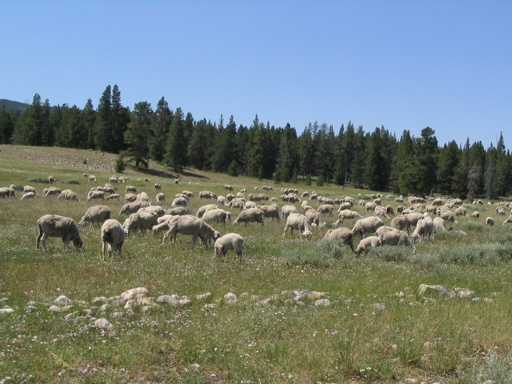
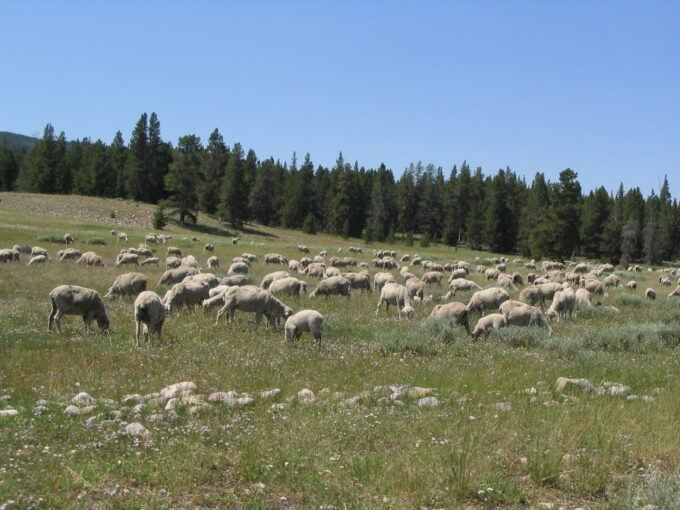
Image by Ken Lund.
Stumbling over the rugged alpine landscape of the High Uintas Wilderness, a bighorn lamb is coughing and struggling, afflicted with pneumonia as the cold skies of winter set in. Here in northeastern Utah, a battle between domestication and wildness has been raging for three decades, while the West’s wild bighorns have fought for survival for over two centuries.
In September, Wilderness Watch filed an objection to a decision signed by the Uinta-Wasatch-Cache National Forest to continue domestic sheep grazing on 144,000 acres, nearly one-third of the High Uintas Wilderness. Releasing another 10,000 domestic sheep into the wild would put countless bighorn sheep at risk of sickness and death, leaving them vulnerable to the harsh conditions of the High Uintas in winter. Sick lambs don’t live long out there.
Brought to America from the old country, the pathogen Mycoplasma ovipneumoniae, or Movi, causes the runaway spread of pneumonia after being introduced to bighorns through domestic sheep. The pneumonia, which is undetectable in domestic sheep, is spread through nose-to-nose contact, a friendly greeting between two long-separated descendants of a common ancestor. For these bighorn herds, the result is nothing short of catastrophic. First the disease annihilates the herd, then it becomes endemic. Ewes become chronic carriers, infecting their lambs for decades after the initial outbreak. Any bighorn lamb that becomes infected has likely been issued a death sentence. If the infection doesn’t take their life, the sickness leaves them vulnerable to predation and the elements. In North America, the bighorn population has plummeted by an estimated 96 percent since Euro-American colonization. There are many reasons for this, but the primary cause of untimely mortality among wild sheep is pneumonia. Tragically, the agencies managing these areas refuse to implement simple solutions, even as they witness the wildlife they’re responsible for dying excruciating deaths year after year.
The impact of domestic sheep grazing on Wilderness doesn’t end with dying lambs—endless ecological problems arise when you turn a Wilderness into a feedlot. Unsupervised sheep defecate wherever they like, which has led to filthy conditions in areas of the High Uintas like Bald Mountain, where domestic sheep run roughshod. Backpackers have reported so much feces covering the ground they couldn’t even find a place to set their packs.
Domestic sheep grazing leads to the depletion of vegetation that would otherwise feed native wildlife, like elk, mule deer, and, of course, bighorn sheep. This leads to accelerated soil erosion and sedimentation that flows downstream and gets dumped into vulnerable ecosystems, impacting aquatic life as well. Excessive sedimentation clogs fish gills, reduces oxygen levels, disrupts the food chain, and leads to the loss of sensitive species such as cutthroat trout.
And yet, having access to these Wilderness lands, overgrazing and trampling them to mud and dust still isn’t enough. Permittees demand the trapping and killing of native wildlife like black bears, mountain lions, and coyotes. This, of course, is after the ranchers and government worked together to trap, hunt, and poison gray wolves in a coordinated campaign of extermination in the Uintas that ended when the last wolf was killed in 1929. Utah’s Bighorn Plan, which is supported by the Forest Service, calls for the killing of cougars and the helicopter gunning of potentially infected bighorn sheep, rather than the more logical and humane closing of livestock grazing allotments. You and I pay for this! Taxpayers foot the bill to prop up the failing business model of public lands ranchers across the West, including 13 million acres of Wilderness. In fact, the ranching corporation grazing their domestic sheep in the High Uintas Wilderness pays less than one cent a day per sheep for the privilege. Where’s DOGE when you need them?
If wild animals are not safe in Wilderness, then there is nowhere safe for them left in the world.
Domestication is sweeping the planet at an unprecedented rate—wild animals make up only four percent of the mammals on earth. The other 96 percent is nothing but humans, our pets, and our livestock. Chickens and poultry make up 70 percent of the avian life left, more than double the population of remaining wild birds. If we haven’t drawn a line already, when will we? The ecological turmoil resulting from modern agricultural practices should be enough, but what about the misery and loneliness at the end of the extinction crisis? E.O. Wilson called this era of mass extinction and biological catastrophe the Eremozoic period, or the Age of Loneliness, when we have given up all the world’s wildlife and biodiversity for a cheeseburger and another pair of socks.
While the thought of dying bighorn lambs and mass extinction is unbearably depressing, some of our ecological problems have straight-forward solutions. Protecting the bighorn sheep of the High Uintas is one such problem, and the solution is clear: end domestic sheep grazing in this alpine Wilderness. Yet land managers seem fanatical in their desire to appease those who exploit the Wilderness to line their pockets.
Wildernesses like the High Uintas are the last remaining sanctuaries for wildlife, as the planet succumbs to the sprawl of civilization. It is vital that these lands remain safe for wild bighorns, because they have nowhere left to go. If we allow ranchers to feed from the public trough, it should come with an understanding that it is done with respect for the land and its wild inhabitants, not at the cost of ecosystem collapse and mass extinction. If this means we must end the practice altogether, especially in Wilderness, so be it. The agencies that approve plans leading to the death of bighorns and the destruction of ecosystems are not just complacent in the ranchers’ conquest, they are equally responsible.
The reality is that domestication and wildness are at odds with one another. They cannot coexist in any sustainable way, because the primary goal of domestication is the taming of wildness. While wildness now only exists in small pockets around America, there are some who wish to see it eradicated entirely. Nearly everything is not enough. A world of domestication is defined by barrenness, sickness, and boredom, but a world of wildness is fertile and vigorous and intense. We must do everything we can to protect what’s wild and prevent the transformation of Wilderness into feedlots. For the bighorns of the High Uintas, there is no more room for compromise.
Mason Parker is Wilderness Watch’s Wilderness Defense Director.
Help end livestock damage to Wilderness
Wilderness Watch applauds Rep. Adam Smith (D-WA) for introducing the Voluntary Grazing Permit Retirement Act (H.R. 5785) this past October. This legislation will expand the successful model of voluntary federal livestock grazing permit retirement across the western U.S., including in Wilderness.
Wilderness Watch strongly supports H.R. 5785 as a solution toward ending livestock damage to Wilderness by bolstering wilderness protection, allotment-by-allotment, fairly and permanently. Specifically, H.R. 5785:
• Authorizes ranchers in 16 Western states to voluntarily waive federal grazing permits or leases to permanently end livestock grazing on an allotment, including in Wilderness. • Ensures retired allotments can’t be re-leased for new grazing permits. • Helps restore wildlife corridors, protect water quality, and reduce the costs of administering grazing programs.
Please write your U.S. House Rep and also call them at (202) 224-3121 and urge them to co-sponsor and pass the Voluntary Grazing Permit Retirement Act (H.R. 5785).
The post Domestic Sheep Grazing and Wilderness are Always at Odds appeared first on CounterPunch.org.
From CounterPunch.org via this RSS feed
You must log in or # to comment.