

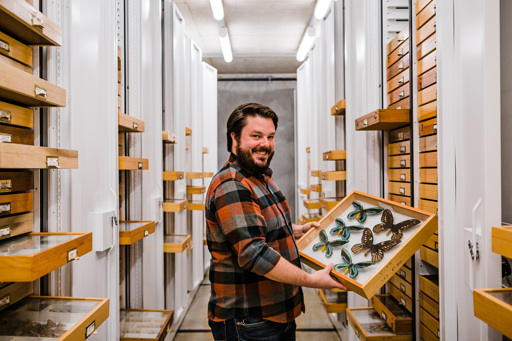
Founder’s Briefs: An occasional series where Mongabay founder Rhett Ayers Butler shares analysis, perspectives and story summaries. Chris Grinter has spent much of his life surrounded by insects — though not in the way most people imagine. As senior collection manager of entomology at the California Academy of Sciences, he oversees one of the world’s major insect archives, preserving everything from the smallest moths to the largest butterflies. His work supports the California All-Taxa Biodiversity Inventory (CalATBI), an ambitious effort to document every species in the state before they vanish. Grinter’s fascination began in suburban Chicago, where he watched butterflies drift through his backyard and wondered about their names. “It all started with butterflies,” he says in an interview with Mongabay. A visit to Chicago’s Field Museum changed everything. “I had my mind blown.” Soon he was volunteering — labeling, databasing, and joining scientists in the field. That curiosity expanded into the hidden world of moths, “about 15 species for every one butterfly.” Even a city garden, he notes, may host species still unknown to science. When CalATBI launched, Grinter’s team helped lead large-scale fieldwork across California, collecting hundreds of thousands of insects over tens of thousands of miles. The project revived a scale of exploration unseen in decades, yielding both discovery and mishap, like getting a van stuck in the Mojave Desert sand and continuing to sample in 38°C (100°F) heat. For Grinter, CalATBI is “both a scientific and civic project.” The academy’s mission — “to regenerate the natural…This article was originally published on Mongabay
From Conservation news via this RSS feed
You must log in or # to comment.