
Photo: Michael Nigro/ZUMA Press Wire/Reuters
In late October, dozens of federal agents, including ICE, poured out of their Manhattan headquarters and onto Canal Street to conduct an immigration raid. A spontaneous crowd surrounded the agents, but by the time local immigration advocates and organizers got there, it was too late. Authorities had already detained several street vendors. Two weeks ago, though, it was the protesters who surprised ICE.
Organizers had a feeling the authorities might take advantage of Thanksgiving weekend to stage their next raid. Their suspicion grew when volunteers who were patrolling Canal Street noticed early that morning on November 29 that there were more vehicles on the road than usual. They also observed that many cars were moving toward a garage nearby. “We would be able to tell that a raid was going to happen just based on the movement around Federal Plaza, because that is ICE headquarters,” says Samantha, a young organizer who declined to be identified for fear of retaliation from the federal government. Activists alerted each other in Signal chats to come to the garage, then issued a call for action to the public on social media. Samantha grabbed a mask, a hat, and 25 whistles and rushed downtown from Brooklyn.
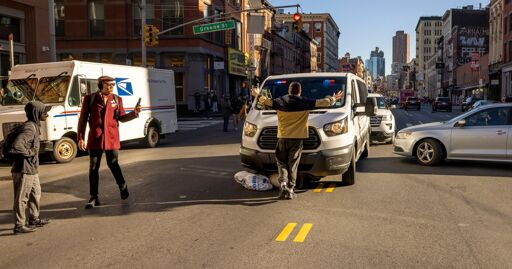
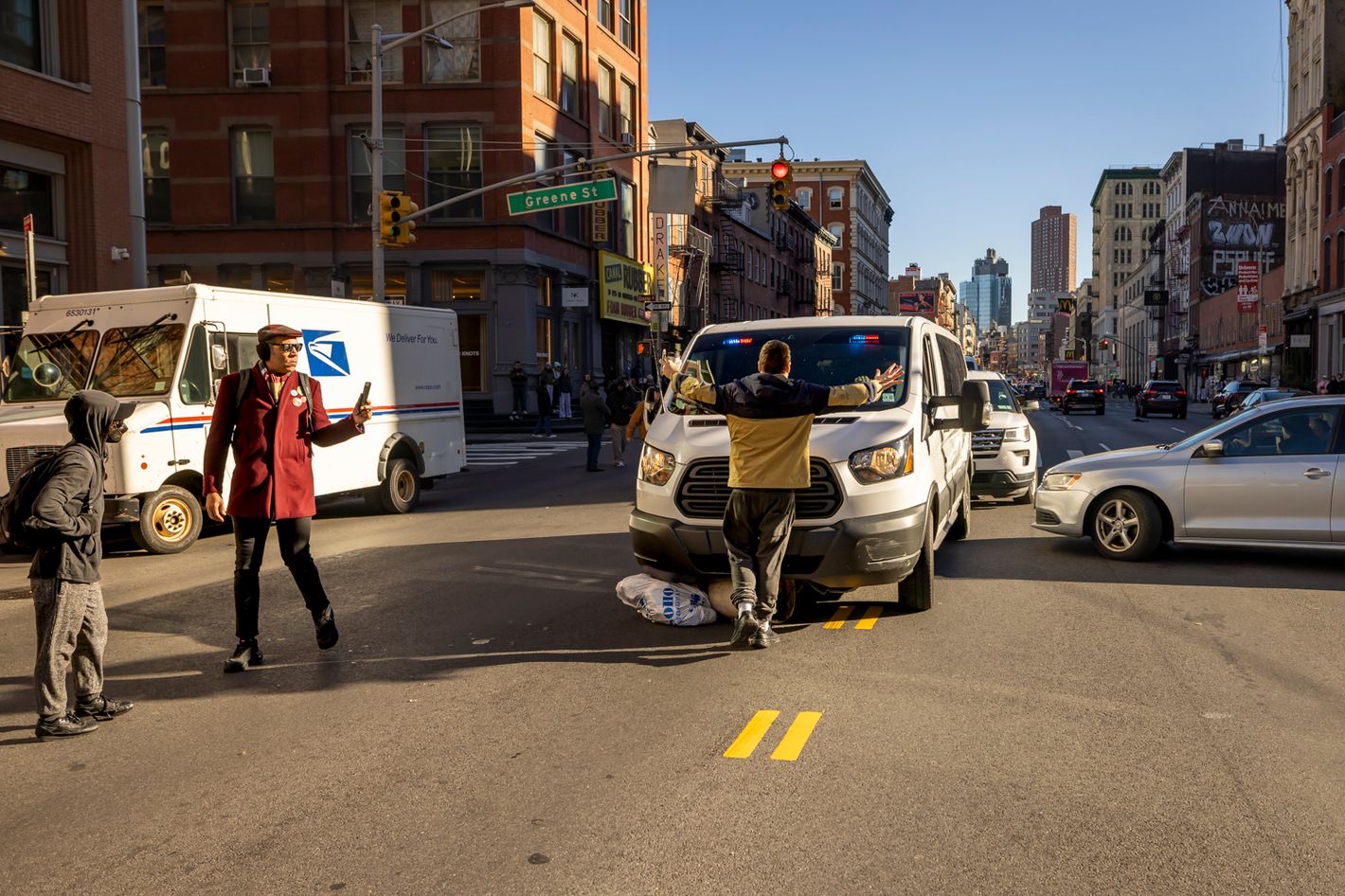
By the time she arrived, about 50 people were blocking the garage’s exit. They locked arms and chanted, “ICE out of New York!” She handed out whistles to passersby, some of whom joined in. “Once people see with their own eyes, Oh, shit it’s happening here in my city, the feeling is a lot different than seeing it on their Instagram Reels or TikTok feed,” she says. Protesters dragged trash cans and wood pallets to put in the federal agents’ path. Others stood in front of government vans, stopping and slowing their progress all the way to Holland Tunnel, about a mile away. Julie DeLaurier, 69, locked eyes with one federal agent and said, “You don’t have to do this.” By the time the NYPD arrived a half-hour later, organizers say the protest had grown to some 200 people. Police eventually cleared a path for ICE to leave, using pepper spray on protesters and arresting more than a dozen people.
“These were all delay tactics — we didn’t interfere with any arrests — but the delays allowed word to spread, and they got no one. We did good work,” DeLaurier says.
DeLaurier and others were prepared to block federal agents after attending community events and protests organized by Hands Off NYC, a volunteer-run coalition that has become a key part of a broad, decentralized effort to defend New York from the Trump administration’s immigration crackdown seen in other cities, including Los Angeles, Chicago, and most recently New Orleans. The coalition includes two of the city’s largest immigrant-rights organizations, New York Immigration Coalition and Make the Road New York. Hannah Stauss, a co-founder of Hands Off NYC, says the group has trained thousands of volunteers in recent months; interest has recently surged to the point where more than 800 people are on a wait list. “Sometimes you trade high security for the ability to scale,” she says. “We always assume that we are infiltrated.” When Hands Off NYC isn’t training, its leaders are organizing, along with coalition members, mass demonstrations such as the city’s most recent No Kings protest.
When the first, successful Canal Street raid happened, immigration advocates got there largely after ICE had already detained street vendors, says Stauss, and there were half as many people as there were a month later. She attributes the faster response to the second operation, in part, to increasing vigilance across the city through more frequent neighborhood patrols performed by local residents. “A lot of it is growing to a point where ICE can’t move quietly in our city,” she says.
The patrols are mainly a response to changing tactics by authorities who are increasingly targeting immigrants on the streets. Activists are particularly vigilant about windows when immigrants are most vulnerable: returning to or leaving work, picking up or dropping off their children at school. It appears federal agents are venturing beyond the courthouse at 26 Federal Plaza, where they have detained immigrants there for routine court hearings. The move to the streets has opened up more creative possibilities to fight back. “You’re more likely to be around people who care,” says one protester who was on Canal Street last month. “If you’re in a federal building and trying to stop a kidnapping, there’s not a ton of people around you that you can call out for … in the same way you could on a street.”
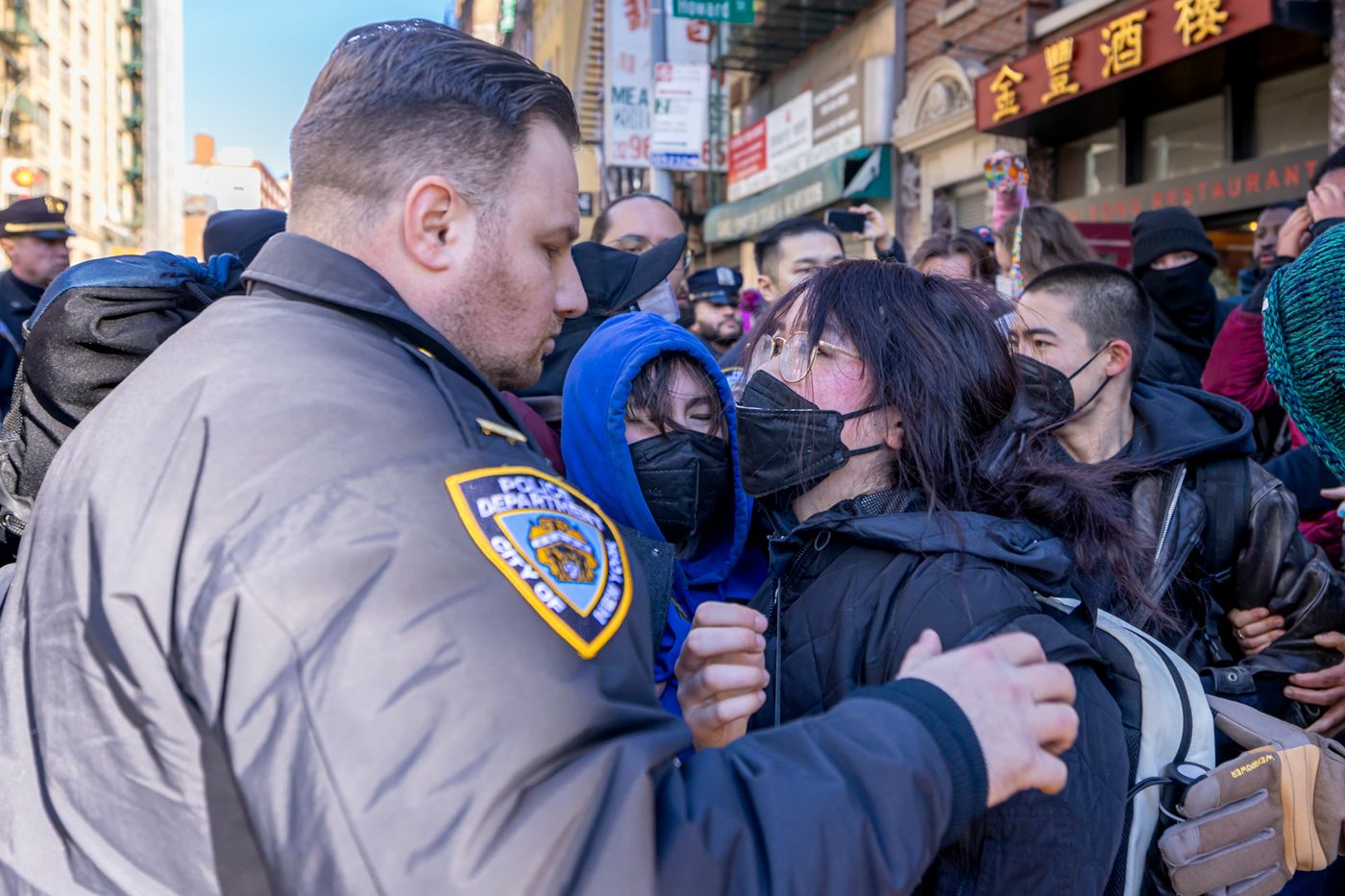
Photo: Michael Nigro/SIPA USA/Reuters
On Saturday, about 1,000 participants signed up for a Hands Off NYC anti-ICE training at a Pentecostal church in Brooklyn. Nancy Campau, an 82-year-old grandmother, always saw herself as “kind of a goody two-shoes.” She came to the training to learn how to step in and document and distract federal agents if she witnessed them trying to detain one of her neighbors. “It would be hard, but I would,” she says. Going forward, she will wear a whistle around her neck to alert people to raids and will offer to walk children to school if their parents are fearful of ICE.
The crowd at Saturday’s training was mostly white. “To put it frankly, old white people have a lot of time, and they’re really angry,” Stauss said. “Having somebody that looks like your grandmother out there, shouting ‘shame’ or out there blowing her whistle, is really important.” Stauss also said they have community buy-in from coalition members, like the NAACP and the Street Vendor Project. “Part of it is about asking how we can show up to support them, instead of asking people who are at greater risk to show up on the streets,” she says.
Trainers ran through scenarios, like ICE grabbing a parent who is dropping their child off to school. They laid out best practices for reporting, recording, and documenting ICE actions, including “using all your personal strength to not use expletives to describe what’s happening.” They cracked open studies about what it takes to topple authoritarian regimes and shared what they learned from other cities, such as adopting Chicago activists’ ideas to use whistles and to report activity on a hotline.
One of the biggest lessons Hands Off NYC learned is the importance of a neighborhood-led rapid-response structure. “That is definitely something we learned from other cities, where we felt like we’re maybe a little behind,” says Hae-Lin Choi, another co-founder of Hands Off NYC. Keya Chatterjee, executive director of Free DC, explains that Washington activists realized they weren’t able to react fast enough without training residents in neighborhoods being targeted by ICE. “This is not the kind of situation where you can have a centralized group that can get to where the issue is,” she says.
Activists in New York say more than 500 people patrol at least 20 neighborhoods daily, led by an autonomous patchwork of people who operate separately from public-facing groups like Hands Off. One of them is Samantha, who signed up for a shift to patrol part of Bushwick on Monday evening, checking multiple Signal chats for updates. She usually walks alone, but others are patrolling nearby at the same time. “The more eyes you have in all areas, the more likely you are to suspect things and the quicker people can converge to get together if there’s a sighting,” she says.
At every intersection, Samantha looks both ways, trying to spot clues. In Bushwick, she says federal agents often huddle at the parking lots by White Castle and Food Bazaar before any enforcement action. They also transfer the immigrants they detain into cars at these locations. Those on ICE patrol look for cars and vans moving in groups, especially if they aren’t personalized, have tinted windows or no license-plate covers, or are double or illegally parked. This night, there is no sign of ICE activity, although the corner of Irving Avenue and Harman Street, right outside a public school, had remnants of a previous encounter. A large warning is painted in red on a white wall: “ICE ABDUCTION HERE,” accompanied by the date, September 13.
Samantha has been demonstrating since she was in middle school, first over gun control and climate, then joined Black Lives Matter marches in 2020. More recently, she was part of the pro-Palestinian student-encampment movement. The years of experience make her a seasoned veteran at a young age, but even she is terrified about what the Trump administration reportedly has planned for people like her. A leaked Justice Department memo noted that Attorney General Pam Bondi is ordering the FBI to “compile a list of groups or entities engaging in acts that may constitute domestic terrorism,” including opposing law and immigration enforcement and harboring “extreme views in favor of mass migration and open borders.”
“We know ICE is not going to slow down,” Samantha says. “It’s undeniably scary — but people are more likely to be courageous when they have a resilient social structure that has their back.”
Related
Portfolio: The Trap at 26 Federal Plaza
From Intelligencer - Daily News, Politics, Business, and Tech via this RSS feed