

Editor’s note: The story is being updated.
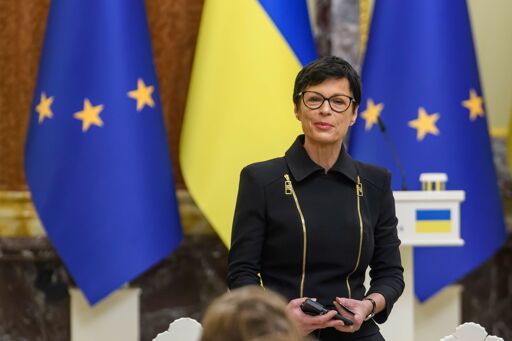
The European Commission and Kyiv have agreed on a 10-point action plan to tackle corruption and strengthen democratic institutions in Ukraine as part of its path to membership, EU Enlargement Commissioner Marta Kos announced on Dec. 11.
The agreement is part of joint EU-Ukraine efforts to advance the technical side of the accession process while Hungary continues to block the formal opening of the negotiation clusters.
The current focus is on implementing and screening measures under the first, second, and sixth clusters, which relate to the rule of law and democracy, the internal market, and external relations, respectively, according to officials.
Priorities listed in the 10-point agreement, concluded on Dec. 10 and to be published soon, “all focus on strengthening the rule of law, fighting corruption, and building strong, accountable democratic institutions in Ukraine,” Kos said at a press conference during an informal EU meeting in Lviv.
The Ukrainian government has committed to prioritizing these goals in the next year, for example, by “expanding the jurisdiction” of Ukraine’s two key anti-graft bodies, the National Anti-Corruption Bureau (NABU) and the Specialized Anti-Corruption Prosecutor’s Office (SAPO), she noted.
The news follows Ukraine’s largest corruption scandal in recent years, in which NABU charged seven people, including President Volodymyr Zelensky’s former business partner Timur Mindich, with a money-laundering scheme involving the state-owned energy company Energoatom.
Speaking beside Kos, Deputy Prime Minister for European and Euro-Atlantic Integration Taras Kachka acknowledged that “Ukraine is going through painful structural reforms and the most recent situation also could eventually cast a shadow on the adherence of Ukraine to anti-corruption reforms.”
This is why Kyiv focuses its efforts on “reforms like amendments to the criminal procedure code or involvement of international experts in the reforms of institutions in the criminal justice,” he said.
Ukraine and the EU initiated the accession process in 2024, but Hungary — widely seen as the most Kremlin-friendly government in the EU — has consistently blocked the opening of the six negotiation clusters.
Hungary’s EU affairs minister, Janos Boka, has skipped the two-day meeting in Lviv, which was co-organized by Denmark and takes place in the last weeks of the Danish Presidency of the Council of the EU, a role that will pass to Cyprus in January.
“It is a disappointment for many of us that we have not been able to formally open Cluster One,” Danish EU Affairs Minister Marie Bjerre said at the press conference.
However, the shift of focus on technical talks means that “the enlargement process with Ukraine is not at a standstill,” she said, noting that “the Cyprus Presidency will be able to continue this approach.”
Bjerre also noted that all six clusters will be under consideration by the Council of the EU by the end of the year, meaning they can all be opened once a political consensus is reached.
In late September, the European Commission announced that Ukraine had completed a bilateral screening process, a major milestone toward accession.
“Reforms are at the center of this process, and nobody can veto Ukraine from doing these reforms,” Kos commented in Lviv.
While Hungarian Prime Minister Viktor Orban has consistently obstructed aid to Ukraine and its path toward EU membership, he faces his greatest domestic political challenge yet in the upcoming parliamentary elections next spring, with Peter Magyar’s opposition Tisza Party leading in most polls.
From The Kyiv Independent - News from Ukraine, Eastern Europe via this RSS feed