

About the author: Olena Havrylchyk is a Professor of Economics at the University Paris 1 Panthéon-Sorbonne. The proposal to use immobilized Russian assets to finance a “reparation loan” for Ukraine will again be discussed at the next European Council meeting on Dec. 18 and 19.
The purpose of this loan is to advance Russia’s future reparations in order to cover Ukraine’s reconstruction and recovery needs, which are estimated at 506 billion euros (nearly $589 billion).
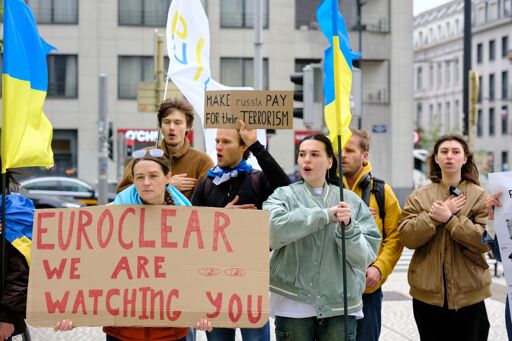
At the previous summit, Belgium blocked the decision; Euroclear Holding, which holds the immobilized assets on its balance sheet, is headquartered there. In an interview with RTBF, Valerie Urbain, Euroclear’s сhief уxecutive щfficer, voiced her opposition to the “reparation loan” mechanism and said that she was ready to challenge this decision in court.
How can it be that a profit-seeking financial institution effectively stands in the way of a collective European decision with major geopolitical implications?
With 42.5 trillion euros ($49,5 trillion) in assets under custody, Euroclear Holding is the largest central securities depository in Europe.
Its role is critical to the functioning of European financial markets, as it records the issuance and transfer of ownership of European securities. In my recent policy note for the French Institute of International Relations, I explain how Euroclear operates and analyze the consequences of the immobilization of Russian assets.
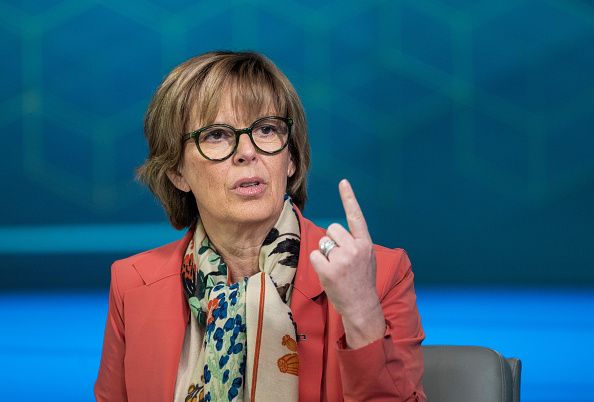
Valerie Urbain, chief executive officer of Euroclear SA, during a Bloomberg Television interview on June 4, 2025, in London, England. (Chris J. Ratcliffe/Bloomberg via Getty Images)
Euroclear and the Belgian authorities argue that investing Russian assets in a “reparation loan” would endanger the institution. Yet, these fears are unfounded.
The European Commission’s proposal explicitly includes state guarantees, and, more importantly, Euroclear’s systemic role means that European authorities would never allow it to fail.
Euroclear Holding holds 49% of all European securities in custody and enjoys a monopolistic position in France, Belgium, the Netherlands, Sweden, Finland, Ireland, and the United Kingdom. Given its central role in the European financial system, any disruption to Euroclear’s operations would pose systemic risks far beyond that of a single institution.
Thus, the claim that the European Central Bank would refuse to provide a liquidity backstop for the loan is simply not credible.
Euroclear’s stance in the debate over Russian assets comes at a moment when the institution itself is under pressure. European policymakers have called for merging Euroclear with other European central securities depositories to create a single, U.S.-style entity.
Importantly, the American counterpart to Euroclear operates as a cooperative and is designated as a financial market utility, a governance model that aligns with the monopolistic nature of these infrastructures.
While confiscating Russian assets involves financial risks, such as the possibility that China or Gulf countries may divest, these risks are not unique to Belgium but apply to all EU member states. Yet Belgium stands alone in blocking the initiative.
Paradoxically, in March 2025, Euroclear obtained authorization from the Belgian authorities to use 3 billion euros of Russian assets to compensate its clients whose holdings had been seized in Russia, without eliciting any concern about financial risk.
Euroclear’s quarterly financial statements show that Russian assets declined from 194 billion euros ($225,8 billion) in June to 193 billion euros ($224,6 billion) in Oct. 2025. This data not only confirms the earlier approval but also highlights the inconsistency in Belgium’s current stance.
The above decision establishes a significant precedent for the confiscation of Russian sovereign assets within the EU. Notably, the proceeds were allocated to compensate Western investors, thereby socializing the losses associated with their activities in the Russian market.
Politically, support for asset confiscation is growing, as it becomes increasingly difficult to justify shifting the financial burden of Ukraine’s defense and reconstruction onto Western taxpayers while substantial Russian assets remain immobilized or frozen.
In March 2025, the European Parliament adopted a non-binding resolution encouraging the seizure of Russian sovereign assets.
To shield Euroclear from the negative consequences associated with the confiscation of Russian assets, the European Central Bank should create a “bad bank” into which all Russian assets held by European banks would be transferred.
A similar mechanism was used after the 2007–2008 financial crisis to relieve banks of their toxic assets. Today, such a measure is essential to free Euroclear Bank from geopolitical risks. The bad bank could then invest in the “reparation loan” issued by Ukraine, which would be repaid only if Moscow pays reparations.
According to historian Jonathan Kirshner, bankers have long been inclined toward policies of appeasement because of their deep aversion to financial and monetary instability, an instinct that is often beneficial.
Yet in his book Appeasing Bankers, he describes cases in which such caution ran counter to national interests, notably in France during the interwar period. Without drawing strict historical parallels, Euroclear’s appeasement posture today appears similarly at odds with Europe’s broader strategic interests.
In the end, this debate is not about financial stability; it is about whether Europe is serious about justice, accountability, and reparations.
Yet in a recent interview, Belgium’s Prime Minister Bart De Wever dismissed the “reparation loan” as “stealing,” cast doubt on Russia’s eventual defeat, and even argued that such a defeat would not be desirable.
This is precisely why the “reparation loan” matters: it conveys a clear and credible European commitment to ensuring that Russia compensates for the damages it has caused.
Editor’s note: The opinions expressed in the op-ed section are those of the authors and do not purport to reflect the views of the Kyiv Independent.
From The Kyiv Independent - News from Ukraine, Eastern Europe via this RSS feed