
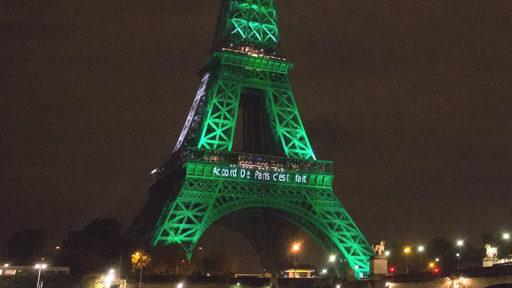
The world’s efforts to avert catastrophic climate change are still far off track a decade after the Paris Agreement’s adoption, but the landmark pact has spurred big strides on cutting planet-heating emissions and reducing the expected rise in global warming.
UN Secretary-General António Guterres conceded for the first time this year that the global average temperature will increase by more than the 1.5C limit above pre-industrial levels agreed in the Paris deal, though he described it as a “temporary overshoot” that could be reversed before the end of this century.
The legally binding accord set an overarching goal to hold “the increase in the global average temperature to well below 2C above pre-industrial levels” while pursuing efforts to limit it to 1.5C.
But even if the most symbolic 1.5C target is missed, the projected global temperature increase by the end of the century has fallen in the decade since the Paris deal was struck on December 12, 2015 – and climate experts say the agreement is still the compass of global climate action.
To mark the agreement’s 10-year anniversary, we take a look at what it has achieved, and what remains to be done:
What has the Paris Agreement achieved on emissions?
When the Paris deal was adopted, no countries had pledged to cut their emissions to net zero. Now, about 70% of global greenhouse gas emissions are covered by net-zero pledges.
“Countries have moved from a patchwork of targets to economy-wide, absolute emission-reduction goals, and projected 21st-century emissions under both current policies and targets have fallen markedly since 2015,” said an analysis by Climate Analytics, adding that climate policies meant global emissions could peak before 2030.
 Dec 10, 2025News
US set to push fossil fuels under its G20 presidency
But Trump’s attempts to undermine climate action could face blowback as most other nations remain committedRead more Dec 9, 2025Politics
Brazil’s Lula requests national roadmap for fossil fuel transition
After countries failed to formally back a global energy transition roadmap at COP30, Brazil’s president takes the initiative by mandating a national planRead more Nov 23, 2025Politics
“We are still here” – COP30 tests resolve to keep fighting climate crisis
Climate Home News rounds up a selection of views on the COP30 climate summit outcomes from politicians, top UN officials and analystsRead more
Assuming current policies on tackling emissions are maintained, the world’s projected temperature increase by the end of the century has fallen to 2.8C from 3C-3.7C when the deal was struck, according to the UN Environment Programme’s latest Emissions Gap Report, showing the impact of climate action.
If countries’ national climate targets, known as nationally determined contributions (NDCs), are fully implemented, projected warming would come down to between 2.3C and 2.5C, the report said.
Paris Agreement helping to avert dozens of hot days each year, scientists say
Still, climate action since 2015 has not been sufficient to prevent overshooting of the 1.5C limit. And even if that happens temporarily and temperatures are brought back down again, it could still have disastrous consequences for ecosystems, economies and vulnerable communities.
“This is not a failure of the Agreement’s design; it is a failure of collective ambition to match its aims,” the Climate Analytics analysis said.
The State of Climate Action 2025 report from the World Resources Institute (WRI) also found there is still a long way to go.
“Across every single sector, climate action has failed to materialise at the pace and scale required to achieve the Paris Agreement’s temperature goal,” the WRI report said.

Campaigners demonstrate at the COP29 climate talks in Baku, Azerbaijan, calling for public funding for climate action, on November 14, 2024. (Photo: UN Climate Change – Kamran Guliyev)
What are the biggest hurdles for the key Paris goals?
None of the 45 indicators assessed in the WRI report were found to be on track to reach their 1.5C-aligned targets by the end of this decade, with some of the worst-performing metrics including halting permanent forest loss, phasing out coal-generated power and scaling up climate finance.
At the same time, public finance for fossil fuels continues to grow – even two years after the world agreed to transition away from coal, oil and gas in energy systems – rising by an average of $75 billion per year since 2014, the WRI report said.
Elsewhere, climate experts say progress has started to slow down, warning that this could push the Paris Agreement’s goals on limiting temperature rise further out of reach.
“Progress made in decarbonising steel has largely stagnated; and the share of trips taken by passenger cars – many of which still rely on the internal combustion engine – continues to rise,” the WRI report said.
The Climate Action Monitor 2025, issued by the Organisation for Economic Co-operation and Development, shows that the number and stringency of policies increased by only 1% in 2024.
Climate Analytics CEO Bill Hare said that while improved national policies meant a global peak in emissions before 2030 was now in sight, a dwindling sense of urgency among decision-makers must be tackled.
“Action has slowed in the last four years, even as climate impacts have grown, and we are still a long way from 1.5C. But the science shows that it is still possible to bring temperatures back well below 1.5C by 2100 after a brief period of overshoot,” Hare said.
COP30 this November highlighted the political challenges in weaning the world off fossil fuels.

Demonstrators, with lamps called ‘Poronga’ on their heads, attend a march in defense of the living forest, territorial rights, and global climate responsibility during the U.N. Climate Change Conference (COP30) in Belem, Brazil, November 13, 2025. REUTERS/Adriano Machado
Demonstrators, with lamps called ‘Poronga’ on their heads, attend a march in defense of the living forest, territorial rights, and global climate responsibility during the U.N. Climate Change Conference (COP30) in Belem, Brazil, November 13, 2025. REUTERS/Adriano Machado
While there was growing momentum for an agreement to start work on a roadmap to transition away from fossil fuels during the summit, the proposal did not make it into the final Belém deal due to opposition from nations that are heavily reliant on fossil fuel production.
The Trump administration, which is withdrawing the US from the Paris Agreement for a second time, did not send a formal delegation to the talks in Brazil, and Washington is expected to use its year in charge of the G20 to promote fossil fuels.
Ten years on, what is actually working?
However, the obstacles to meeting the world’s climate goals do not mean no progress has been made towards them.
“Paris is working: it bent the curve,” said Hare from Climate Analytics. “Now our future depends on the political will to move forward fast enough to finish the job,” he added.
Framework climate laws have more than tripled since 2015 and national climate policy tools are up seven-fold, a recent study by the Energy & Climate Intelligence Unit (ECIU) found.
When it comes to the clean energy rollout, “the Paris Agreement has had a transformative global impact”, the ECIU report said.
Renewables now provide an additional 20% or more of electricity in 20 countries, according to a new study by Zero Carbon Analytics. Global clean energy capacity has increased 2.4 times since the pact was agreed, reaching 4,448 gigawatts (GW) in 2024.
Solar and wind have grown more than 1,500% faster than forecast by the International Energy Agency (IEA) in 2015, and renewables have just overtaken coal as the largest source of electricity generation.
“We are already investing twice as much into renewables than fossil fuels. Now renewables meet 80% of global electricity demand growth [and] solar has been deployed 15 times faster than predicted 10 years ago,” said Christiana Figueres, one of the architects of the Paris Agreement and a founding partner of the Global Optimism civic organisation.
The adoption of electric vehicles (EVs) is already 40% above the IEA’s 2015 projections and on track to be 66% higher by 2030.
Yet despite the faster-than-expected growth in EV adoption, the WRI analysis said the sector was still off track for achieving the Paris Agreement’s 1.5C warming limit.
“The advances we’re seeing in the real economy are telling us we are walking in the right direction, even if too slowly,” added Figueres.
What’s next for the Paris Agreement?
On top of US President Donald Trump’s abandonment of climate action, heightened geopolitical tensions, trade rivalries and aid cuts could hamper the new cycle of national climate plans (NDCs), said Paula Castro from the Center for Energy and the Environment at Zurich University of Applied Sciences.
The NDCs are a key Paris Agreement mechanism and must be strengthened in a five-year cycle. The latest round of plans were due by September 2025, but around two-thirds of countries missed the UN deadline. Several dozen NDCs have filtered in since then, including the European Union’s plan.
Global emissions are expected to fall by about 10% by 2035 based on a preliminary assessment of the new NDCs announced by countries that produce nearly 60% of the world’s greenhouse gases, the United Nations Framework Convention on Climate Change has said.
The Intergovernmental Panel on Climate Change has said that countries should cut their emissions much more rapidly, with a 60% drop from 2019 required by 2035 to limit warming to 1.5C.
Angola lowers climate ambition in blow to “spirit” of Paris Agreement
Trump’s decision to pull the world’s biggest economy out of the Paris Agreement drew international criticism, but climate experts do not expect it to halt progress elsewhere.
“While it’s clear the speed and scale has to increase, the institutional buy-in of the Paris Agreement continues and moves forward despite two pull-outs by the US,” said Jennifer Morgan, former German state secretary and special envoy for international climate action.
She said the rising cost of climate-linked disasters should give fresh impetus to the goals of the 2015 accord.
“We know just in Europe extreme weather events cost 43 billion euros per year … Not acting on climate has a huge cost to the economy, and that’s beginning to resonate with leaders,” she said.
The Paris Agreement paved the way for the establishment of a global fund to help deal with the growing “loss and damage” from worsening extreme weather and rising seas in developing countries.
It recognised the issue – and the need to address it – for the first time in an international treaty, while stipulating in line with rich nations’ demands that this should not open the door for liability or compensation for the effects of the climate crisis.
Nonetheless, a loss and damage fund was subsequently launched in 2023 with contributions from donor governments and is due to start allocating money next year for projects in vulnerable countries.
This article was updated on December 11 to add the latest projections and the outcome of COP30.
The post As the Paris Agreement turns 10, what has it achieved? appeared first on Climate Home News.
From Climate Home News via this RSS feed
You must log in or # to comment.