
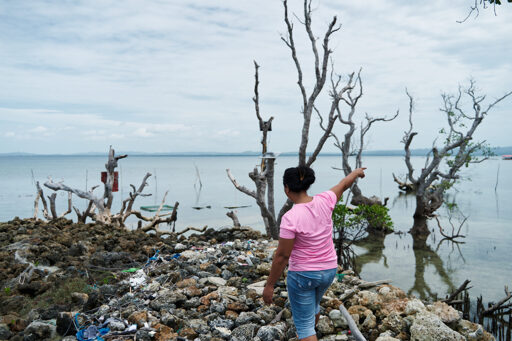
Trixy Elle, a fishmonger from Batasan Island, lost her home and her business when Typhoon Odette tore through the Philippines in 2021. She is among a group of survivors who filed a lawsuit this week in a UK court seeking damages from Shell over the oil giant’s role in climate change.
In today’s world, it sometimes feels like we’re all slightly more connected: that smartphones and social media have helped us to understand what people on the other side of the world are going through.
But after living through the horrors of Super Typhoon Odette, which tore through my home in the Philippines in December 2021, killing or injuring more than 1,800 people, I know this isn’t true. Unless you’ve lived through it yourself, you’ll never know the feeling of having to swim away from your own collapsing home, or the sound of 175 mph (281 km/h) winds devastating your entire community. No amount of photo or video footage can ever bridge that gap.
Fossil fuel companies in the Global North, which bear huge responsibility for the climate crisis, are largely protected from the impacts of their polluting activities. But those of us living on small islands, at the sharp edge of climate change, don’t have that luxury.
 Oct 23, 2025Justice
Philippines storm victims to seek damages from Shell in “unprecedented” climate claim
The case is the first civil claim to directly link an oil firm’s climate impact to deaths and personal injury in the Global South, its backers sayRead more Jul 31, 2025Justice
Top UN court paves way to lawsuits over inadequate climate finance
The International Court of Justice has advised that the level of climate finance given to developing countries must be compatible with limiting global warming to 1.5CRead more Jul 30, 2025News
PR firm working for Shell wins COP30 media contract
As calls grow to keep fossil fuel influence out of UN climate talks, campaigners say Edelman’s partnership with the oil and gas major raises an alarming conflict of interestRead more
My family lost everything. We lost our business and had to sell our precious belongings just to rebuild our house. We now live in non-stop fear. Even moments meant for joy are now tinged with anxiety and stress. After all, Odette – also named Rai – tore through our islands right before Christmas. We didn’t, and still don’t, know when the next disaster will hit, only that thanks to the fossil fuel industry, the threat is always growing.
Profit before people
We’ve done nothing to cause the climate crisis, but because fossil fuel companies have chosen profit over people, our lives have been destroyed. Scientists have said the likelihood of a disaster like Odette in the Philippines has roughly doubled due to global warming.
None of this is fair. That’s why we’ve chosen to turn our fear into action and take the fossil fuel giant Shell to court.
Since at least 1965, Shell has known that fossil fuels are the primary cause of climate change. The corporation was warned that if it failed to curb its emissions, the world could suffer major economic consequences by 2038. But still, it chose not to change course. Shell is one of the world’s largest emitters, accounting for 2.04% of historical global emissions. Contrast that to the Philippines, which has the highest risk of climate hazards but has contributed just 0.2%.

The trail of devastation left by Typhoon Rai in Southern Leyte, the Philippines, December 2021 (Photo: Leah Payud/Oxfam)
The trail of devastation left by Typhoon Rai in Southern Leyte, the Philippines, December 2021 (Photo: Leah Payud/Oxfam)
We’re not naive about the scale of the challenge. Shell is a huge company with endless resources. But we’re living in an age of scientific discovery. Attribution science can now directly link individual extreme weather events to climate change, and emissions to specific fossil fuel companies.
The law is also changing. We’re seeing courts recognise the role and responsibilities of major emitters in the harm climate change causes our planet. In May, a German court ruled that major emitters can be held liable for climate damages abroad.
Peruvian farmer loses climate case against RWE – but paves way for future action
In July, the International Court of Justice advised that governments have a binding duty to protect people and the planet from the climate crisis, and so the potential liabilities for fossil fuel companies are substantial. Some estimates say the climate damages attributable to the 25 largest oil and gas companies could be more than $20 trillion.
Polluters must pay
By filing this case, we are seeking financial compensation for losses and damages. We’re still living with the consequences of Odette, even today.
The “polluter pays” principle is clear: those most responsible for environmental harms, including fossil fuel giants like Shell, should cover the costs of managing them. That’s the basis of our claim. We are also asking for concrete steps to be taken, from replanting mangroves to rebuilding sea walls, in line with our right to a balanced and healthy environment, something set out in the Filipino constitution.
Just as importantly, we are asking for justice. We want to send a powerful message to companies like Shell. For too long they have been able to burn fossil fuels while chasing endless profit, despite knowing how dangerous it is. But in 2025 the science and the law are both on our side. Sooner or later they will have to clean up their act.
===========================================================
Shell says claim is “baseless”
When asked to comment on the pending case by Climate Home News in October, Shell acknowledged that more global action was needed on climate change but rejected the suggestion that the company had unique knowledge about the problem.
A company spokesperson has responded to media reports about this week’s court filing saying: “This is a baseless claim, and it will not help tackle climate change or reduce emissions.”
The post The risk of another “super typhoon” is growing – that’s why we’re suing Shell appeared first on Climate Home News.
From Climate Home News via this RSS feed