

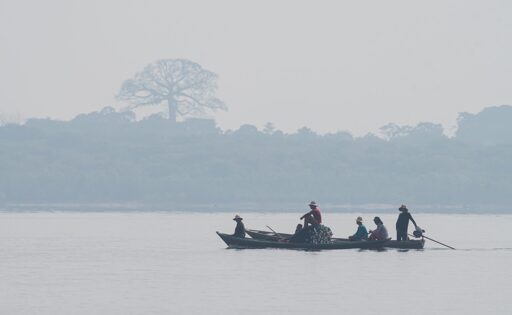
Five out of 10 lakes in the central Amazon had daytime temperatures over 37° Celsius, (98.6° Fahrenheit) during the region’s 2023 extreme heat wave, a recent study found. One of the most well-known water bodies is Tefé Lake in Amazonas state, northern Brazil. In September and October 2023, 209 pink and grey river dolphins, roughly 15% of the lake’s population, died in Tefé Lake. The mass mortality happened just as the lake soared to a record 41°C (106°F) across the entire 2-meter (6.6-foot) water column. “You can’t even put a finger in the water. … It is so hot that your natural instinct is to withdraw your hand,” lead author Ayan Fleischmann, a researcher at the Brazil-based Instituto Mamirauá, told Mongabay by phone. “The temperature is beyond the tolerance limit for most Amazonian aquatic animals.” Dolphins aren’t the only species that suffered with the heat. In one local fish farm, more than 3,000 fish died as temperatures crossed 35°C (95°F), well over the safe limit for the Amazonian tambaqui (Colossoma macropomum) and pirapitinga (Piaractus brachypomus). Other mass fish deaths were recorded across several states of the Brazilian Amazon. As the drought continued into its second year, an estimated 20-30 metric tons of fish and other animals, including caimans, turtles and stingrays, died in the Aramanaí Channel in Pará, a waterway connected to the Amazon River. More than 200 dolphins died in the Amazon in 2023 due to extreme heat. Image courtesy of Miguel Monteiro. Researchers recorded temperatures at in situ monitoring…This article was originally published on Mongabay
From Conservation news via this RSS feed
You must log in or # to comment.