

When Issa Shivji presented the case of Tanzania’s unfolding “silent class struggle” more than five decades ago, the political terrain was still fertile enough to engage with such analysis, even if the ruling class lacked the courage to confront it.
Fast-forward to today, and that context has radically shifted. The state and much of the population have become deeply invested in superstitious neoliberal illusions, leaving little room for class-based critique. This transformation has also reinforced the power of the long-standing nationalistic slogan, “the Island of Peace,” a carefully constructed myth that masks inequality and silences dissent.
It has served the ruling class by binding society together under superficial unity, often at the expense of the legitimate aspirations of the working people. The state has milked this myth to consolidate its power, crush dissent, and silence class struggles under the refrain: “Tanzania is an island of peace”.
This myth has conflated docility with peace, fear with tolerance, and silence with harmony. It has nurtured the illusion of Tanzanian exceptionalism, claiming we are peaceful, reasonable, and uniquely unshakable as a nation. Under this ideology, thinking, speaking, or acting against injustice (primarily perpetuated by the agencies of this exploitative system and midwifed by the state) is branded “un-Tanzanian”.
Street vendors demanding the “right to city”, peasants and pastoralists resisting “land grabbing” in the name of investment or conservation, artisanal miners seeking “access to mining sites”, workers demanding “dignified working conditions”, and political groups organizing for mere “freedom of association”: all are vilified as unpatriotic when they dare to resist.
Up to October 29, the state still clung to the fantasy that the “island of peace” remained intact. But millions had already realized it was a fable, a shield for the ruling class and a sword against the majority underprivileged working people.
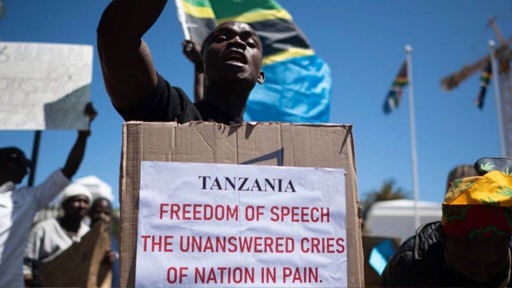
When people took to the streets, they shattered a long-standing taboo: the belief that Tanzanians can only demonstrate at the state’s will. Historically, resistance here has been sectoral, fragmented, and easily crushed. But the October 29 uprising shook the foundations of state power, forcing the ruling elite into panic.
The state’s violent response from October 30–November 1 revealed not only fear but also the structural pressures of a neoliberal order. Under this regime, dissent threatens entrenched networks of power and capital, where profit is valued above human life. The killings, confiscations, and intimidation were less about restoring order than about protecting the status quo.
The old belief in an “omnipotent state” has been seriously injured. As the wheel of treachery is fast spinning, and unless reversed, the winner may indeed take it all, but such victory will require ruling by the sword, not legitimacy. My wish is that, if a winner must emerge, it should be the working people, the underprivileged majority.
Catalyzed by impunity and double standards
The post-socialist era, the return of multiparty politics, and the expansion of the NGO sector introduced new challenges that the ruling Chama Cha Mapinduzi (english: “Party of the Revolution”: CCM) bureaucracy could not easily control. The new political culture opened space for criticism, even shaming. Yet both the opposition and NGOs, despite their rhetoric, often share the same neoliberal ideological foundations as CCM. So they’re best at shaming one another rather than constructively criticizing one another.
As a counter-strategy, the CCM perfected a quasi-apartheid approach: curtailing the opposition’s influence while deepening mass subordination. Many cadres are known to openly boast that CCM membership guarantees immunity from breaking the law. The law has been lethal against dissidents but lenient toward the ruling class and its cronies.
This dual system, impunity for the powerful, repression for the dissenting underprivileged, has generated deep mutual distrust. Tanzania has reached a point where lacking a CCM membership card is akin to lacking the mythical “666” mark of acceptance. Access to wealth, trade privileges, or legal bypasses increasingly depends on, if not directly associated with, loyalty to the CCM.
But millions of loyal supporters still remain excluded from the inner sanctum of affluence. They cheer but never dine.
The pot of pomposity and contempt
Before the October 29 Massacre, the largest state-orchestrated killing since the German colonial Maji-Maji atrocities, warnings about escalating tensions were ignored. Instead, the state invested in smear campaigns, social-media censorship, abductions, and hollow calls for peace.
Notably, Tanzanian Ambassador to Cuba Humphrey Polepole, who resigned from his diplomatic post in July 2025 in protest against the CCM and the state’s capture by comprador networks (known as “Wanamtandao” in Tanzania), was abducted on October 6. His whereabouts remain unknown; the last traces of him were bloodstains on his house floor.
Some state officials openly boasted of their power, daring citizens to protest, threatening to shoot them or break their legs. Thus, a population already suffocated by frustrations was pushed into a corner and then mocked for choosing resistance.
Those who preach about “other ways of seeking justice” that demonstrators should have embarked on must be honest enough to name those ways, and to explain the fate of those who previously attempted them. From workers, peasants, and pastoralists, to outspoken activists and opposition leaders, the pattern has been consistent: intimidation, physical assault, jail, exile, or at worst, death.
On whose interests?
To understand the massacre, one must excel beyond emotions. When askaris (“soldiers”) and hired mercenaries (as it was alleged) shot non-combatant citizens, even at point-blank range (some inside their homes), they were not defending peace but the status-quo.
In a world of “profit over people”, peace is an afterthought. The swift vilification of demonstrators by the state and ruling class was not meant to protect the nation.
The ruling class does not fear losing lives; they fear losing relationships with presidents, ministers, and MPs who safeguard their deals, overlook their faults, co-invest in their ventures, and donate generously to their philanthropic endeavors.
To them, the young people killed in Tunduma, Arusha, and Dar es Salaam are expendable, mere obstacles framed as terrorists or traitors.
Even if the demonstrators’ demands were not radical, the state acted swiftly to avoid disappointing its capitalist patrons’ interests.
Big businesses disrupted by the protests will recover insured, compensated, or supported by state concessions. But the dead will not rise. Their families will not be compensated. Their memory will fade and extinguish unless those who marched continue organizing and demand justice in their honor.
The demonstration was an eruption of agony produced by decades of neoliberal prescriptions enforced by a monolithic CCM party-state that doesn’t mind treating Tanzanians as livestock while bowing submissively to multinational capital.
One does not need a political science degree to understand the failure of neoliberalism; lived experience is lesson enough. It appears as though the likes of those who gathered at Milmani City for the CCM fundraising gala on August 12, 2025, have won, alongside international capital, which is thriving in Tanzania’s current climate.
Read More: Protests erupt in Tanzania amid disputed elections, internet shutdown, and curfew
While many demonstrators lacked polished placards, their voices were clear:
“CCM wauwaji” (CCM are killers)
“Tunataka nchi yetu” (We want our country back)
“Hatutaki ufisadi” (We reject grand corruption)
“Hatutaki utekaji” (We reject abductions)
It is therefore cynical to claim the protest lacked demands, and they were all mob-gangs and terrorists.
The massacre can either converge the long-scattered struggles of working people, uniting movements that have long operated in silos, or it can deepen its fragmentation, allowing every hard-won gain to be swept away by a state committed to patronage, exploitation, and impunity.
The post From the “Island of Peace” myth to massacre appeared first on Peoples Dispatch.
From Peoples Dispatch via this RSS feed
You must log in or # to comment.