

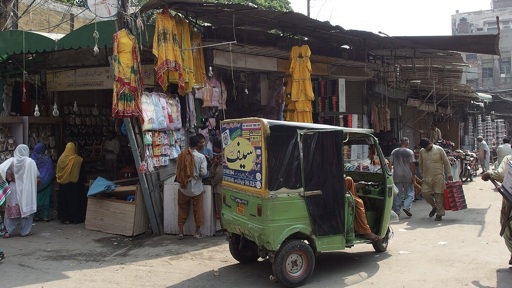
On the occasion of International Human Rights Day, scores of rickshaw drivers in Pakistan staged a protest in front of Lahore Press Club on Wednesday, December 10, against the Punjab government’s attack on their only source of income.
Protesters carried banners denouncing the state’s actions against Chingchi rickshaws and shouted slogans demanding an end to what they called repressive policies. The protest was called by the Punjab Rickshaw Union (PRU) and the Mazdoor Kisan Party (MKP).
The Punjab government, in November, banned Chingchi rikshaws in the province, calling them hazardous for public safety and the environment as a part of its larger attempts to establish road safety and curb vehicular pollution.
Chingchi rickshaws are modified motorcycles used for cheap and easily available sources of public transport in various parts of Pakistan.
Lahore has repeatedly been recorded as one of the worst polluted cities in the world in recent years. The city’s air, due to industrial and vehicular emissions, particularly during the winter, becomes hazardous for its citizens.
However, the government’s sudden move has caused a major public inconvenience and led to large scale protests from the transporters in Punjab. Transporters had called for a strike earlier this week which was called off after an agreement was reached with the government at the last moment.
After the government crackdown, one of the Chingchi drivers, named Ashfak, tried to self-immolate in Lahore in desperation.
The PRU, in a statement, demanded the government take responsibility for all such instances if it continues with its insensitive policy.
Poor people left without jobs and means of transportation
Speaking to Peoples Dispatch, Irfan Ali, leader of the PRU and MKP, stated that in the absence of proper and affordable public transport, poor people have been taking Chingchi rickshaws for years to commute to work or elsewhere in various parts of the country.
These are affordable and fit the budget requirements of working people in the country, most of whom are struggling to earn even the minimum wage, which is 40,000 Pakistani rupees, or less than 150 US dollars per month.
The crackdown in the name of safety and pollution unleashed by the state, in the absence of alternative arrangements, will destroy the only affordable means of public transport in the city for the poor, Ali claimed.
Ali also claimed that many of the Chingchi drivers have spent most of their resources to get the rikshaws and if the government takes them away or imposes hefty fines drivers are unable to pay, they will be unemployed overnight without any alternative means to survive or pay their debts.
Ali admonished the government for its failure to think about the problems people are subjected to due to its sudden realization of road safety or pollution. He argues that the approach of implementing laws without thinking about their repercussions on the poor families is not only insensitive but also undemocratic.
Ali also accused the government of using public safety or pollution as an excuse to extort money from poor drivers in the form of hefty and unreasonable fines.
Protesting drivers demanded that if the government really wants to shutdown the Chingchi rickshaws and is serious about fighting pollution or providing safety to people, it must provide alternatives for both the drivers and the commuters.
Some protesters noted that the government should facilitate drivers buying electric rickshaws at affordable prices or on installment so that affected families do not lose their livelihoods.
The post Rickshaw drivers in Lahore, Pakistan robbed of their livelihood after state crackdown appeared first on Peoples Dispatch.
From Peoples Dispatch via this RSS feed