
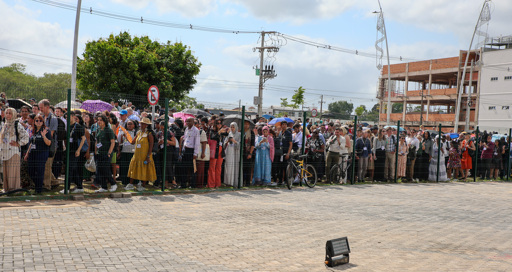
Governments sent fewer people to the COP30 summit in Belém than they did to any COP talks since 2014, newly-released UN data reveals, as they faced a shortage of officially-sanctioned and affordable accommodation.
While 42,618 people – including security and volunteers working at COP30 – attended the conference in the Amazon, just 7,527 of them were there with official government lanyards, known as “party badges”.
That’s the smallest number of government delegates than for any COP since the Paris Agreement was adopted in 2015 and around half as many as attended last year’s COP in the Azerbaijani capital of Baku.
While government attendance was well down in Brazil, other delegates from non-governmental organisations, the media and those given “party overflow” badges by governments were present in good numbers.
Many government departments have strict rules about which types of accommodation can be booked. This prevented many officials from finding rooms on websites like Booking.com or Airbnb and restricted them to the official COP30 accommodation platform, which was sanctioned by the Brazilian government.
Accommodation providers in Belém told Climate Home News that the Brazilian government’s bureaucratic restrictions prevented them from listing their properties on this platform. With the supply of rooms limited, prices on the platform were high, starting at around $240 a night.
Flights to Belém were also expensive. With the city’s airport only having a handful of international flights, many delegates had to transit through bigger Brazilian cities thousands of kilometres away like Rio de Janeiro and Sao Paulo.
To combat the shortage of reasonably priced accommodation, the Brazilian government offered countries 10-15 price-capped rooms each on two cruise ships near Belém.
The government also moved the leaders’ segment of the COP to just before the start of the negotiations to ease the peak in demand for accommodation. The UN, meanwhile, increased the daily allowance it gives to negotiators from most developing countries.
The drop in attendance was most pronounced among government negotiators from Central Asia and Eastern Europe, who went to COP29 in nearby Baku in large numbers. This was only partly balanced out by an increased number of Brazilians and neighbouring Latin Americans at COP30.
The UAE and Azerbaijan, the outgoing and incoming presidencies at COP29, also sent far fewer people to COP30 than they did to COP29. The official US delegation fell from 234 at COP29 to zero at COP30, as the Trump administration dismissed the importance of the talks and decided not to send a team.
But other declines in the numbers appeared to have no particular political or geographic pattern. The delegation of the Pacific island of Nauru dropped from 17 at COP29 to one at COP30 while Zimbabwe’s fell from 181 to just 44.
Despite fears they would be worst hit by a shortage of accommodation, small island and least-developed nations did not reduce their delegation sizes more than governments did on average.
Some large wealthier countries also pared back their delegations, with Germany and China both cutting their head count by around half.
The total attendance of 42,618 people was the fourth-highest of any COP, behind the last three conferences – but less than the over 50,000 people Brazilian officials said had been expected and the 56,118 who registered to participate.
Around 11,000 were working at the conference as support staff including security guards and volunteers. The number of people at the COP taking part in the talks – comprising government officials, observers and media – was just under 32,000.
COP31 will take place in November 2026 in the Turkish tourist-resort city of Antalya, where hotel rooms and international flights are expected to be more abundant than in Belém.
The post Government attendance at COP30 was lowest in 10 years appeared first on Climate Home News.
From Climate Home News via this RSS feed
You must log in or # to comment.